Fastest Milky Way star feels black hole's spin
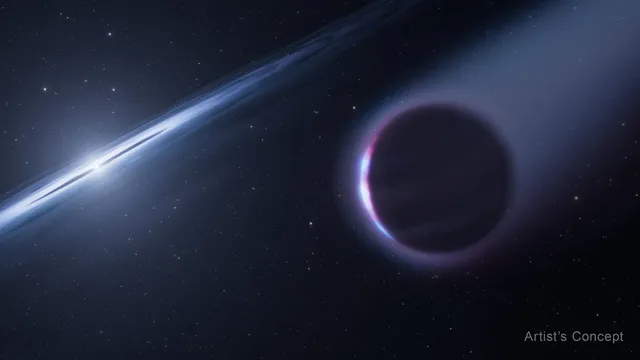
Astronomers using the European Southern Observatory's VLT Interferometer discovered S301, a star orbiting the supermassive black hole Sagittarius A* at the Milky Way's center. It completes an orbit in just 8.7 years, approaching to roughly Saturn's distance from the Sun, and at closest approach reaches 25,000 km/s — over 8% of the speed of light.
Because of this extremely tight orbit, S301 is the first star close enough to feel the black hole's rotation, which drags and twists spacetime around it. Within the next decade, researchers hope to use the star's motion to directly measure Sagittarius A*'s spin, providing a key test of Einstein's general theory of relativity.
JWST: "Quasars" reveal galaxies with massive stars
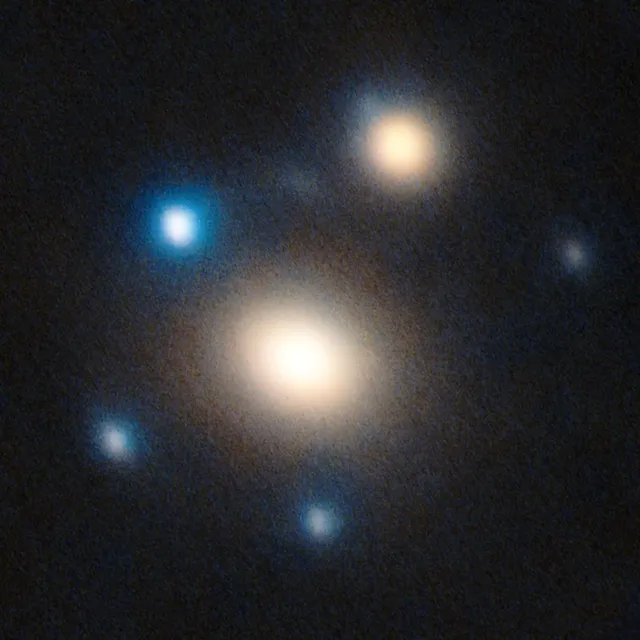
The James Webb Space Telescope examined two sources, J1450-0144 and J1429-0104, previously classified as faint quasars based on optical data. NIRSpec spectra revealed strong helium emission and P Cygni wind profiles that standard stellar populations cannot reproduce — but models with very massive stars exceeding 100-475 solar masses fit well.
These galaxies are forming stars at rates up to 540 solar masses per year and are only 2-4 million years old. The finding challenges the classification of luminous sources from the reionization era, suggesting some objects labeled as quasars are actually galaxies powered by exotic populations of extremely massive stars.
Dust ring near PDS 70c may spawn moons
Researchers analyzed ALMA data on the circumplanetary disk around the young gas giant PDS 70c, comparing two dust distribution models: a drift model, where grains migrate toward the planet, and a ring model, where dust concentrates at a set distance. The ring model closely reproduces the observed emission spectrum, while the drift model requires an unrealistically high dust content.
If the ring truly exists, its conditions satisfy both the streaming and gravitational instabilities needed for dust grains to clump into moon-forming building blocks. The next-generation Very Large Array, expected to begin operations in the mid-2030s, should pinpoint the dust's location and reveal whether the disk can indeed give birth to exomoons.
BHEX to image dozens of black hole shadows
Current ground-based radio interferometers, including the Event Horizon Telescope, can resolve a black hole's shadow for only two objects due to limited angular resolution. The proposed space mission Black Hole Explorer (BHEX) would operate in the millimeter band from orbit, dramatically surpassing ground-based capabilities.
According to the team's projections, BHEX could determine masses for 70-90 supermassive black holes from their emission size, probe magnetic field structures for 20-30 sources, and directly resolve shadows for 20-25 objects. This would turn isolated observations into a systematic survey of black hole populations across diverse galactic environments.
LRO images Falcon 9 impact crater
On Aug. 5, 2026, a Falcon 9 upper stage that had launched the Firefly Blue Ghost 1 mission back in January 2025 struck the Moon's surface. Six days later, NASA's Lunar Reconnaissance Orbiter captured the resulting crater with its Narrow-Angle Camera, precisely timing its pass over the target site 60 miles below.
Images taken from different viewing angles revealed a crater about 60 feet wide (18 meters) and less than 10 feet deep, surrounded by bright and dark rays of ejected material. The darker streaks are older regolith weathered by solar wind and cosmic rays, while the brighter patches are fresh material excavated from beneath the surface during impact.