When astronomers compiled the SHELLQs catalog — a survey hunting for the most distant quasars — two objects, J1450-0144 and J1429-0104, were classified as faint quasars. Both shine remarkably brightly (M_UV≈−23.5), which made it logical to attribute this luminosity to a black hole actively feeding on surrounding matter. But new observations with the James Webb Space Telescope tell a different story: these aren't quasars at all, but galaxies achieving record brightness thanks to extraordinarily massive stars.
J1450-0144 is observed at redshift z=6.627, corresponding to a universe roughly 800 million years old. J1429-0104 is even older, at z=6.796. Both objects belong to the so-called "epoch of reionization" — the period when the first stars and galaxies ionized the neutral hydrogen filling the young universe.
What NIRSpec revealed
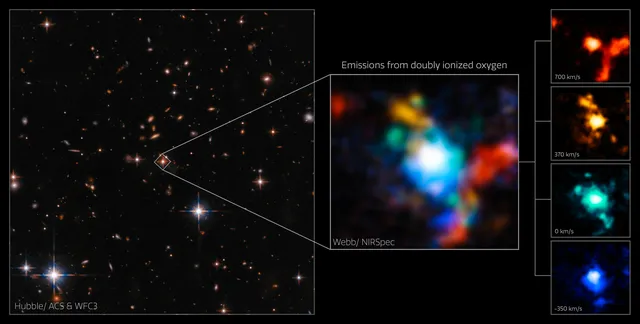
The James Webb Space Telescope's NIRSpec instrument produced detailed spectra of both sources. Instead of the typical bright red continuum with broad emission lines from surrounding gas expected from quasars, researchers saw a blue UV continuum and narrow nebular lines — signatures characteristic of starlight rather than a black hole's accretion disk.
The most crucial finding was broad He II emission at 1640 angstroms, with rest-frame equivalent widths of 8.8±1.2 angstroms for J1450-0144 and 3.7±1.1 angstroms for J1429-0104. Simultaneously, nitrogen (N V), silicon (Si IV), and carbon (C IV) lines showed so-called P Cygni profiles — a combination of absorption and emission produced by powerful stellar winds. This combination — strong helium plus pronounced wind profiles — is essentially absent from standard stellar population models.
Stars hundreds of times the Sun's mass
The researchers tested specialized models incorporating so-called very massive stars (VMS) — objects exceeding 100 solar masses, with dedicated stellar wind calculations. Only these models could simultaneously reproduce both the strength of the helium line and the shape of the P Cygni profiles in both galaxies.
According to these models, the active star-forming episode in J1450-0144 lasted just 2-4 million years — an instant on cosmic timescales. For J1429-0104, the range of allowed durations is broader. Stellar masses were estimated at log(M*/M_sun)≈9.2-9.9, with star formation rates reaching 300-540 solar masses per year — an enormous pace of star birth even by early-galaxy standards.
Particularly interesting is how massive the heaviest stars in these systems could be. Equivalent-width diagnostics for J1429-0104 yielded a lower limit of at least 225 solar masses for the upper mass cutoff. For J1450-0144, the numbers were so extreme they exceeded the entire available model grid — up to 475 solar masses.
What ALMA found
Beyond spectroscopy, the team obtained ground-based ALMA Band-6 data targeting the ionized carbon [CII] line at 158 micrometers — a standard tracer of cold gas in distant galaxies. Both systems showed notable [CII] emission: luminosities of approximately 0.8×10⁹ and 4.1×10⁹ solar luminosities for J1450-0144 and J1429-0104, respectively.
In J1429-0104, researchers additionally detected bright dust continuum emission. Both the dust and [CII] gas turned out to be offset by roughly 5,400 parsecs from the galaxy's visible UV light — pointing to a more complex, likely non-uniform spatial structure than a simple compact galaxy or a black hole's accretion disk.
Why this matters
The study's authors emphasize that wherever the luminosity functions of galaxies and quasars overlap — that is, in the realm of the brightest objects in the early universe — source classification becomes ambiguous. J1450-0144 and J1429-0104 demonstrate that very massive stars can power some of the most UV-luminous sources at cosmic dawn. This means some objects previously counted among the faint quasar population may need reclassification, which in turn requires revisiting the inferred demographics of both galaxies and quasars at the brightest end of the reionization-era distribution.