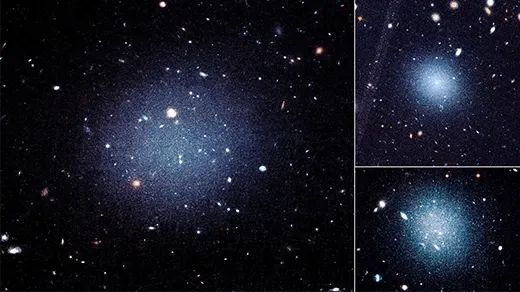
About 65 million light-years from Earth, three galaxies look wrong. They are not whirlpools bursting with light but pallid objects, dimly lit by a smattering of stars. Michael Keim, an astrophysicist at Yale University, says they have a "ghostly appearance." But that is not even the strangest thing about them.
All three galaxies, DF2, DF4 and DF9, contain little dark matter. A paper published in June 2026 in the peer-reviewed journal The Astrophysical Journal proposes how they formed. It also adds an argument to the long debate over what dark matter is, and whether it exists at all.
Galaxies missing their main ingredient
Dark matter makes up 27% of the universe and about 85% of all matter. We cannot see it, but we feel its gravity. It pulls ordinary matter together, lets stars form and keeps stars on the edges of fast-spinning galaxies from flying off. "Almost all galaxies are dominated by dark matter," says Shyam Balaji, a theoretical physicist at King's College London.
DF2 was discovered in 2018. It is roughly the size of the Milky Way but has 200 times fewer stars, so it is far dimmer. To estimate its mass, astronomers tracked the motions of its stars with the Keck Observatory in Hawai'i. Even for a galaxy so poor in stars, it was lightweight. It holds at most 400 times less dark matter than expected, which made DF2 the first known galaxy deficient in dark matter.
In 2019, another such galaxy, DF4, was observed. In 2026, DF9 joined them. Its mass is about 100 million Suns, consistent with ordinary matter alone. With dark matter, it would be 100 times more massive. All three lie along a line as neighbors, and astrophysicists noticed.
How galaxies without dark matter could form
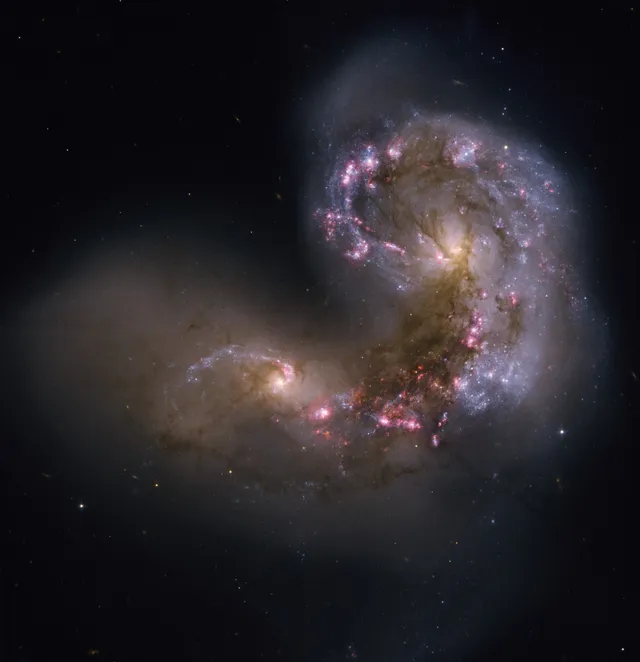
Dark matter is known to act only through gravity. There is no compelling evidence that it interacts with other fundamental forces, such as electromagnetism. If two ordinary galaxies collide head-on, dark matter would feel very little drag and keep going. Ordinary matter interacts through all four fundamental forces, so it would get tangled up.
Aaron Romanowsky, an astronomer at San José State University, compares it to jousting knights. The knights and their lances collide and fall in a heap, while the horses keep running at full speed. In this picture, gas and dust clumped together and formed three new galaxies without dark matter. They then had to struggle to form a new batch of stars.
A similar separation is seen in the Bullet Cluster, two huge galaxy clusters 3.8 billion light-years away that collided long ago. The James Webb Space Telescope recently observed it. Its mass distribution makes sense only if dark matter and ordinary matter were torn apart in the collision. In DF2, DF4 and DF9, this separation can be seen with even greater clarity.
How solid is the result
Not everyone agrees on the mechanism. Kinwah Wu, a theoretical astrophysicist at University College London, notes that the triplet shows none of the fluid, wispy features expected after a galactic collision. He suggests the galaxies passed through a large group of massive galaxies, which stripped away their dark matter.
Stacy McGaugh of Case Western Reserve University, a longtime proponent of modified-gravity theories, is more skeptical. He calls a collision a plausible origin story, but an exceptional one. If that is what happened, the rest follows. But he is not convinced it is the only way, and without knowing the origin, he does not think anything can be said about the nature of dark matter.
What it means for MOND
Most experts cannot see how these galaxies could exist without dark matter being a physical thing, even if their origin is debated. "It's hard to explain how you'd get something like this evolving by itself without something like dark matter," says Chamkaur Ghag of University College London.
What this is showing is that dark matter is not just a modification of gravity.Michael Keim, astrophysicist, Yale University
MOND, or modified Newtonian dynamics, was proposed in 1983 by Mordehai Milgrom. It says there is only visible matter, but its gravity works differently than we thought. At very weak gravitational pulls, the force would dwindle less than scientists think, so galaxies could hold together without extra gravity from dark matter.
But if you separate ordinary matter from dark matter, galaxies lacking dark matter should struggle to form stars. That is what DF2, DF4 and DF9 show. According to Balaji, it is easier to remove matter in a collision than to turn off a law of nature. Ghag notes that MOND was already hit in 2015, when LIGO first detected gravitational waves. They travel at the speed of light, implying gravity works the same way throughout the cosmos.
What dark matter is remains unknown. Candidates include a stealthy type of neutrino, weakly interacting massive particles (WIMPs) and primordial black holes as small as atoms. "We don't know which dark matter candidate is the right one," says Daniel Whiteson, a particle physicist at the University of California, Irvine. But he adds that there are many independent lines of evidence that dark matter is matter.