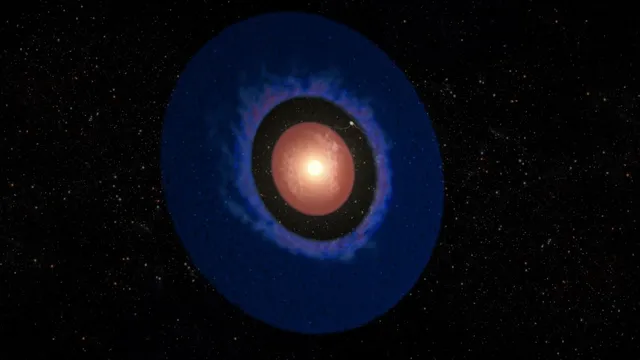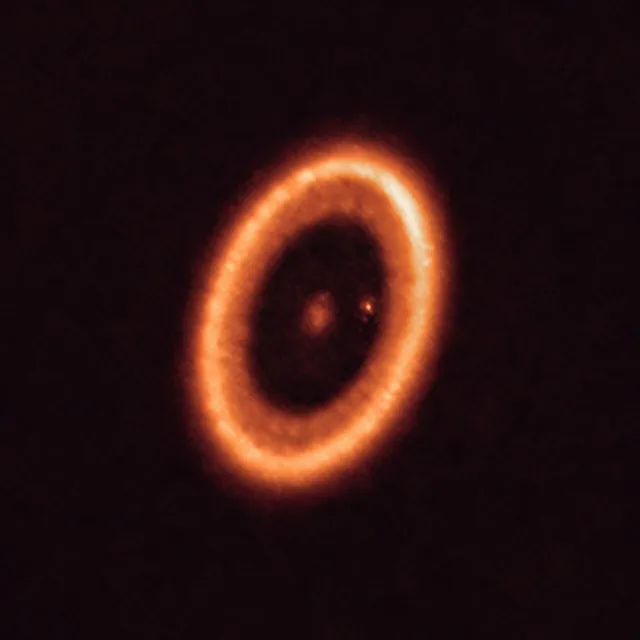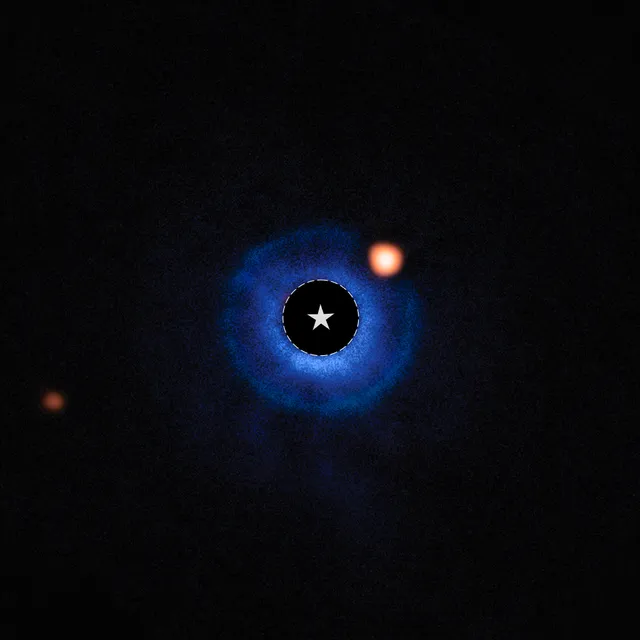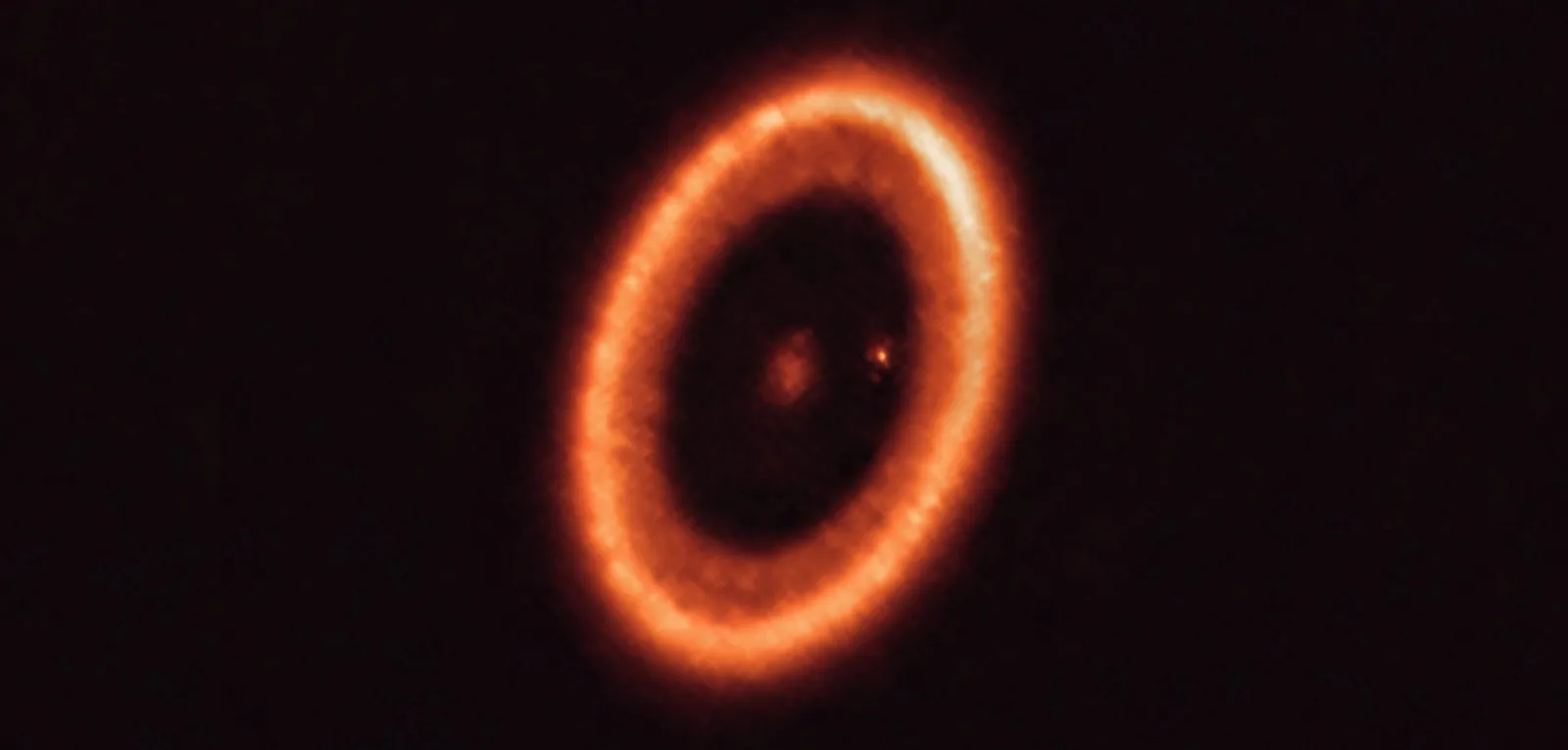
Roughly 370 light-years from Earth, the young star PDS 70 hosts two giant planets still in the process of forming — PDS 70b and PDS 70c. The system has become something of a natural laboratory for watching planet formation happen in real time. In 2019, ALMA observations added another first: a circumplanetary disk detected around PDS 70c, essentially a miniature version of a protoplanetary disk, but orbiting the planet rather than the star.
Since then, researchers have been trying to pin down what exactly produces the disk's emission and how material is distributed within it. New work led by Yuhito Shibaike at Kagoshima University offers a clearer answer.
Two competing models
The open question was straightforward: does the signal ALMA detects come from dust, and if so, how is that dust arranged? The team tested two possibilities.
The first, the "drift" model, has dust grains steadily migrating inward toward the planet due to aerodynamic drag from the surrounding gas. This is a common process in protoplanetary disks, and modeling suggests it could just as easily occur in circumplanetary ones. The result is a disk that's largely optically thin — transparent to the radiation the telescope detects.
The second, the "ring" model, concentrates dust into a dense, optically thick band at a specific distance from the planet. Forming such a ring is physically plausible, potentially arising from a localized bump in gas density, material outflows, or other processes seen in similar simulated systems.
What the numbers show
The team compared predictions from both models against ALMA observations across multiple wavelengths — essentially, the disk's spectral energy distribution.
The result was fairly clear-cut. The ring model naturally reproduces the observed data across a range of realistic parameters — ring size, dust density, temperature. The drift model, by contrast, only works if one assumes an unrealistically high dust-to-gas ratio in the material feeding into the circumplanetary disk from the star's protoplanetary disk. In other words, explaining the observed spectral slope through drift alone would require a dust concentration inconsistent with what's known about such systems.
This isn't definitive proof, but it's a strong argument that the dust around PDS 70c really is gathered into a dense ring rather than spread thinly across the whole disk.
Dust or free electrons
The researchers are upfront about the limits of their work: they couldn't fully rule out an alternative explanation in which some of the emission comes not from dust but from free–free emission — a signal produced by free electrons moving through the disk's ionized material, deflected by charged particles. The spectral shape this mechanism produces is similar enough to thermal dust emission that current data can't cleanly distinguish between the two.
That should change with the next-generation Very Large Array (ngVLA), expected to begin full science operations in the mid-2030s. Its resolution should allow astronomers to directly pinpoint where the dust sits within the disk, resolving the question of what's actually producing the emission.
A hint of moons in the making
The most intriguing implication of the study concerns not the planet itself, but the possible future of its moon system. If the dust really is concentrated in a dense ring, the conditions inside it — particle density, grain size, dynamics — likely satisfy the requirements of two mechanisms needed to build solid bodies: streaming instability and gravitational instability. Both describe how individual dust grains can stick together and grow into larger objects — the rocky building blocks of future moons.
This doesn't mean moons are already forming around PDS 70c. But the researchers note that the physical conditions for such a process could plausibly exist. If future observations confirm this, the PDS 70 system may turn out to be not just a showcase for planet formation, but the site of the first-ever observed birth of an exomoon.