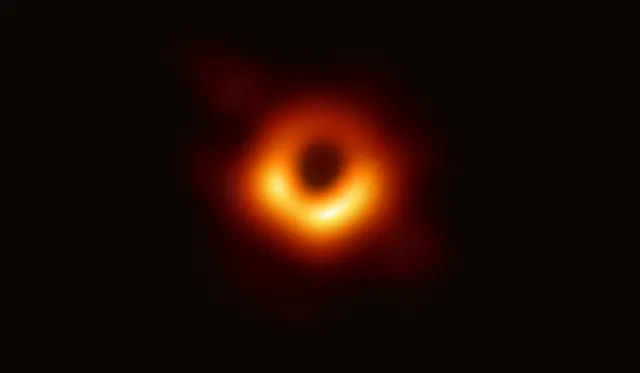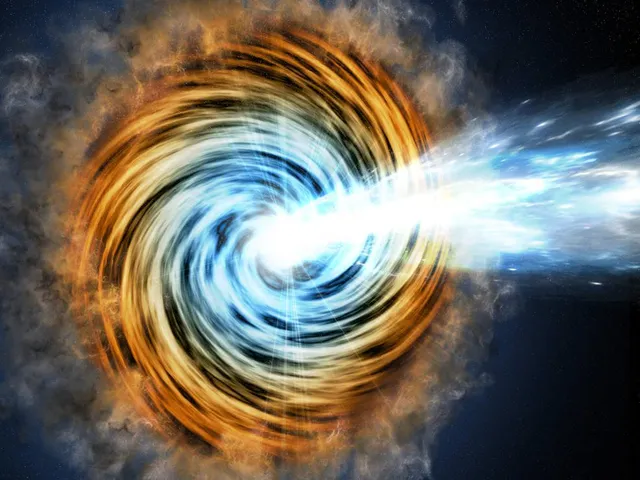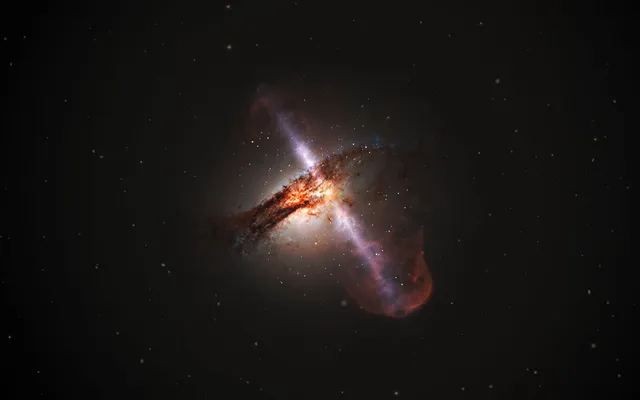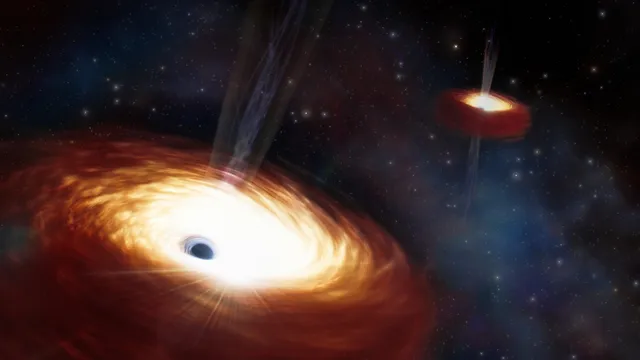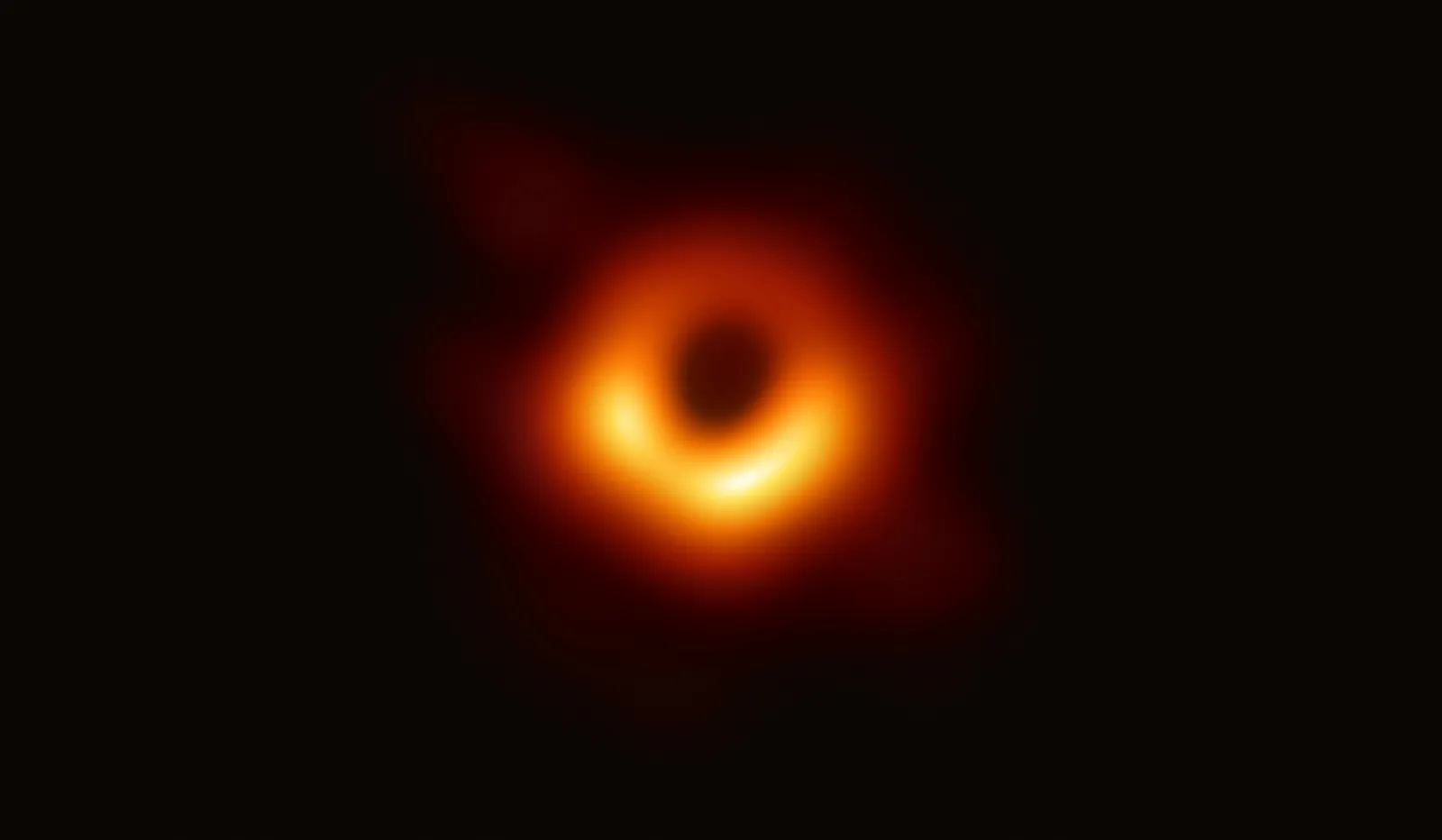
Imaging a black hole shadow — the dark silhouette set against a ring of glowing infalling gas — was one of the most striking achievements in recent astrophysics. The Event Horizon Telescope collaboration produced such images for Sagittarius A*, the black hole at the center of the Milky Way, and for the black hole in the galaxy M87. But that's where the list ends. Ground-based radio telescope networks simply don't have the resolution to see this level of detail in any other object.
The reason is straightforward: the longer the distance between interferometer receivers, the sharper the resolution. A ground-based network is limited by the diameter of Earth itself. To go further, you need a receiver in space. That's exactly what the proposed Black Hole Explorer (BHEX) mission would provide — a space-based millimeter/submillimeter VLBI telescope working alongside ground stations as one giant combined instrument.
How many black holes could be resolved
The authors of the new study ran a series of simulated observations to estimate exactly how many objects BHEX could probe at event-horizon resolution. They based their estimates on a recently developed model of the spatial density of supermassive black holes in the nearby universe.
The results: for 70-90 sources, BHEX could estimate black hole mass by measuring the size of the emitting region around it. For 20-30 sources, it would be possible to map linear polarization of the radiation — a direct way to probe the structure of magnetic fields near the event horizon, which are thought to govern accretion and jet formation. Finally, for 20-25 objects, the mission's resolution would be sufficient to directly resolve the black hole shadow itself.
The authors also considered a targeted observation scenario — pointing the telescope not at the whole available population, but specifically at roughly 50 of the nearest supermassive black holes. In that case, they expect size measurements for around 30 sources, and shadows plus polarization patterns for about 10.
Targeted observations of about 50 nearby supermassive black holes are expected to yield size measurements for roughly 30 sources and shadow and polarization patterns for about 10.
Testing the predictions with detailed models
To ground these estimates beyond pure statistics, the researchers ran more detailed image simulations for eleven specific nearby supermassive black holes. For this, they used general relativistic magnetohydrodynamic (GRMHD) models — computational models describing how matter heated to millions of degrees moves through the strong gravitational field near a black hole and emits light distorted by the curvature of spacetime.
These detailed simulations matter because real black holes vary a great deal. They differ in accretion rate — how actively the black hole is "feeding" on surrounding gas — radio brightness, host galaxy type, and the viewing angle at which the accretion disk appears from Earth. The eleven chosen objects span this range of conditions, allowing a check on how reliable the broader population-level predictions really are.
Why this changes the game
Until now, event-horizon-scale black hole studies have been limited to two unique cases. That seriously limits any generalization: there's no way to tell whether Sagittarius A*'s shadow is typical for black holes of its mass, or whether the polarization patterns seen in M87 are specific to a particular type of active galaxy.
If BHEX flies, astronomers would finally have a systematic sample — dozens of objects with varying properties instead of two isolated examples. That would open the door to testing general relativity's predictions across different gravitational conditions, studying how magnetic fields shape jet formation across different galaxy types, and ultimately understanding how universal the physical processes near black hole event horizons really are.