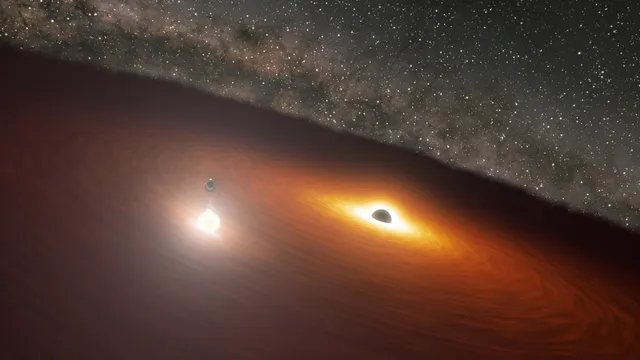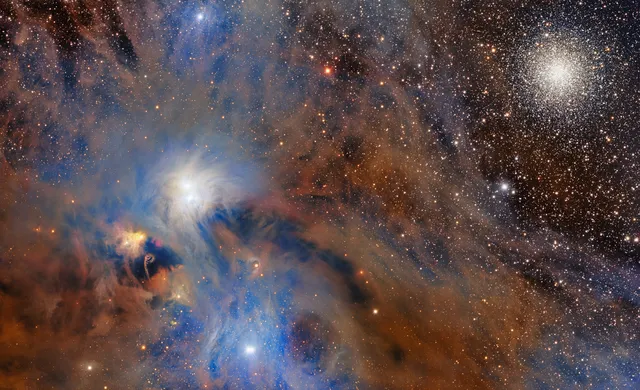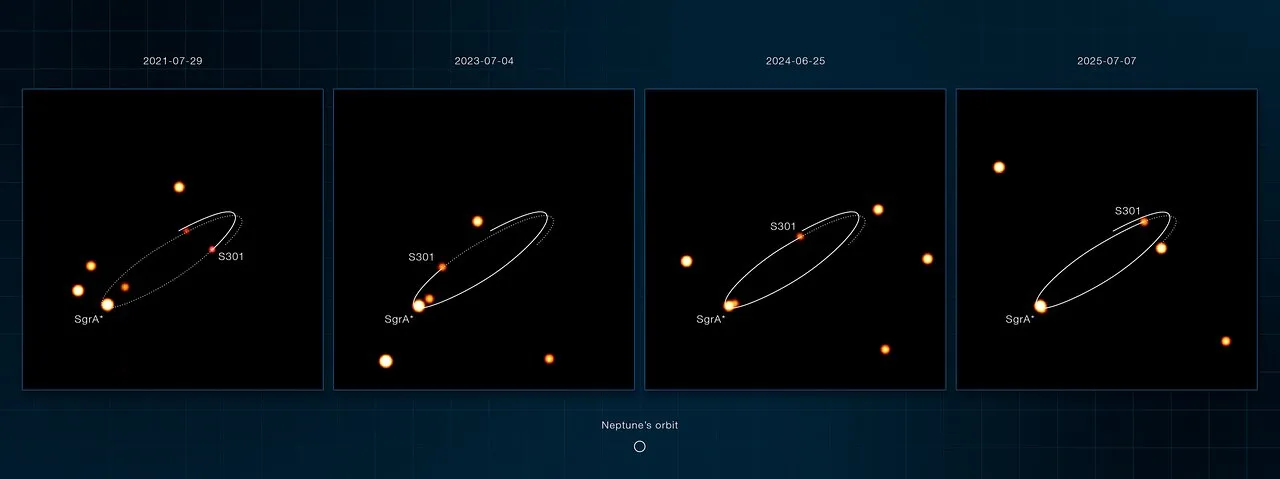
At the heart of the Milky Way lies a supermassive black hole, Sagittarius A*, weighing about four million times the mass of the Sun. For decades astronomers have tracked stars orbiting it — that's how the black hole's existence was confirmed in the first place. Now a team using the GRAVITY+ instrument on ESO's VLT Interferometer in Chile has found a star that breaks every previous record for proximity and speed. The study is published in Nature.
A record-breaking orbit
The new star, named S301, reaches 25,000 km/s at its closest approach to the black hole — a hundred thousand times faster than a commercial airplane, and over 8% of the speed of light. That makes it the fastest known star in the Galaxy.
A full orbit around Sagittarius A* takes just 8.7 years — remarkably short for an object circling a black hole of this mass. Its minimum distance is 1.78 billion km, about 12 astronomical units, only 20% more than the Sun-Saturn distance. No other star has ever been observed coming this close to the Galaxy's central black hole.
According to Felix Mang, a PhD student at the Max Planck Institute for Extraterrestrial Physics (MPE) and lead author of the study, such a tight and fast orbit is unprecedented.
Finding a star two billion times fainter than a familiar giant
S301 is two billion times fainter than Betelgeuse, the orange star visible to the naked eye in Orion. Spotting such a faint object near the bright, crowded galactic centre is a serious technical challenge.
The solution was ESO's VLT Interferometer at the Paranal Observatory, which combines light from four 8-metre telescopes into a single virtual telescope with roughly ten times the spatial resolution of one 8-metre mirror. Co-author Frank Eisenhauer, GRAVITY+ Principal Investigator, notes that Paranal is the only place in the world where this kind of observation is possible, since no other observatory has four 8-metre telescopes able to work together as an interferometer.
The team has used the GRAVITY instrument on the VLTI to monitor stars near the galactic centre since 2017. Over the past several years, a series of upgrades known as GRAVITY+ have made it possible to detect increasingly faint objects. The team first directly glimpsed S301 in spring 2023 and traced its orbital history back to 2017, finding that its last closest approach occurred in early 2023.
Torn from a binary system
Such a tight orbit raises a puzzle: stars cannot form so close to a massive black hole, since tidal forces would prevent a gas cloud from collapsing into a star there. S301's orbital properties point to a different origin story.
The star was most likely once part of a binary pair. When that pair ventured close to Sagittarius A*, the black hole's tidal forces tore it apart — one star was captured into a tight orbit, while its companion was likely flung outward with such high velocity that it may have left the galaxy altogether.
Testing Einstein with a black hole's spin
The real significance of S301 goes beyond speed and proximity records — it offers a way to test one of general relativity's key predictions.
According to Einstein's theory, a spinning black hole drags spacetime along with it, an effect known as frame dragging. It's felt more strongly by objects orbiting fast-rotating black holes at close range. Because of its extreme orbit, S301 is the first known star sensitive enough to this effect to allow a direct measurement of Sagittarius A*'s spin.
For the first time, we would actually be able to measure very directly the spin of a massive black hole, which would be a key test of Einstein's theoryStefan Gillessen, Max Planck Institute for Extraterrestrial Physics
Juan Osorno of the Paris Observatory, who also played a key role in the study, points out that without this star, researchers would need several more decades of tracking other stars to get anywhere close to measuring the black hole's spin.
Nobel laureate Reinhard Genzel, MPE director and a founding member of the collaboration, emphasizes that the discovery is the result of decades of careful monitoring of stars near the galactic centre, and that S301's proximity to Sagittarius A* opens a new window into the fundamental properties of spacetime in this extreme environment.
S301's next closest approach to the black hole will occur in 2031. Follow-up observations with GRAVITY+, and later with the MICADO instrument on ESO's upcoming Extremely Large Telescope, should allow astronomers to trace at least two complete orbits of the star. That amount of data is what's needed to constrain S301's trajectory precisely enough to directly determine, for the first time, the spin of the supermassive black hole at the centre of our Galaxy.