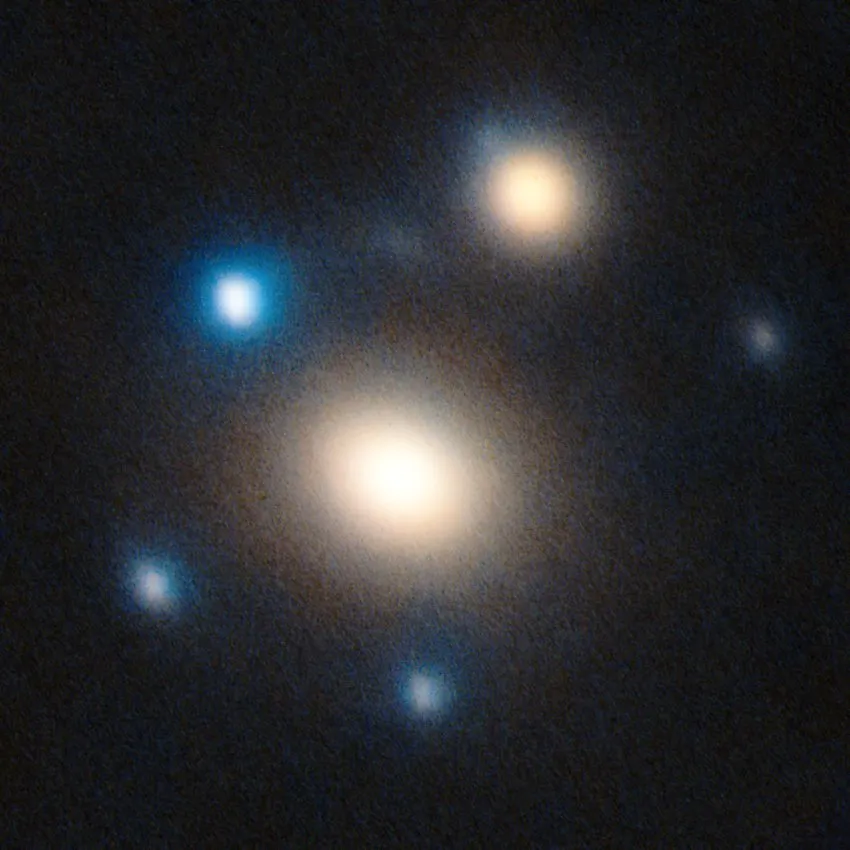
Superluminous supernovae are among the most powerful stellar explosions, many times brighter than ordinary supernovae. The hydrogen-poor group, SLSN-I, is defined by spectra without hydrogen lines. Most of them have been studied in the nearby universe. Now one has been examined in detail at redshift 2.0155.
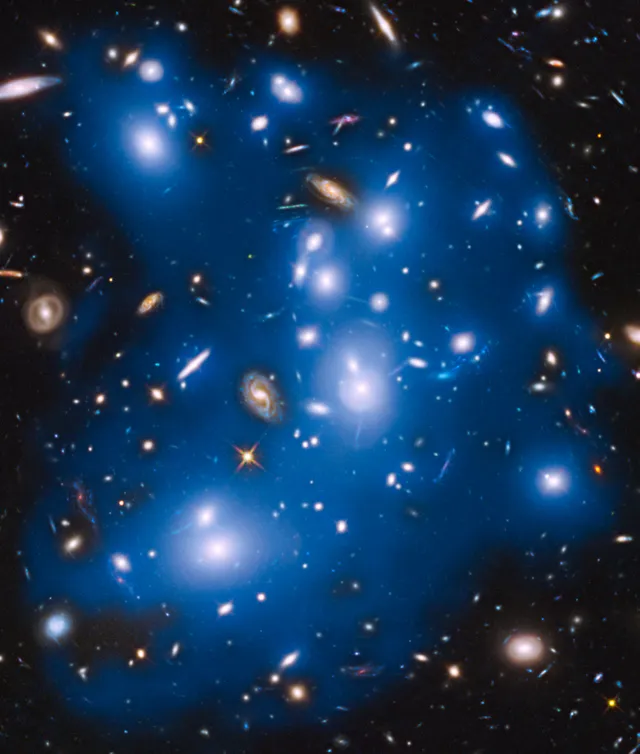
This is supernova 2025wny, which is strongly lensed. A massive object lies between it and Earth, bending the light and boosting its apparent brightness. The results are available as an arXiv preprint and have not yet been peer reviewed.
How the data were obtained
The spectra were taken with the KCWI integral-field spectrograph on the Keck-II telescope. Such an instrument records a spectrum at every point of the field of view. The observations span 11 to 61 days after maximum light. Because of the redshift, the ultraviolet light emitted by the explosion arrives in a range a ground-based telescope can observe.
Photometry (brightness measurements) came from Pan-STARRS. It was used to determine the magnification of the brightest image: μ = 19.4 ± 1.6. Mass models of the lens gave values 2-4 times lower. This gap shows that mass models alone may not be enough for such systems.
What the model and spectra say
The light curve was compared with a model in which the explosion is powered by a magnetar (a neutron star with an extremely strong magnetic field) plus the decay of ⁵⁶Ni (radioactive nickel). The calculations were done with MOSFiT. They give a magnetar spin period of 4.1 (+0.7/−1.0) ms and a magnetic field of 2.4 (+1.1/−0.8) × 10¹⁴ gauss. These are typical parameters for nearby SLSNe-I.
The model reproduces the light curve near maximum, but it cannot explain the late-time plateau in brightness. The authors conclude that an additional power source is needed.
The ultraviolet spectra show almost no line blanketing from iron-group elements. The absorption lines match those previously identified in SLSNe-I through abundance tomography.
The host galaxy
Narrow interstellar lines give a metallicity estimate. It indicates that the supernova exploded in a galaxy with sub-solar metallicity.
Lines from the host galaxy also reveal gas outflows at about 575 km/s. The fraction of Lyα photons (an ultraviolet hydrogen line) that escape the galaxy is 0.23 ± 0.03, which the authors describe as exceptionally high.
What it means
The main conclusion is that 2025wny matches lower-redshift superluminous supernovae reasonably well. The explosion mechanism therefore does not appear to change by this redshift. But this is a single object, so it cannot prove anything about the whole population.
How solid is the result
The magnetar parameters come from a model fit. It describes only the light curve near maximum, and the plateau afterwards remains unexplained. The lens magnification from photometry is clearly higher than the mass-model estimates. The paper has not yet been peer reviewed.
What comes next
New surveys, including LSST and Roman, should find more superluminous supernovae at high redshift. They will show whether such explosions in the early universe stay consistent with those seen nearby.