One of the main ways to explain supermassive black holes is the heavy-seed pathway. In it, a black hole forms from the collapse of a supermassive star (SMS) and starts out with a huge mass. But the standard direct-collapse scenario has a weak spot: it needs an extremely strong external far-ultraviolet (FUV) field.
A new paper, posted as a preprint on arXiv, suggests another route. According to cosmological radiation-hydrodynamic simulations, supermassive stars can form even when the external radiation is below the critical level. The role of the "ultraviolet shield" is taken over by stars born inside the halo itself.
Why the standard scenario needs strong ultraviolet
In gas without heavy elements, the main coolant is molecular hydrogen (H₂). It lets the gas lose heat, break into clumps and form many relatively small stars. For a supermassive star this is a problem, because the material is shared among many objects.
To avoid it, the classical picture needs external FUV to destroy H₂. Then the gas cools only through atomic transitions, stays warmer and can collapse as a whole. But the radiation intensity required is extremely high, so such conditions are rare.
What the authors simulated
The researchers looked at metal-free haloes where atomic cooling is efficient. The external FUV background was subcritical: J₂₁ = 1–10². This is the intensity in standard J₂₁ units, below the level required in the classical scenario.
The simulations included FUV and ionizing radiation from stars formed inside the halo. The evolution was followed for roughly 1–2 million years after star formation began.
Two stages of collapse
At first, everything looks ordinary. H₂ cools the gas, fragmentation occurs, and normal Population III stars appear, the first generation of stars.
Then feedback kicks in. The internal FUV from these stars photodissociates H₂, meaning it breaks the molecules apart, and further fragmentation stops. The surrounding warm gas reservoir contracts under self-gravity and undergoes global collapse through atomic cooling.
This collapse drives an inflow of 0.1–1 solar mass per year. Rapidly accreting protostars, which gain mass from the surrounding gas, reached 2–6 × 10⁴ solar masses by the end of the simulations, that is, 20,000–60,000. Accretion was still ongoing.
What it means
The authors expect these objects to grow into supermassive stars of about 10⁵ solar masses and then form direct-collapse black holes (DCBHs). This is an extrapolation: the simulations ended earlier.
The global collapse is accompanied by clustered star formation. A compact, top-heavy stellar system, dominated by massive stars, forms around the supermassive stars.
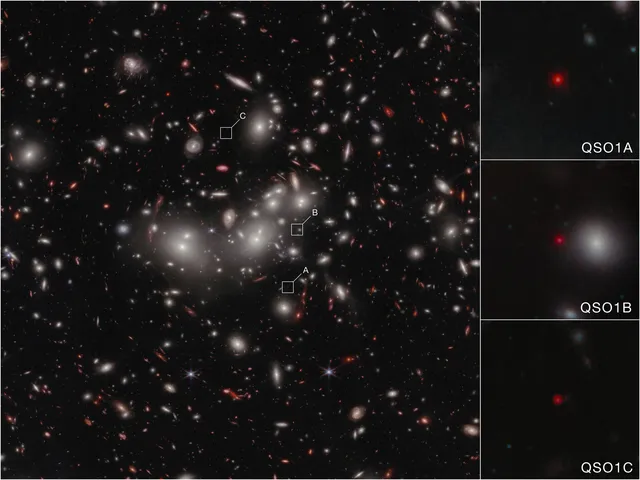
The estimated DCBH abundance is 10⁻³–10⁻² per cubic comoving megaparsec. A comoving megaparsec is a unit of volume that accounts for the expansion of the Universe; one megaparsec is about 3.26 million light-years. According to the authors, this is high enough for such black holes to be a plausible progenitor population for Little Red Dots and present-day supermassive black holes.
How solid is the result
This is numerical modelling, not a direct observation, and the paper has not yet been peer reviewed: the source is a preprint. The simulations cover only 1–2 million years, so the final masses of the stars and black holes are estimates rather than computed outcomes. The DCBH abundance estimate also depends on the assumptions of the model.
Still, the conclusion is substantive. The authors argue that internal stellar feedback can trigger the formation of supermassive stars rather than only prevent it. This substantially relaxes the requirement on the external FUV field and makes the heavy-seed scenario less demanding about conditions.