Euclid Finds the Universe's Oldest Quasars
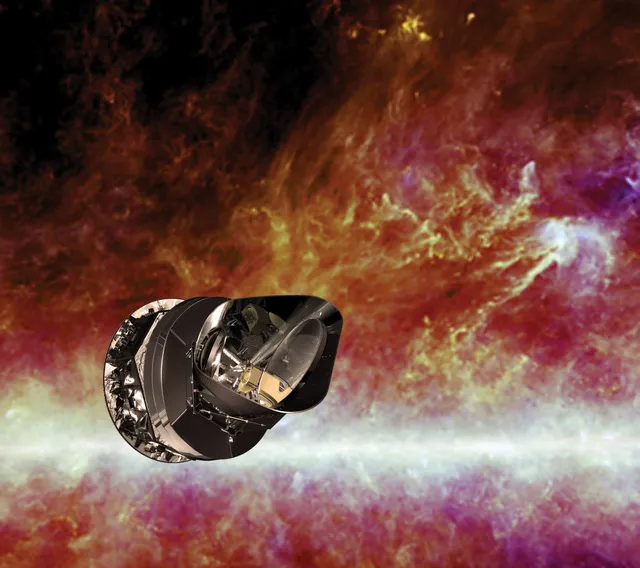
Over a single year of operation, the Euclid space telescope, launched by the European Space Agency in 2023 to map the dark Universe, spotted 31 quasars from the early epochs of cosmic history. A quasar marks a phase when matter spirals onto a galaxy's central supermassive black hole, releasing energy that outshines the rest of the galaxy's stars combined.
Two of the objects turned out to be new record holders, with redshifts of 7.77 and 7.69 — their light has traveled for over 13 billion years, showing them as they were just 670 million years after the Big Bang. Finding the first ten quasars at such extreme distances once took astronomers more than a decade, while Euclid matched that pace with 12 similar objects in just one year of observations.
How SKA Will Probe Pulsar Wind Nebulae
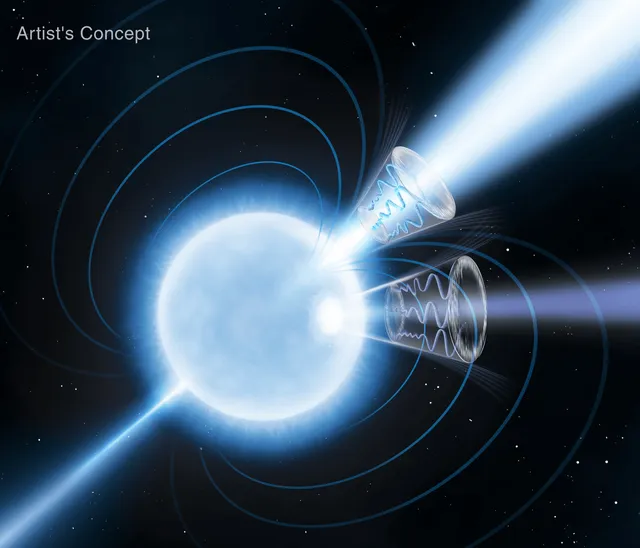
Pulsar wind nebulae form when a stream of charged particles from a neutron star collides with supernova debris or interstellar gas. A team led by Joseph Gelfand described how the future SKA (Square Kilometre Array) radio telescope could help reveal how electron-positron pairs are actually born in a neutron star's magnetosphere, fueling this wind.
Particles in these nebulae are accelerated to energies above 10^15 electronvolts — roughly a hundred thousand times more than the Large Hadron Collider achieves. The authors suggest heavier particles, such as protons, might also be accelerated, meaning these nebulae could be a source of the Galaxy's most energetic cosmic rays. SKA will surpass current instruments in sensitivity, dynamic range and timing precision, enabling far more detailed polarization maps of these objects.
IXPE Measures the Lighthouse Pulsar's Magnetic Field
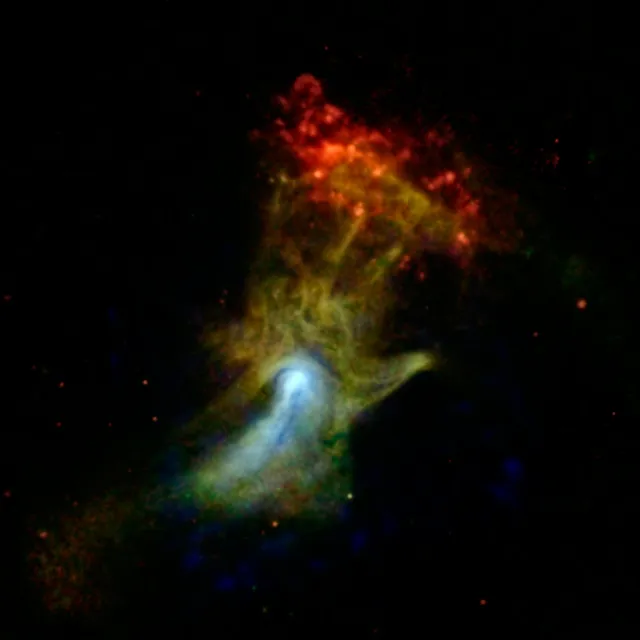
The IXPE telescope directly measured the magnetic field of the pulsar PSR J1101−6101, which spins 16 times per second and sits inside the 'Lighthouse' nebula, known for its thin X-ray filaments. A 2008 hypothesis proposed that the most energetic particles break through the shock front and stream along the Galaxy's magnetic field lines, but direct evidence had never been found.
In June 2025, IXPE observed the nebula for nearly 18 days, and new analysis methods allowed measurement of polarization in the filament, the trailing wake, and the pulsar itself. With over 99% confidence, the team confirmed the filament's magnetic field runs along the particle flow. Yet the degree of polarization was higher than models predicted, pointing to weaker magnetic turbulence than previously assumed.
Stellar Mergers May Spin Up Black Holes
A single massive star sheds almost all its angular momentum before its core collapses, so black holes born from solitary stars spin very slowly. But in dense globular clusters, stars collide often, and a team led by Ishaan Sathish tested, across roughly 150 cluster models built with Cluster Monte Carlo and the MESA stellar evolution code, how such mergers affect the spin of a resulting black hole.
Some merger products develop a thick accretion disk around their core, resembling pre-collapse collapsar-like structures, and this disk can efficiently spin up the black hole right up to core collapse. The authors estimate that up to half of black holes in such clusters could form through mergers, with about 10% coming from 'significant' mergers with a mass ratio above 0.1.
IceCube Hunts Neutrinos from Gravitational Waves
The IceCube observatory in Antarctica checked whether black hole and neutron star mergers detected by LIGO, Virgo and KAGRA are accompanied by bursts of high-energy neutrinos. For the O4a observing run, a team led by Jessie Thwaites deployed, for the first time, an automated pipeline that analyzes data and alerts the astronomical community without delay.
Using two methods — a maximum-likelihood analysis and a Bayesian approach — the researchers found no statistically significant signal, including for the most notable candidate, S231025a. Still, they set upper limits on neutrino emission for a much larger set of sources, nearly double the number covered by all previous observing runs combined, a result valuable for the fast search for electromagnetic counterparts.