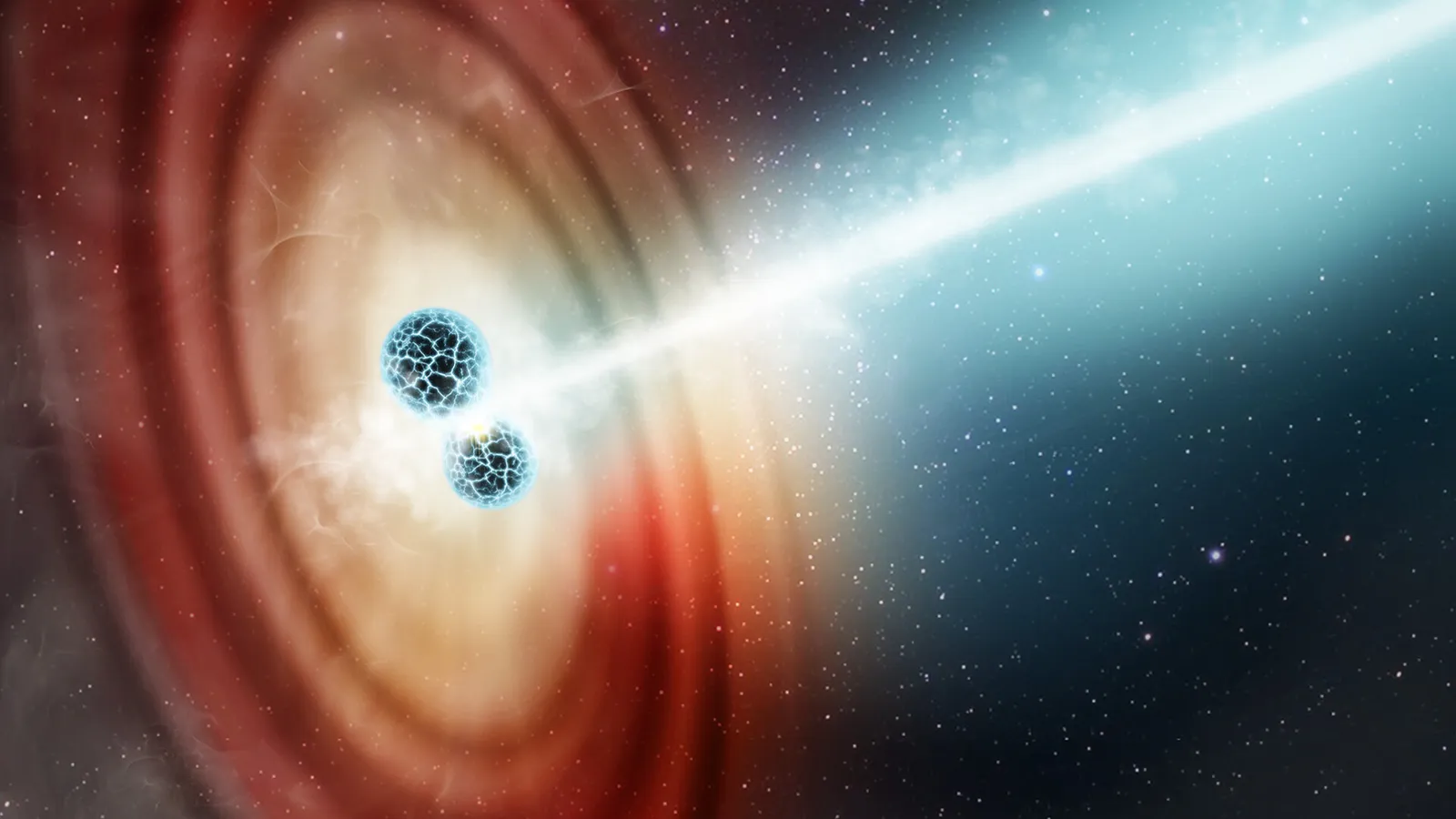
When two black holes or neutron stars merge, spacetime itself trembles — that ripple is a gravitational wave. The LIGO, Virgo, and KAGRA (LVK) detectors catch this tremor and alert the astronomical community almost immediately. But a gravitational wave alone rarely pins down where in the sky the source is — the search area often stays large. That's why the IceCube observatory in Antarctica looks for a different trace of the same event: high-energy neutrinos.
During a merger, particle acceleration is expected to occur, producing both a short gamma-ray burst and a flood of neutrinos. Neutrinos barely interact with matter, so they travel from source to Earth in almost a straight line, undeflected by magnetic fields or material along the way. Catching such particles at the same time as a gravitational wave can sharply narrow the patch of sky where an optical or gamma-ray counterpart — the so-called third messenger — should be searched for.
An Automated Pipeline for O4a
In a new study submitted to The Astrophysical Journal, the IceCube Collaboration presents results of a search covering O4a, the first part of LVK's fourth observing run. Similar analyses were done before for the first two runs and for O3, but this time researchers set up an automated pipeline: it receives LVK alerts, analyzes IceCube data, and sends results to the community without delays from manual processing.
“For this LVK observing run, we set up an automated pipeline for receiving, analyzing, and sending results to the astronomical community,” explains Jessie Thwaites, the study's lead and a postdoctoral researcher at Queen's University. “This allowed us to improve our response time to these alerts.”
The result is a much faster reaction compared to O3: IceCube can now send results to other telescopes far sooner after a merger, while the chance of catching an electromagnetic counterpart is still high.
Two Methods and the S231025a Candidate
Researchers applied two approaches already used in earlier runs. The first is an unbinned maximum likelihood analysis, applied to the most significant gravitational-wave alerts. The second is a Bayesian analysis that accounts for prior information about likely astrophysical sources and works with both significant and low-significance alerts.
No statistically significant signal was found in either case. But researchers set upper limits on possible neutrino emission for a far larger number of sources — almost double the count from all previous observing runs combined.
The most notable coincidence in the O4a sample involved gravitational-wave candidate S231025a. Researchers overlaid the map of the source's likely location with neutrino positions recorded within ±500 seconds of the merger time. It's the clearest practical example of how the method works, even though statistical significance wasn't reached here either.
Searching for the Third Messenger
Response speed has direct practical value. When IceCube promptly points toward possible neutrino candidates, other telescopes get a narrowed patch of sky to search for an electromagnetic counterpart — light in any band that would confirm the source's nature.
“In response to our alerts, other telescopes pointed in the direction of the candidate neutrinos that we detected to search for electromagnetic counterparts,” adds Justin Vandenbroucke, a study coauthor.
Doğa Veske, one of the study's leads, stresses the importance of this approach for multimessenger astronomy — a field combining different types of signals from the same cosmic source.
Our follow-ups shrink the area that needs to be scanned by astronomers, making feasible follow-ups for finding the third messengerDoğa Veske, Middle East Technical University
With planned improvements to gravitational-wave detectors and the proposed expansion of IceCube itself — the IceCube-Gen2 project — the number of events available for this kind of joint analysis should grow. That raises the odds of catching that rare moment when a gravitational wave, a neutrino, and light all point to the same source at once.