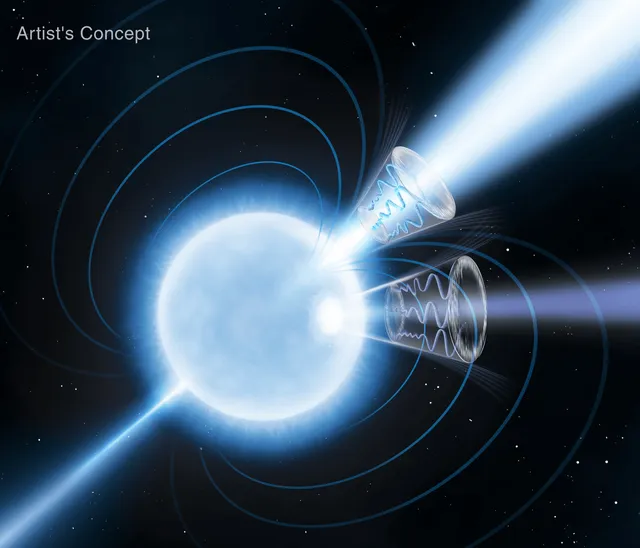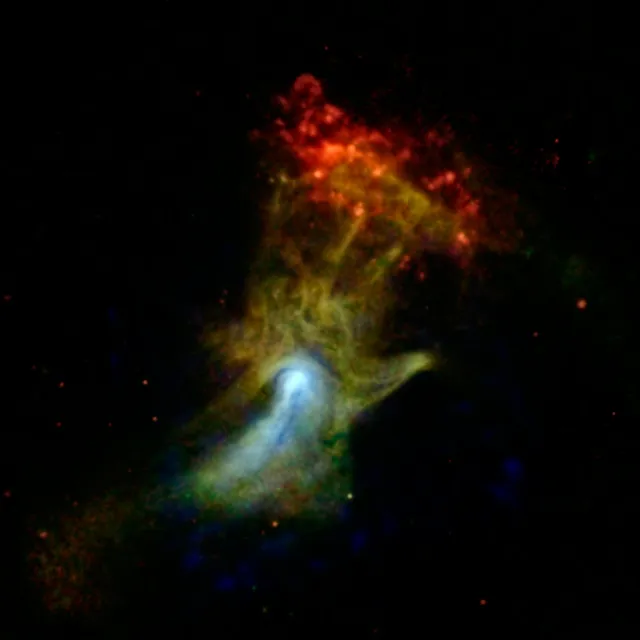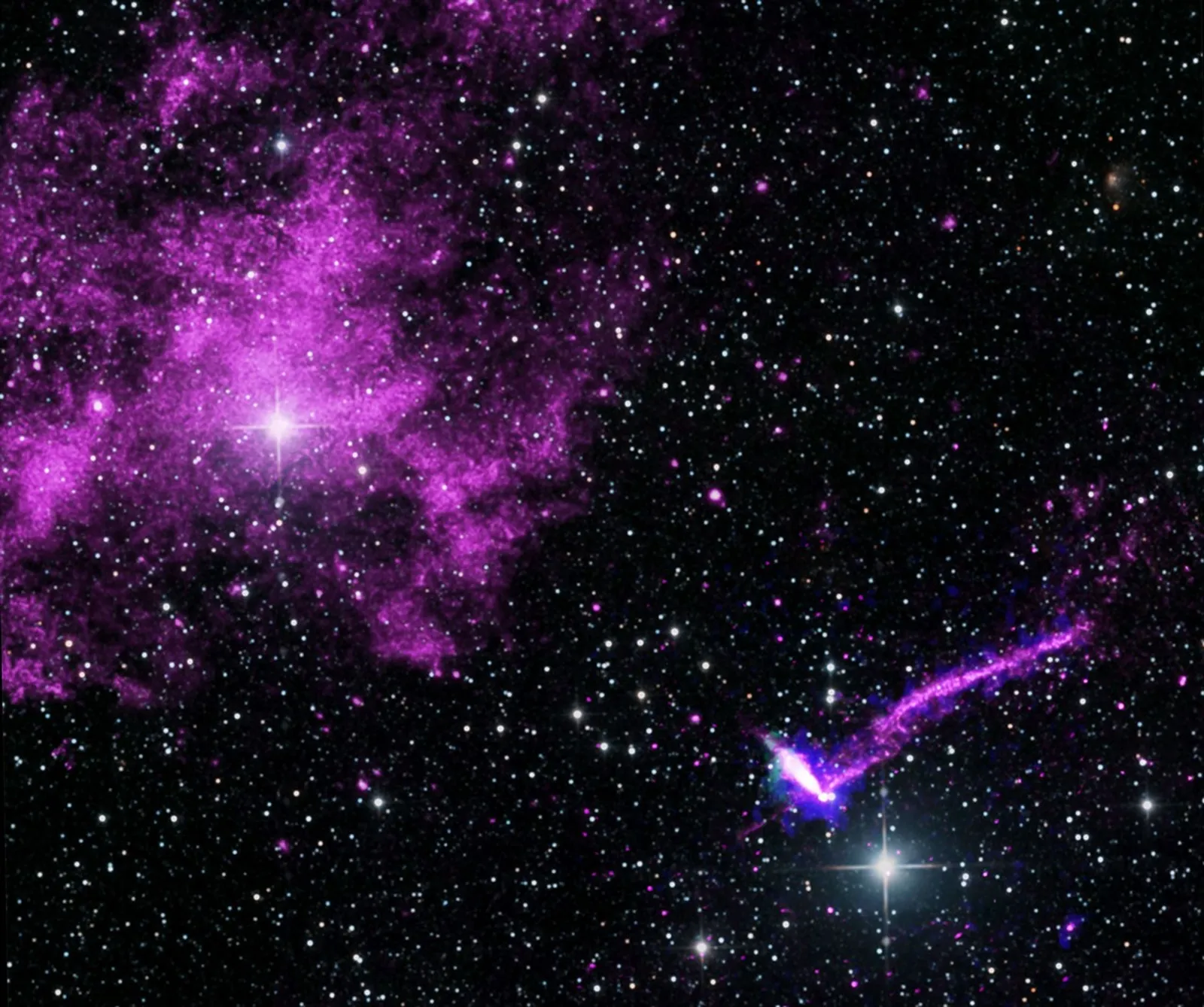
Pulsar PSR J1101−6101 spins 16 times per second, blasting out streams of particles at nearly the speed of light. It sits inside a nebula astronomers call the “Lighthouse,” named for the thin X-ray structures stretching away from the neutron star. These structures have puzzled scientists for years: a theory explaining them dates back to 2008, but no direct measurement existed until now. A team led by Jack Dinsmore of Stanford University has finally obtained direct confirmation using NASA’s IXPE space telescope.
The study, published in the Astrophysical Journal, delivered more than confirmation of an old hypothesis. It also produced new data that don’t fit existing models. The result shows that even well-studied objects like pulsar wind nebulae can hide structure more complex than expected.
How particles break through the shock
The neutron star at the nebula’s center is the leftover core of a massive star, heavier than the Sun, compressed to the size of a city. Its powerful magnetic field accelerates charged particles to nearly light speed.
When these particles slam into thin interstellar gas, they form a bow shock, much like the wave at the front of a speeding boat. Most particles get trapped behind this shock, forming a turbulent trail behind the pulsar.
But researchers suspected since 2008 that the highest-energy particles manage to break through the shock and flow along the Galaxy’s magnetic field lines, forming a long, thin structure called the filament. That hypothesis needed a direct test.
The “smoking gun” would come from measuring the polarization of the light, which reveals the direction of the magnetic field. If the field points along the filament, that confirms particles there are moving along the field lines.
What IXPE measured
The Lighthouse Nebula is relatively faint, making polarization measurements difficult. The IXPE team developed new analysis methods that use every bit of available data without simplifying steps that could throw away information.
In June 2025, the telescope observed the nebula for nearly 18 days. Thanks to the new techniques, the team obtained polarization measurements not only for the filament but also for the trail and the pulsar’s own emission.
The result: with more than 99% confidence, the magnetic field in the filament does align with the particles’ flow. It’s direct confirmation of a hypothesis first proposed 17 years earlier.
Weaker turbulence and a mismatch with radio data
While the field’s direction confirmed the models of particle motion, the degree of polarization turned out higher than predicted. High polarization points to weaker magnetic turbulence than the models assume.
Many of the models for filaments assume strong magnetic turbulence. The high polarization degree we measured indicates lower turbulence than such models require.Roger Romani, Stanford University professor, study co-author
Another surprise came from comparing the X-ray data with radio observations. IXPE data showed the magnetic field responsible for X-ray emission runs parallel to the trail. But separately collected radio observations revealed a field pointing almost exactly perpendicular to it.
According to Niccolò Bucciantini of the Italian National Institute for Astrophysics, a co-author of the study, this divergence is the first clear sign that particles of different energies occupy distinct regions of the system. It hints at multiple, possibly very different, acceleration mechanisms at work within the same nebula.
IXPE is a joint mission of NASA and the Italian Space Agency, with partners in 12 countries, led by NASA’s Marshall Space Flight Center. The Lighthouse Nebula results add another example of how X-ray polarimetry reveals structure in extreme objects that other observation methods can’t detect.