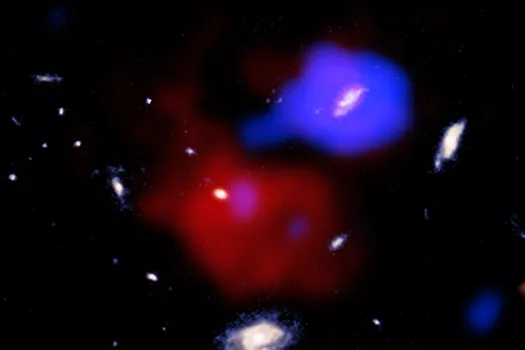
The history of galaxy formation is, in many ways, the story of diffuse cosmic gas being transformed into stars. One key source of this fuel is the circumgalactic medium: cool gas surrounding a galaxy that can eventually fall inward and help ignite new star formation. Earlier observations showed that in the early Universe, this cool gas is especially abundant at the densest intersections of the cosmic web — its "nodes." It seemed reasonable to expect galaxies in these regions to be forming stars vigorously.
A galaxy that broke the pattern
In 2022, astronomers observed one such cosmic web node with NASA's James Webb Space Telescope. Most galaxies detected there matched expectations, actively forming stars. But one galaxy stood out sharply: a compact, red object sitting right at the center of a massive reservoir of cool gas, yet forming very few new stars. Because of its round, reddish appearance in the JWST image, the team nicknamed it the "Red Potato."
The puzzle was obvious: why would a galaxy stop forming stars while surrounded by so much cool gas? Researchers compared the situation to coastal deserts in Chile and Namibia, places that sit right next to the ocean yet receive almost no rainfall. The Red Potato seemed to face a similar paradox — plenty of gas nearby, but almost no "rain" of new stars.
What Chandra's X-ray view revealed
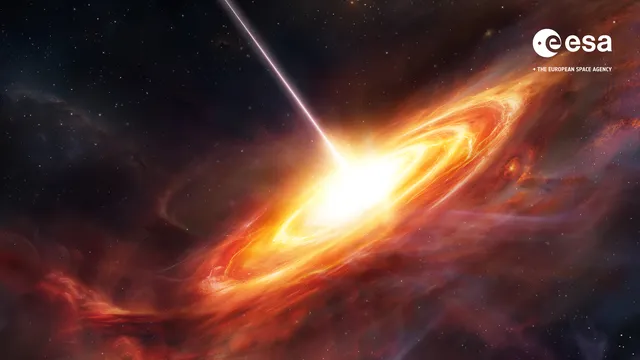
The answer began to emerge when the team analyzed new data from NASA's Chandra X-ray Observatory. Within the gas reservoir surrounding the Red Potato, they found an extended X-ray jet, clear evidence of activity from a massive black hole at the galaxy's center. Archival radio observations from Australia's ASKAP telescope (Australian Square Kilometre Array Pathfinder) provided additional confirmation of the jet's existence.
A detailed analysis of the gas kinematics — how the gas moves around the galaxy — added a crucial detail. The jet doesn't simply pass through the gas envelope; it appears to actively stir it, keeping it turbulent. Instead of settling inward and cooling down to conditions suitable for star formation, the gas remains disturbed and dispersed.
We found an important clue: the cool gas reservoir surrounding the Red Potato galaxy is intersected by an extended X-ray jet, which is clearly powered by a massive black holeWeichen Wang, postdoctoral researcher, University of Milano-Bicocca
Why this matters for early galaxies
The discovery shows just how powerful the influence of black hole jets can be on galaxy formation in the early Universe. The relationship between cool gas supply and star formation is often assumed to be fairly direct: more gas, more stars. The Red Potato adds an extra layer of complexity to that picture — a black hole's jet activity can effectively suppress star formation even when raw material is abundant.
James Webb Space Telescope continues to reveal more early-Universe galaxies with similarly weak or absent star formation. Whether the same mechanism — black hole jets stirring up cool gas — applies to all of them remains an open question. Thanks to its exceptional sensitivity to X-rays, Chandra is expected to play a key role in testing this idea across a larger sample of similar galaxies in the future.