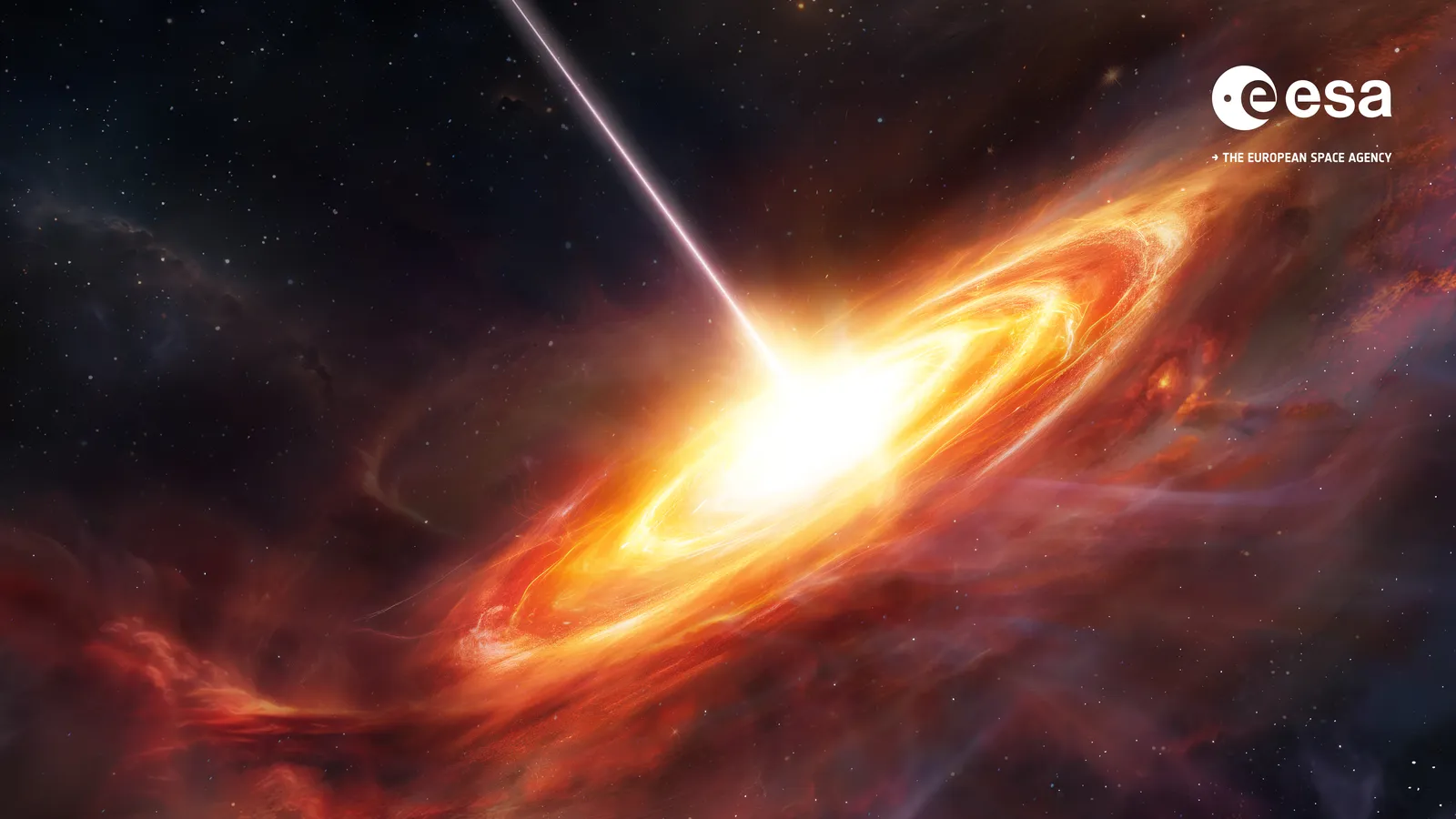
Euclid, the space telescope that the European Space Agency launched in 2023 to map the dark Universe, has delivered an unexpected bonus: in a single year of operation, it has discovered 31 quasars from the early days of cosmic history. Two of them are the most ancient ones known so far, shining back when the Universe was only 670 million years old — about 5% of its present age.
These objects blazed with the light of a trillion Suns. The discovery is described in a paper led by Daming Yang of Leiden University, forthcoming in Astronomy & Astrophysics.
How a galaxy's core lights up
A quasar is not a distinct type of celestial object but a temporary phase in a galaxy's life. It occurs when large amounts of gas and matter spiral inward onto the supermassive black hole at the galaxy's centre.
This infall of material releases enormous amounts of energy. The galaxy's nucleus starts to shine brighter than anything else around it — sometimes hundreds to thousands of times brighter than the rest of its host galaxy combined.
That is why quasars can be seen across such vast distances, even though the supermassive black holes and galaxies hiding them remain invisible on their own.
Two record-holders 13 billion years away
The two most ancient quasars in the new sample carry the technical designations EUCL J172902.75+641018.1 and EUCL J125308.55+705432.3. Their redshifts (a measure of distance and motion tied to how light stretches in the expanding Universe) are 7.77 and 7.69, respectively.
Both objects lie just over 13 billion light-years from Earth. That means we see them as they were during the Universe's first 670 million years.
The previous record belonged to a quasar with a redshift of 7.64, discovered in 2021. The new record-holder does not surpass it by much — but the fact that Euclid found two such objects within a short observation period shows the scale of the telescope's capability.
Overall, the new findings include 12 quasars with a redshift of 7 or above, corresponding to the first 770 million years of the Universe's life.
Why so few of these quasars have been found
Hunting for quasars from that era is difficult for two reasons. First, they are rare: in the early Universe, few galaxies had grown large enough to power such intense nuclear activity.
Second, their light is faint and primordial, easily confused with light from far closer stars within our own galaxy.
Finding the first dozen quasars with a redshift above 7 took astronomers more than a decade of work. Euclid surpassed that result in a single year of observations.
Euclid is a true game-changer. Before, we could only find a handful of the very brightest ancient quasars, but Euclid lets us search far more efficiently across huge areas of sky to capture much fainter lightDaming Yang, Leiden University
According to Antonio La Marca, an ESA Research Fellow on the Euclid team, this work amounts to the first true census of quasars at the dawn of the Universe, rather than just a collection of isolated chance discoveries.
The epoch of reionisation and what comes next
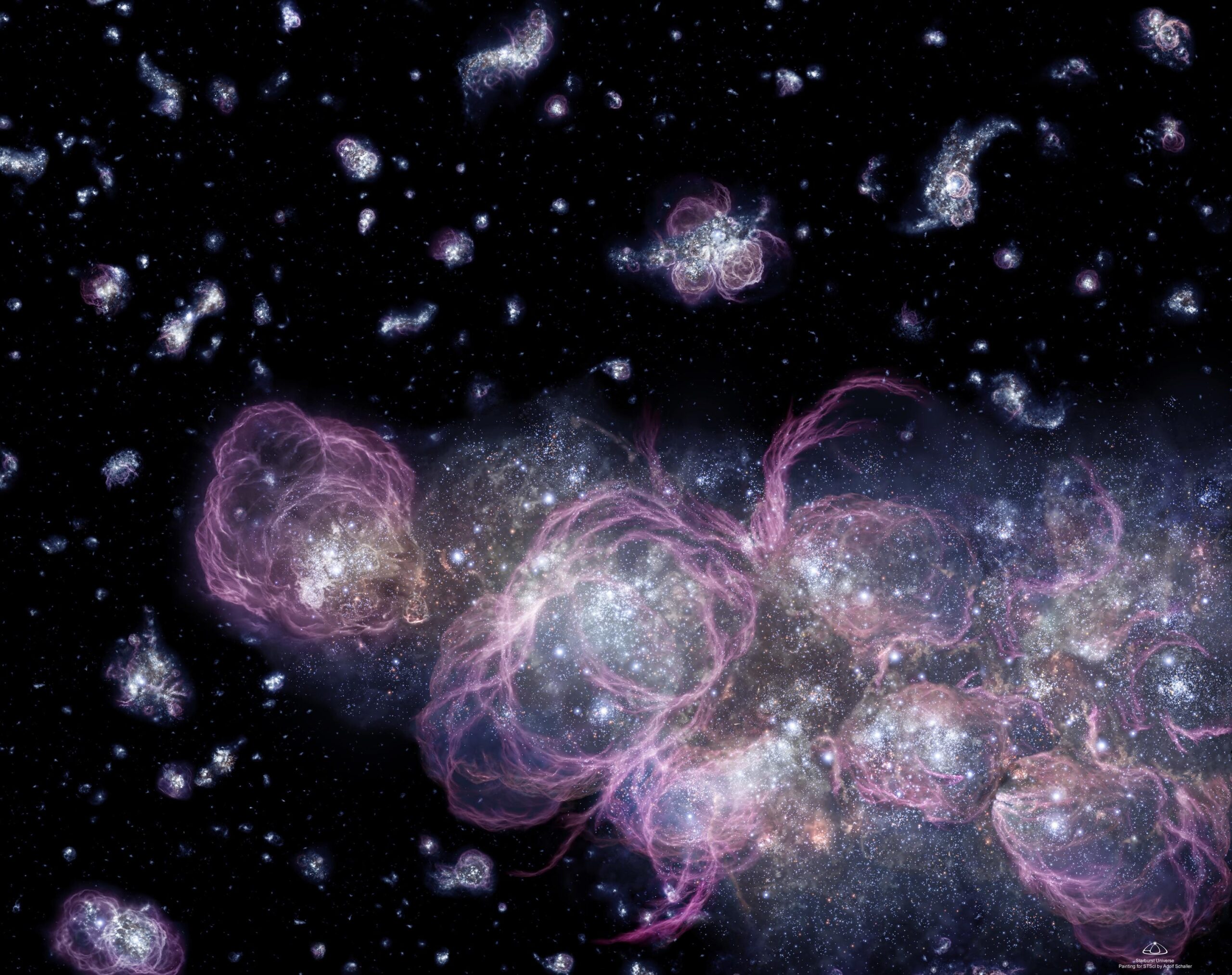
These quasars belong to a period astronomers call the epoch of reionisation. This is the transition when the cold, dark Universe (the so-called "dark ages") began to heat up and become "ionised" under the energetic light of the first stars, galaxies, and black holes.
This epoch laid the foundation for the structure of the cosmos we observe today. Quasars act as time machines, letting researchers look into how the first supermassive black holes and their surrounding galaxies took shape.
One quasar from the sample has already received closer attention: observations led by Silvia Belladitta and colleagues showed it is embedded in a dusty, gas-rich galaxy furiously forming new stars. This offers a hint of what the host galaxy of an early supermassive black hole might look like.
So far, the 31 quasars have been found in data from the Euclid Wide Survey, which will eventually cover more than one-third of the entire sky once complete. That means the current discovery is only a small fraction of what the telescope may still reveal in the most distant and ancient corners of the Universe.