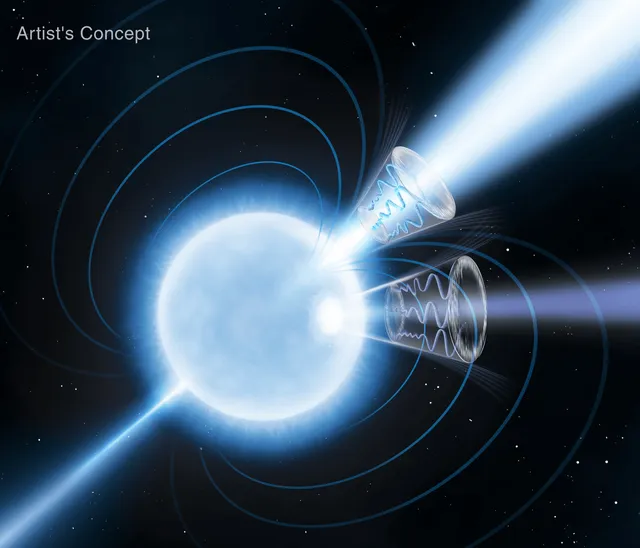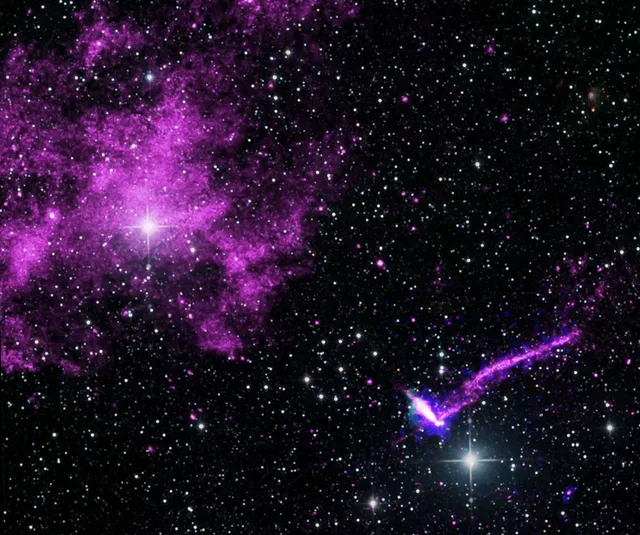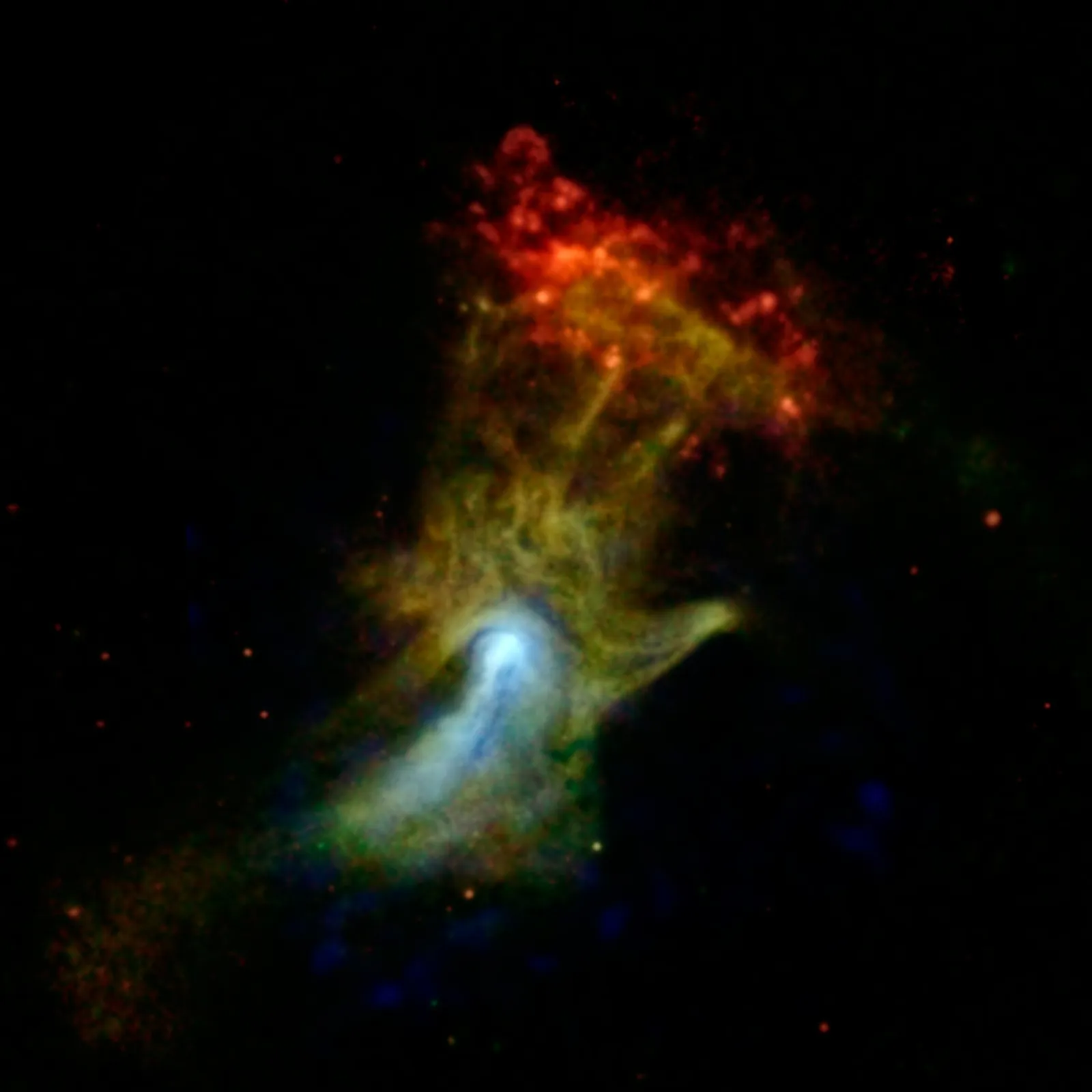
A neutron star is the ultra-dense remnant left behind after a massive star explodes as a supernova. It spins at enormous speed and carries a powerful magnetic field that flings charged particles into space. This outflow is known as the pulsar wind. When it collides with supernova debris or the interstellar medium, it forms a pulsar wind nebula, or PWN.
These nebulae are more than striking structures in astronomical images. They are natural laboratories for physics that cannot be replicated on Earth. A team led by Joseph Gelfand has outlined how the future Square Kilometre Array (SKA) radio telescope could reshape our understanding of these objects.
How electron-positron pairs are born in the magnetosphere
A central question in this field is how electron-positron pairs are actually produced within a neutron star's magnetosphere. This process powers the entire pulsar wind, yet the details of how it unfolds remain unclear.
The researchers stress that answering this requires spatially-resolved maps of the continuum and polarized radio emission from these nebulae. That means not just an overall brightness measurement, but a detailed picture of how emission is distributed across the nebula and how it is polarized in different regions.
Polarization matters here because it carries information about the structure of the magnetic field. And it is the magnetic field that governs how particles move and get accelerated within the nebula.
Particles pushed beyond what Earth's labs can reach
Particles within the pulsar wind are accelerated to energies above 10^15 electronvolts. For comparison, that is roughly a hundred thousand times more than the energies achieved at the Large Hadron Collider, humanity's most powerful particle accelerator.
The authors suggest that alongside electrons and positrons, baryons — heavy particles such as protons — may also be accelerated in these environments. If confirmed, pulsar wind nebulae could turn out to be one source of the highest-energy cosmic rays produced within the Milky Way.
Acceleration alone, however, is not the whole story. It matters just as much how these particles travel afterward. Observations need to trace their path within the nebula and how they eventually escape into the surrounding interstellar medium.
SKA's sensitivity as a new class of instrument
This is where hopes rest on the SKA — the Square Kilometre Array, a future radio telescope that will combine thousands of antennas into a single observing network.
According to the authors, the SKA will significantly surpass existing instruments across three key parameters: sensitivity, dynamic range, and timing precision. Together, these improvements should yield sharper and more detailed maps of pulsar wind nebulae than have ever been possible.
The significant improvements in sensitivity, dynamic range, and timing capabilities offered by the Square Kilometre Array have the potential to greatly improve our understanding of the origin of some of the highest energy particles produced in the Milky Way.Joseph D. Gelfand and co-authors
The paper is part of a series of science case studies for the SKA project, published as part of Advancing Astrophysics with the SKA II ahead of the telescope's construction. Its purpose is to define concrete scientific goals that new observations should be able to address.
For pulsar wind nebulae, this means moving from rough estimates toward detailed maps of magnetic fields and particle motion. That, in turn, brings researchers closer to answering where in the Galaxy particles with energies unattainable on Earth actually come from.