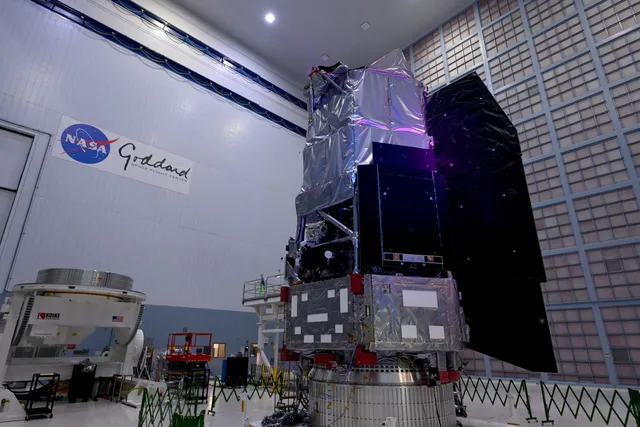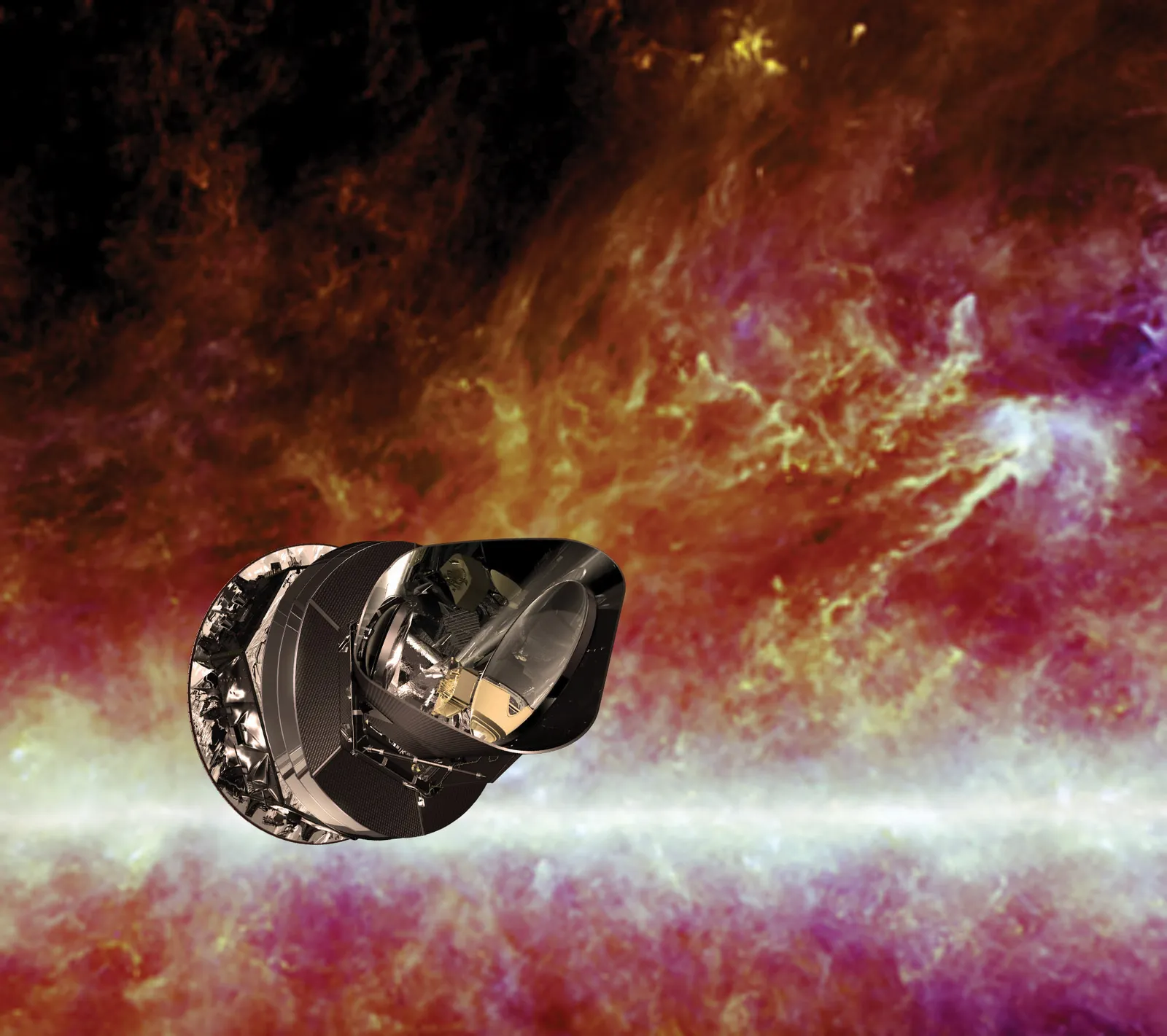
The cosmic microwave background (CMB) is the leftover radiation from the early universe, released roughly 380,000 years after the Big Bang, when the universe cooled enough to become transparent to light. Its spectrum closely matches that of a perfect blackbody at about 2.7 kelvin. But "closely" is the operative word. The tiniest deviations from that perfect thermal curve carry information about processes that occurred long before the first stars formed, as well as about hot gas in later cosmic epochs. Measuring exactly these deviations — known as spectral distortions — is the goal of the proposed FOSSIL mission.
The project is described in a preprint posted on arXiv. This means FOSSIL is currently a mission concept — a detailed proposal for a future instrument, not a built or launched spacecraft.
What FOSSIL would measure
The mission is built around absolute spectroscopy: measuring not just temperature differences across the sky, but the precise intensity of sky radiation across a broad frequency range, from 50 GHz to 2 THz. The instrument would have 130 spectral channels, allowing it to resolve fine features in the spectrum's shape.
The main targets are three types of CMB spectral distortions. The mu-type arises when energy is injected into the very early universe, before the CMB itself fully formed, disrupting the thermal equilibrium of photons. The Compton y-type, including a relativistic correction, is a signature of CMB photons scattering off hot gas in later epochs, such as in galaxy clusters and the intergalactic medium. According to the proposal, FOSSIL's monopole sensitivity — its sensitivity to the sky-averaged signal — would be roughly three orders of magnitude better than COBE/FIRAS, still the most precise CMB spectrum measurement, made back in the 1990s.
Why it matters
Spectral distortions offer one of the few windows into cosmic epochs inaccessible to standard CMB anisotropy maps or large-scale galaxy surveys. In particular, they are sensitive to primordial density fluctuations on very small scales — roughly from k=10 to k=10^4 inverse megaparsecs. These scales are smoothed out in the standard CMB temperature maps due to photon diffusion, yet they may carry signatures crucial for testing inflationary models.
Beyond probing the early universe, spectral distortions are also sensitive to dark matter physics — including possible annihilation, decay, or interactions with photons and baryonic matter — as well as to scenarios for the formation of primordial black hole seeds. Another goal is measuring the total thermal energy content of the universe, which helps pin down feedback models in galaxy formation — the processes by which energy from stars or active galactic nuclei affects surrounding gas and subsequent star formation.
Beyond cosmology
While FOSSIL's primary purpose is early-universe cosmology, its wide frequency coverage and fine spectral resolution (130 channels) make it useful for other astrophysics as well. Stated applications include precise characterization of the Cosmic Infrared Background (the combined glow of distant galaxies too faint to resolve individually), line intensity mapping during "cosmic noon" — the epoch when star formation across the universe peaked — and detailed mapping of dust within the Milky Way, which matters both for cosmology (dust contaminates CMB observations) and for studying the Galaxy itself.
How solid is the result
It's worth stressing that FOSSIL is currently a proposal described in a preprint, not an approved or operating mission. The stated sensitivity targets and channel counts are design goals, not results from actual measurements. Still, the explicit benchmark against COBE/FIRAS and the specific numerical targets — a thousandfold sensitivity gain, the frequency range, the channel count — point to a fairly detailed engineering concept, building on decades of experience from earlier CMB missions.