Spin is one of just two quantities, alongside mass, that fully define a black hole. Standard stellar evolution theory predicts that massive stars shed most of their angular momentum before core collapse, through stellar winds and the expansion of their outer layers. As a result, black holes formed from the collapse of a single star are expected to have spins close to zero. But dense star clusters play by different rules: stars there collide constantly, and every collision is a chance to transfer angular momentum from one star to another.
A team led by Ishaan Satish set out to test how strongly such collisions might reshape the picture of black hole birth. The work relies on two simulation tools: Cluster Monte Carlo (CMC), which models the dynamics of thousands of stars in a cluster using the N-body method, and MESA, a code for detailed calculations of a single star's internal structure and evolution. The first provides statistics across an entire cluster, the second delivers the physics of what happens inside a star produced by a merger.
How CMC hunts for spun-up black hole candidates
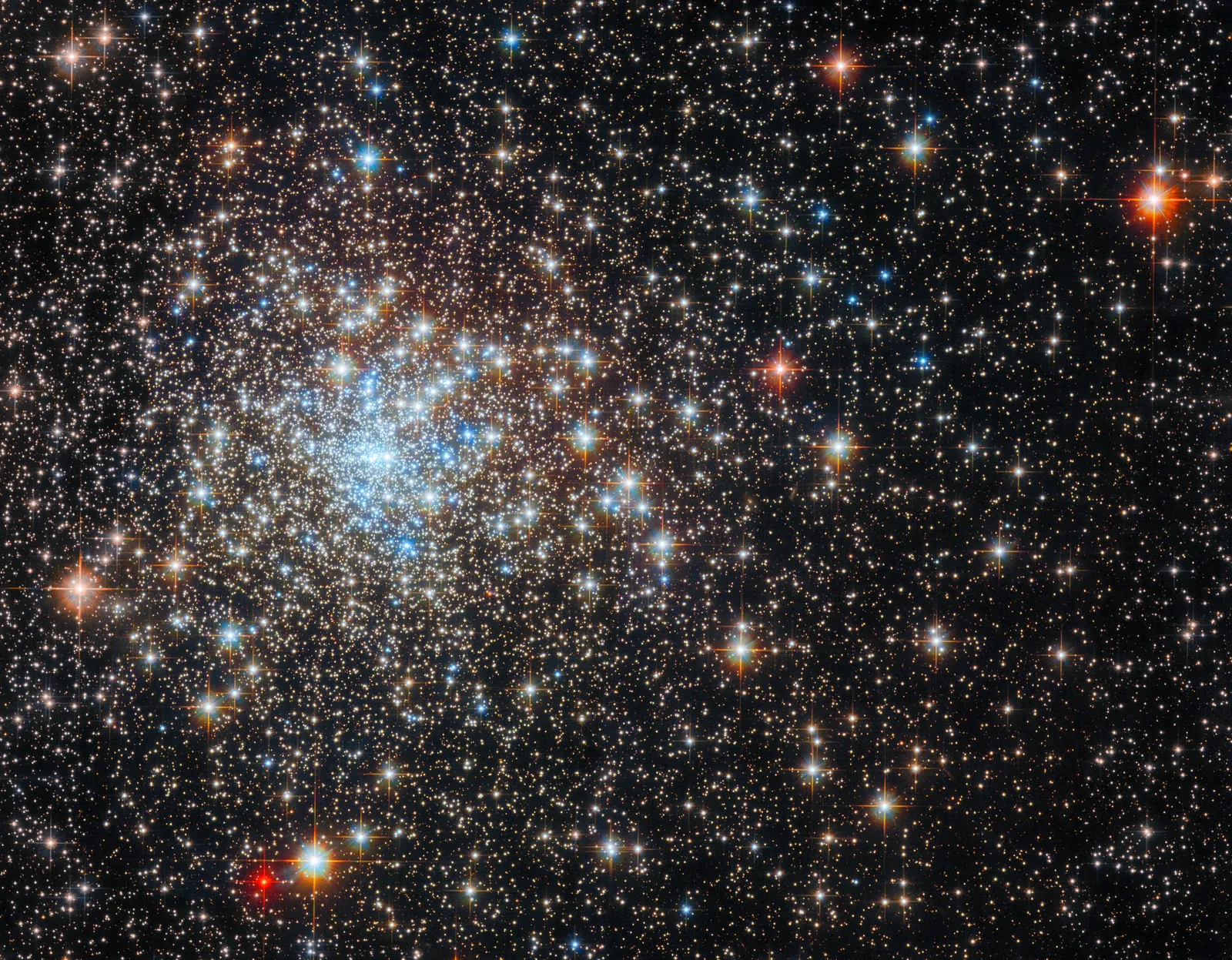
The authors analyzed roughly 150 star cluster models built with CMC. These models reproduce conditions typical of Milky Way globular clusters — dense spherical collections of hundreds of thousands of stars, where distances between neighbors are far smaller than in an ordinary galactic disk.
In each model, the researchers searched for mergers of massive stars that end in black hole formation. Special attention went to "significant" mergers — events where the mass ratio between the two component stars exceeds 0.1. These are, in theory, the events capable of transferring enough angular momentum to noticeably affect the final black hole spin.
The most promising candidates identified in CMC were then followed up with MESA, to track exactly how angular momentum redistributes inside the merged star and what the rotation profile looks like immediately before core collapse.
A thick disk as the spin-up mechanism
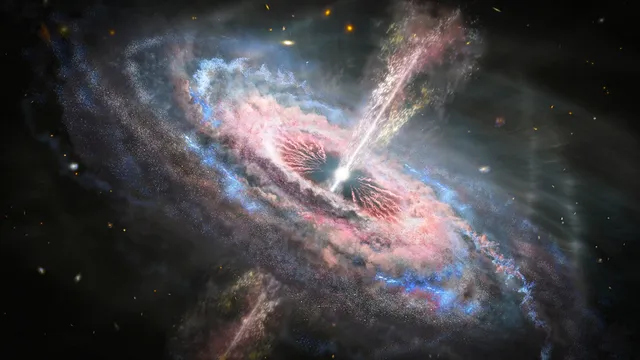
The central idea is simple to state but far-reaching in its implications. During a merger, one star transfers part of its angular momentum to the other. Some merger products evolve not into ordinary supergiants but into objects with a thick accretion disk around the core — structures resembling the collapsar-like objects described in some pre-collapse models.
Such a disk can efficiently spin up the future black hole right up to the moment of core collapse. This stands in sharp contrast to the standard picture, in which a star sheds nearly all its rotational reservoir long before the core actually collapses.
Half of black holes traced to mergers
For clusters resembling Milky Way globular clusters, the results turned out substantial. According to the team's estimates, up to half of all black holes in these models may form as a result of massive star mergers. About 10% of that comes specifically from "significant" mergers with a mass ratio above 0.1.
Preliminary angular momentum estimates point to substantial spin-up in merger products, with correlations emerging between mass ratio, stellar properties, and the resulting black hole spin. In some cases, the dimensionless spin parameter reaches 0.5 or higher, against a theoretical maximum of 1.
Implications for gravitational wave searches
The authors stress that these are preliminary results that still need refinement. But if the trend holds up, it would matter for how gravitational wave observatories interpret their signals.
Black holes with noticeable spin, born in dense clusters, leave a distinct imprint on the gravitational wave signal of a merger — unlike the "slow" black holes expected from single massive stars. If a significant fraction of black holes in globular clusters are indeed born already spun up from earlier mergers, that would give researchers a new way to distinguish dynamically formed gravitational wave sources from those born in binaries outside clusters.