Youngest Known Exoplanet Found
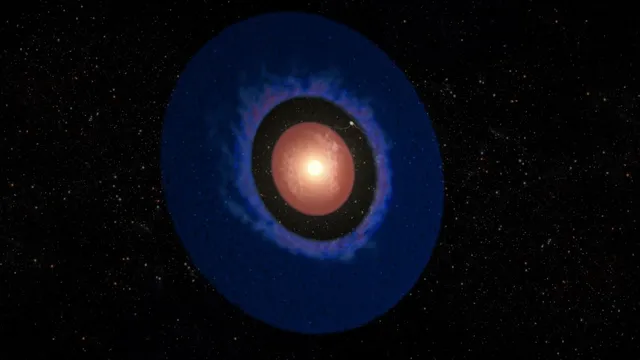
A team led by Andrea Bernardi of Universidad Diego Portales used archival coronagraph observations from the Keck Observatory to search for planets embedded in the disks of seven young stars. The object, Elias 2-24 b, turned out to be roughly Jupiter-mass and sits within a gap in the disk of a star located 450 light-years away, exactly where planet-formation theory predicts it should be carving a path.
Previous record holders for youngest known exoplanet were over 5 million years old and already strained existing models. Elias 2-24 b suggests current planet-formation theories are still missing key processes, offering a rare glimpse of what our own solar system may have looked like in its earliest stages.
Little Red Dots Are Black Hole Galaxies
"Little Red Dots" (LRDs) at redshifts 4–8 have been among the most puzzling JWST discoveries — their V-shaped spectra and compact 100–200 parsec sizes defied standard astrophysical explanations. New work argues they are simply direct-collapse black holes still wrapped in the massive disk that formed them.
Cosmological simulations reproduce the observed spectra: dense gas at the disk's center traps X-rays from the black hole, creating Balmer absorption features while letting some UV, optical and infrared light escape. A dense star cluster of 10⁸ solar masses and 150-parsec radius forms alongside the black hole, matching observations of real LRDs across a range of redshifts.
JWST Detects Dust From Decades-Old Supernova
Using the James Webb Space Telescope, researchers serendipitously detected a point source at the location of Type Ic supernova SN 1983V, which exploded more than four decades ago. Analysis shows the source differs from nearby HII regions and is most likely the dusty remnant of the supernova itself, with archival Hubble data hinting at an H-alpha counterpart linked to ongoing shock interaction that heats the dust.
The dust mass is estimated at roughly 7.7×10⁻³ solar masses, unusually large for a stripped-envelope supernova. The dust appears distributed in a torus, suggesting mass loss from binary interaction rather than a spherical wind. SN 1983V is the second-oldest supernova detected by JWST after SN 1980K.
Gamma-Ray Burst 1000 Times More Powerful
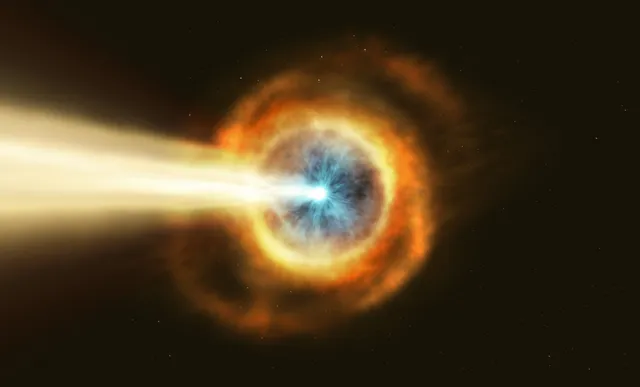
A team led by Yi Wen describes a gamma-ray burst with ambiguous properties that do not cleanly fit any known category. One explanation is that the event was a giant flare from a magnetar — an extreme energy release from a neutron star with an ultra-strong magnetic field.
The problem is that matching the observed parameters would require the flare to be three orders of magnitude — a thousand times — more energetic than any known magnetar giant flare. This either challenges the hypothesis or points to a new, far more energetic subtype of event intermediate between short gamma-ray bursts and classical magnetar flares.
Chandra Catalogs 327 X-ray Sources
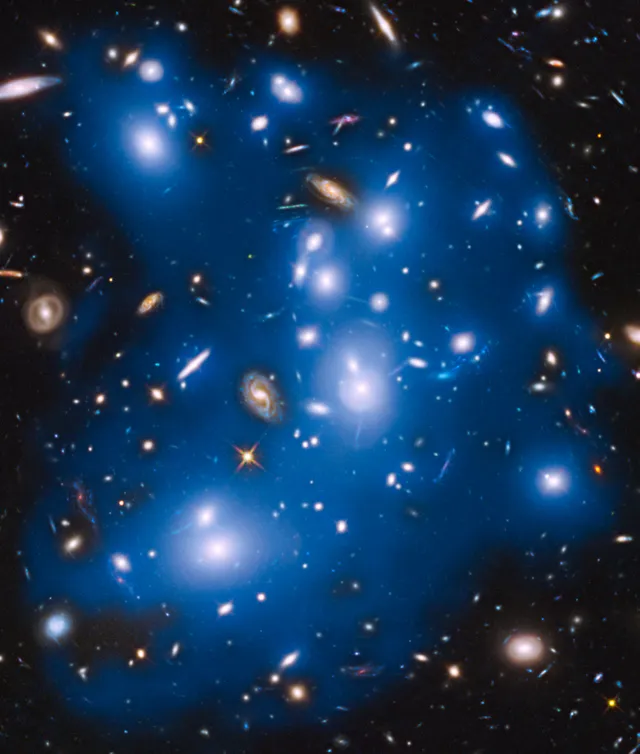
Astronomers have released the first catalog from CLUES, an ultradeep X-ray survey of the Abell 2744 cluster field built from 101 archival Chandra observations totaling 2 million seconds of exposure. It ranks as the third-deepest extragalactic X-ray survey to date, further boosted by gravitational lensing from the massive cluster at redshift 0.3.
Careful image analysis yielded 327 point-like X-ray sources across soft, hard, and full energy bands over 369 square arcminutes. Their number density broadly matches blank-field surveys, though with a slight excess at the brightest fluxes. All data products are publicly released, making the field a valuable resource given its extensive complementary coverage by Hubble and JWST.