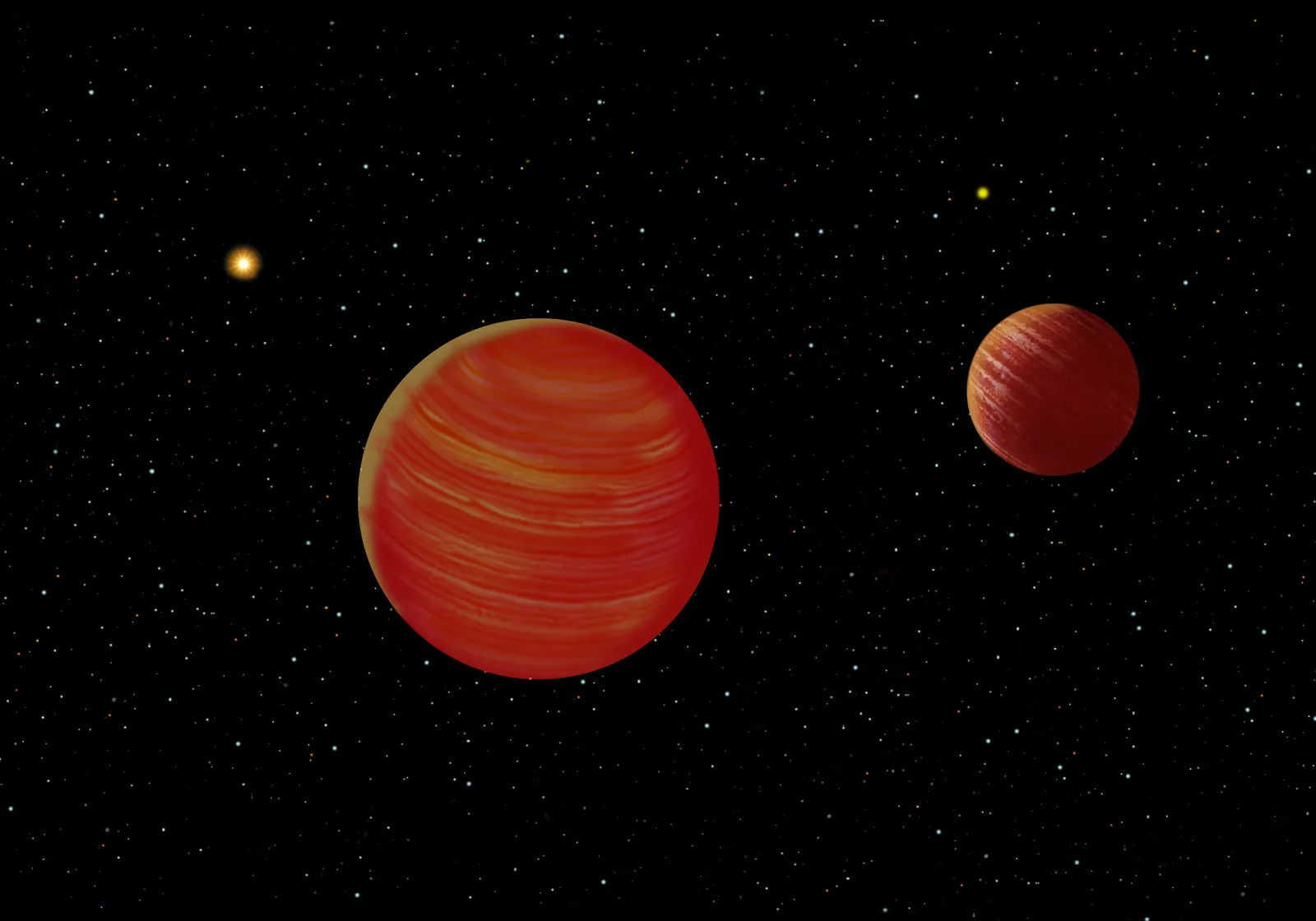
ε Ind Ab is a mature giant exoplanet. It is more massive than Jupiter, which makes it a super-Jupiter. A new study using data from the James Webb Space Telescope finds that its atmosphere contains noticeably more deuterium than Jupiter's. The work is a preprint on arXiv and has not yet been peer reviewed.
Deuterium is a heavy isotope of hydrogen. Its nucleus holds a proton and a neutron, while ordinary hydrogen has only a proton. Astronomers have long used the deuterium-to-hydrogen ratio (D/H) as a clue to the origin and evolution of the Solar System. Now the tool has been applied to a planet around another star.
What was measured
The team detected deuterated methane in the atmosphere of ε Ind Ab. This is methane in which one hydrogen atom is replaced by deuterium. The detection significance is 48σ, a very high level of confidence: the signal is almost certainly not a fluke.
From this signal they measured the D/H ratio, which is (4.4 ± 0.7) × 10⁻⁵. That is close to the values of Uranus and Neptune. But it is about twice those of Jupiter, Saturn and the protosolar nebula (the cloud of gas and dust from which the Solar System formed).
The researchers also estimated the abundance of heavy elements: carbon, oxygen, nitrogen and sulfur. All are enriched uniformly, at a level similar to Jupiter's.
Where the deuterium comes from
The combination of the two results is the key point. The planet has as many heavy elements as Jupiter, yet twice the deuterium. To explain this, the authors argue that ε Ind Ab must have accreted solids with D/H of at least 1%. That is at least 30 times more deuterium-rich than typical Solar System comets.
Such high values are known elsewhere. They are found in the interstellar comet 3I/ATLAS and in organic molecules in star-forming regions. On this basis the authors conclude that the planet gathered pristine solids that formed in a very cold environment.
What's new
Earlier, D/H in giant-planet atmospheres was measured within the Solar System. Jupiter and Saturn have values close to the protosolar one, while Uranus and Neptune are about twice as high. Now the measurement has been made for a mature giant planet around another star. Its result is closer to the ice giants than to the gas giants.
Yet in heavy-element content ε Ind Ab resembles Jupiter. So the familiar link between "many heavy elements" and "much deuterium" does not show up here. Deuterium acts as a separate clue to what the solids swallowed by the planet were made of.
How solid is the result
The detection of deuterated methane itself is very robust, at 48σ. The D/H measurement carries an uncertainty of ±0.7 × 10⁻⁵, about a sixth of the value. That is enough to distinguish the planet from Jupiter and Saturn, but not from Uranus and Neptune.
The conclusion about solids with D/H of at least 1% follows from comparing the measurements with accretion models. It is an interpretation, not a direct observation. It rests on the fact that similar values are seen in 3I/ATLAS and in organic molecules in star-forming regions. The preprint still has to go through peer review.
What's next
If the method works for ε Ind Ab, it can be applied to other mature giants. D/H could then become a way to compare the conditions in which planets formed around different stars. For now it is one planet. But it suggests that the solids from which giants grow can come from much colder places than comets of the Solar System indicate.