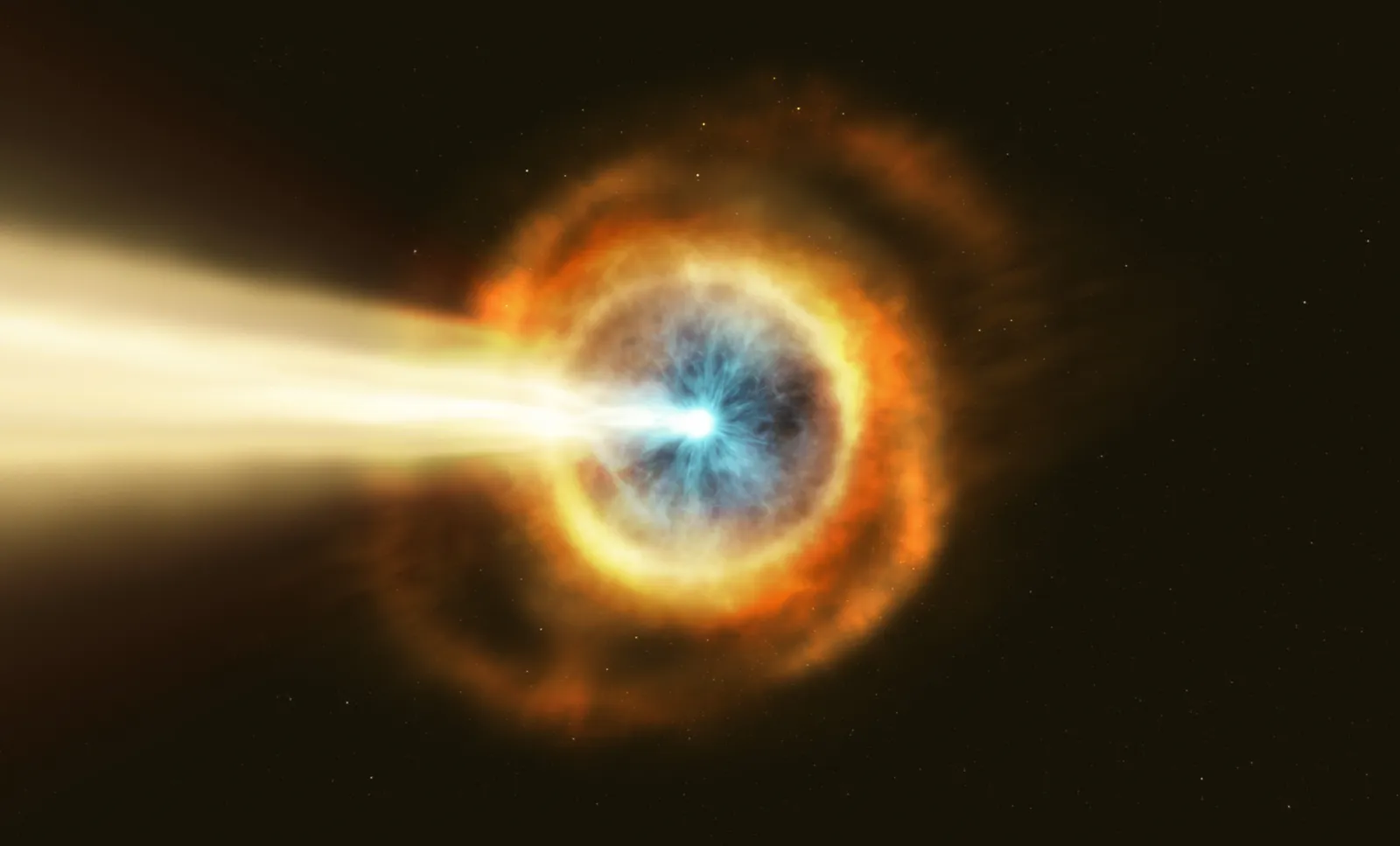
Gamma-ray bursts are among the most energetic flashes in the universe, and for decades astronomers have tried to sort them into clean categories based on their origin. A new event, described in a paper by Yi Wen and colleagues in the Astrophysical Journal Letters, breaks that tidy classification: its properties place it somewhere between two well-established types of sources.
Two populations of bursts
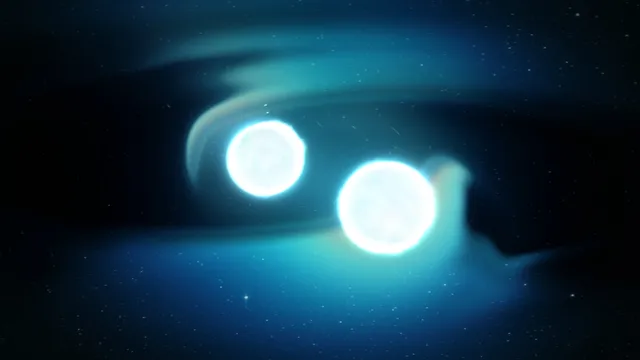
Short gamma-ray bursts (SGRBs) are traditionally linked to the merger of two neutron stars, or a neutron star and a black hole. It's a catastrophic event: two ultra-dense objects spiral together and merge within a fraction of a second, releasing energy on a scale that's hard to grasp. Events like this were famously connected to a gravitational-wave signal from a neutron star merger back in 2017.
The second category is magnetar giant flares. A magnetar is a neutron star with a magnetic field trillions of times stronger than Earth's. Occasionally something like a "starquake" occurs in its crust — a sudden rearrangement of the magnetic field that releases a powerful but brief burst of gamma rays. These flares are also bright, but based on observed statistics, they're usually much less energetic than merger-driven bursts.
Where the line blurs
The event analyzed by Yi Wen and colleagues doesn't fit cleanly into either group. Its duration and light-curve shape look intermediate — something between a typical SGRB and a typical magnetar giant flare.
The real puzzle appears if the magnetar explanation is assumed. In that case, the burst's energy turns out to be enormous: three orders of magnitude, roughly a thousand times, greater than any previously recorded magnetar giant flare. That's an extraordinary gap, one that either casts doubt on the magnetar hypothesis or forces a rethink of just how powerful magnetars can get.
The alternative is to treat it as an ordinary short gamma-ray burst from a compact object merger, just with an unusual signal shape. Both explanations have weak points, which is exactly why the authors describe the event as having "intermediate" properties.
Why it matters
A clean split between gamma-ray burst categories lets astronomers quickly decide how to respond to a new detection: whether to search for a gravitational-wave counterpart, or to expect a possible repeat flare from the same magnetar years or decades later. If the boundary between SGRBs and magnetar giant flares turns out to be blurrier than assumed, that changes how observatories worldwide react to similar signals going forward.
It would also mean rethinking models of neutron star magnetic fields — specifically, what mechanisms, if any, limit how much energy a magnetar can release in a single flare, if it turns out they can produce bursts a thousand times stronger than previously seen.
For now, the researchers stop short of a definitive conclusion about the event's origin. It stands as a reminder of just how diverse — and not always neatly classifiable — the most energetic phenomena in the universe can be.