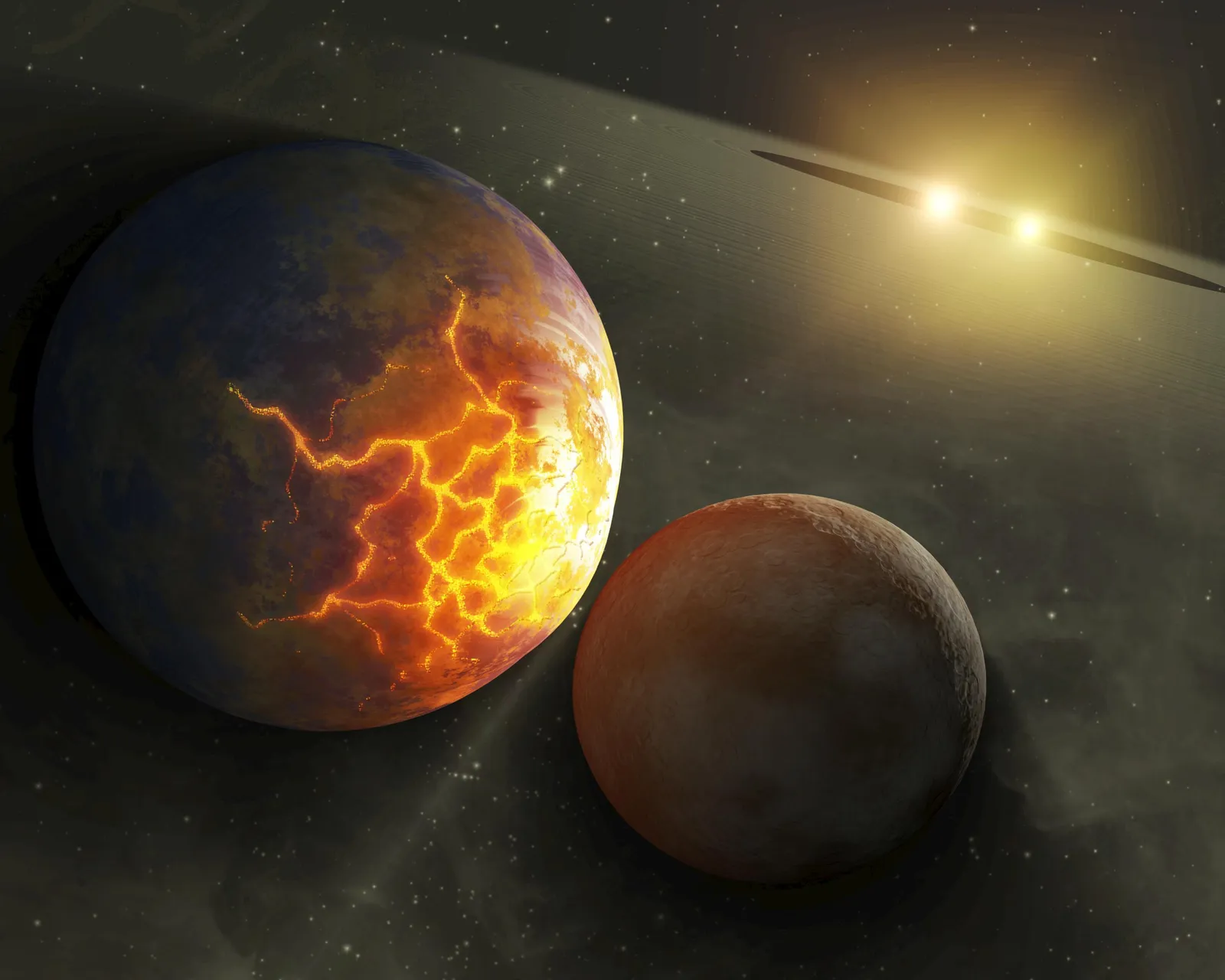
Beneath Africa and beneath the Pacific Ocean, at the boundary between the mantle and the core, almost 2,900 kilometers down, lie two structures unlike the rest of Earth's interior. Each one is the size of a continent. Geophysicists have known about them for forty years, but only recently has an explanation appeared that sounds like science fiction: they may be the remains of another planet.
How to look 2,900 kilometers down
There is only one way to look 2,900 kilometers down: listen to earthquakes. Seismic waves pass through the whole planet, and networks of stations around the world record how long they take. If a wave arrives late, something with different properties lies along its path.
In the 1980s, the first hints of large three-dimensional variations deep inside Earth emerged. Over time the picture sharpened: two giant regions, one under Africa and one under the Pacific, where waves slow down noticeably. They were named large low-velocity provinces. The material in them is denser than the surrounding mantle and richer in iron.
A planet that left no trace
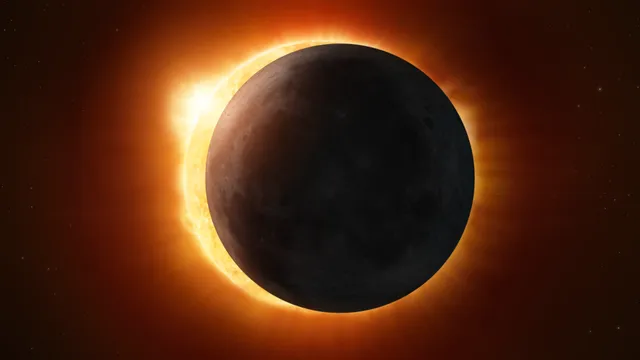
The most widely accepted explanation for the Moon's origin goes like this: about 4.5 billion years ago, a planet roughly the size of Mars slammed into the young Earth. It is called Theia. The Moon formed from the scattered debris.
But the hypothesis came with an awkward question: where is Theia itself? No trace of the impactor had been found on Earth. That is exactly what geophysicist Qian Yuan heard in 2019 at a seminar at Arizona State University. The speaker described the giant impact, Yuan noted that the Moon is relatively rich in iron, and the lecturer added that no trace of the impactor had ever been found. Yuan later recalled having a "eureka moment" right then.
The iron-rich impactor could have transformed into mantle blobsQian Yuan, Caltech
What the models showed
The idea was tested with computer simulations, and in November 2023 it was published in the peer-reviewed journal Nature. The key result came from high-resolution simulations of the impact: most of the energy stayed in the upper half of the mantle. The lower mantle turned out cooler than older, coarser models suggested, and it did not melt completely.
So the blobs of Theia's iron-rich material that ended up deep inside Earth did not mix with the mantle. Being denser, by roughly 2–3.5%, they gradually sank to its base. Caltech compares this to a lava lamp that has been switched off, with lumps of wax resting at the bottom. Had the lower mantle been hotter, the material would have been stirred in, like paints in a pot. By Caltech's estimate, each blob is now roughly twice the size of the Moon.
What is not proven
It is important to separate two things: the blobs under Africa and the Pacific really exist, that is a measurement. That they come from Theia is still only a hypothesis. There are other explanations. One is that they are oceanic crust accumulated over billions of years as it sank into the mantle at subduction zones. Another is that they are remnants of a primordial layer formed while the young Earth's mantle was still solidifying.
The Theia model is also sensitive to its starting assumptions: the density of the material, the size of the fragments, how thoroughly it mixed. And Earth and the Moon are strikingly similar in isotopic composition, which has long complicated simple impact models.
Why it matters
If the hypothesis holds, the material of another planet did not simply vanish but shaped Earth's development from the very beginning. The blobs near the core are linked to mantle plumes, rising currents of hot rock. The authors propose, as a next step, studying how this material may have affected early geology: the formation of the first continents and the onset of plate tectonics.
All of this can only be tested indirectly: with sharper seismic maps of the interior, the geochemistry of rocks that rise from great depths, and new samples from the Moon. For now, it seems a piece of another planet may be closer than any meteorite: right beneath our feet.
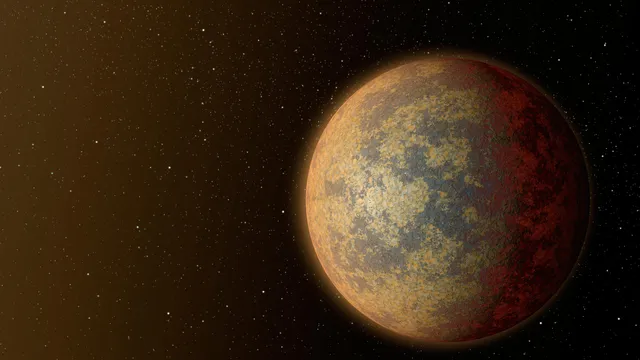
Illustration: NASA/JPL-Caltech.