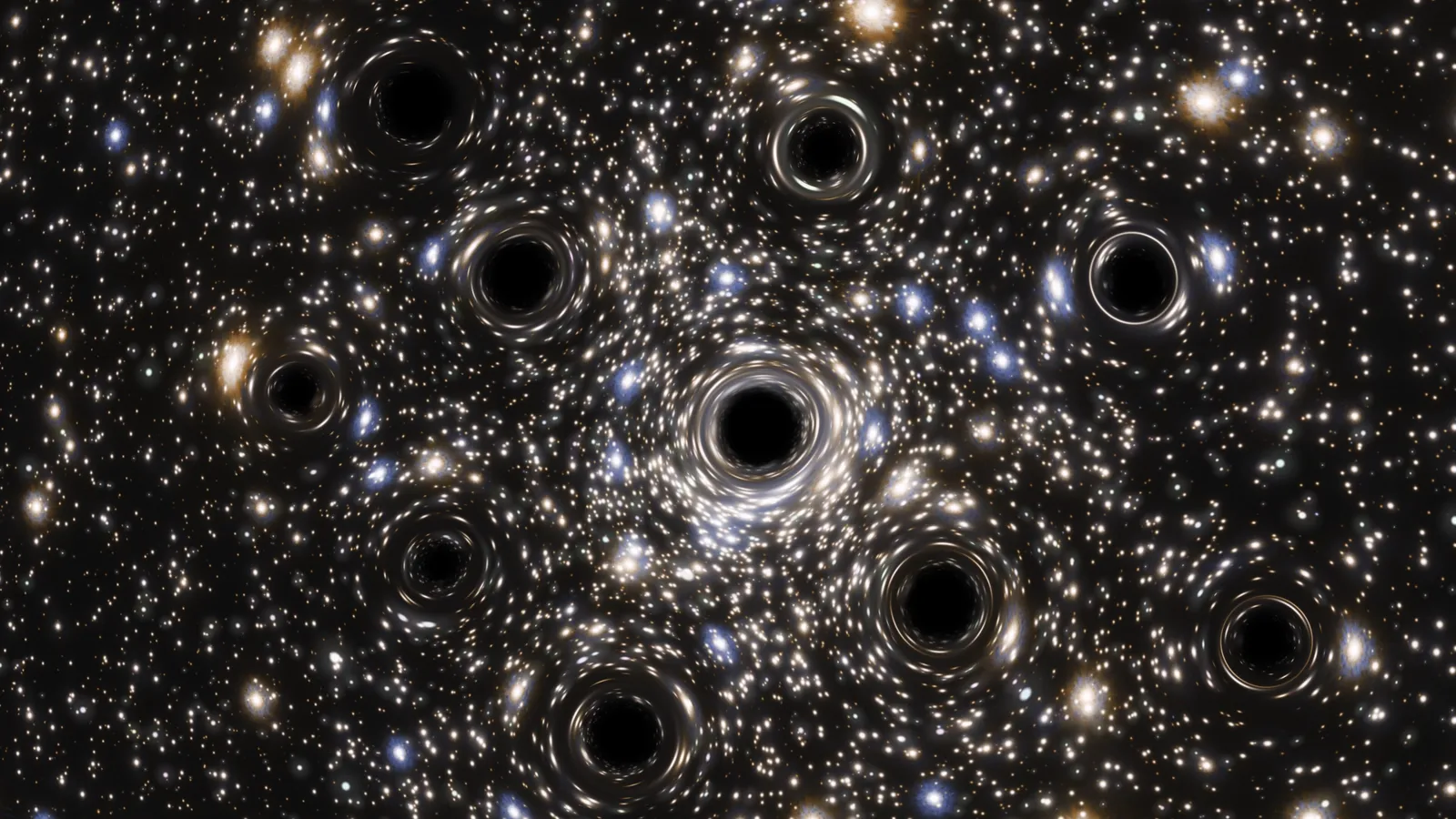
Little Red Dots, compact distant galaxies seen by JWST in the early Universe, may be systems hosting newly formed direct-collapse black holes. In this scenario, a black hole does not begin with the death of a massive star. Instead, it forms through the rapid collapse of a large gas cloud.
The interpretation comes from the preprint “Little Red Dots are Direct-Collapse Black Hole-Forming Galaxies,” posted on arXiv. The study has not yet been peer reviewed, so its conclusion should be treated as a testable model rather than a final identification.
Compact galaxies with difficult spectra
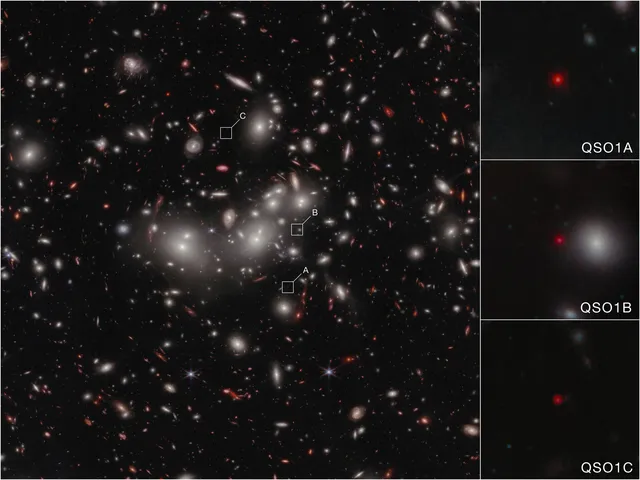
Little Red Dots received their name because they appear as tiny reddish sources in JWST observations. They are only about 326–652 light-years across, an extremely compact scale for galaxies.
Their spectra have been especially difficult to explain. These objects show bright ultraviolet and infrared emission separated by a pronounced dip. Their spectra also contain Balmer absorption features, signs that some of the light has passed through dense hydrogen gas.
Earlier explanations included unusually compact stellar systems, heavily obscured black holes, supermassive stars, and more exotic objects. According to the authors of the new study, those ideas do not always explain the origin of the dense absorbing shell, the detailed spectral shape, the abundance of the objects, and their inferred lifetimes at once.
A gas disk around a young black hole
In the new simulations, a direct-collapse black hole forms inside a massive disk of gas. The disk does not immediately disappear after the black hole forms. Instead, it continues to surround the central object with dense material.
That material shapes the observed light. Gas in the central parts of the disk is dense enough to trap X-rays from the black hole. Some of that energy is absorbed and re-emitted at other wavelengths. At the same time, part of the ultraviolet, visible, and infrared light can escape.
The model also produces a dense stellar cluster beside the black hole. The cluster has a mass of 100 million Suns and a radius of about 490 light-years. This is consistent with the compact sizes measured by JWST for Little Red Dots.
The model matches several kinds of objects
The researchers compared their simulated spectra with observations of several Little Red Dots. They report matches for both typical sources and objects with particularly strong Balmer breaks, sharp changes in brightness near hydrogen spectral features.
The model was also applied to one of the most distant known members of this population, whose light comes from a very early period in cosmic history. That matters because this era may have been when the seeds of later supermassive black holes first appeared.
Why it matters
Black holes with masses of millions or billions of Suns already existed when the Universe was young. How they grew so large so quickly remains a major problem in astrophysics. Direct collapse is one possible route because it can create a more massive initial black hole than ordinary stellar death.
If Little Red Dots are truly galaxies at this stage, JWST may be observing environments where such black holes are being born. The next step will be to test the model against a larger sample of spectra and look for signatures that can distinguish it from competing explanations.