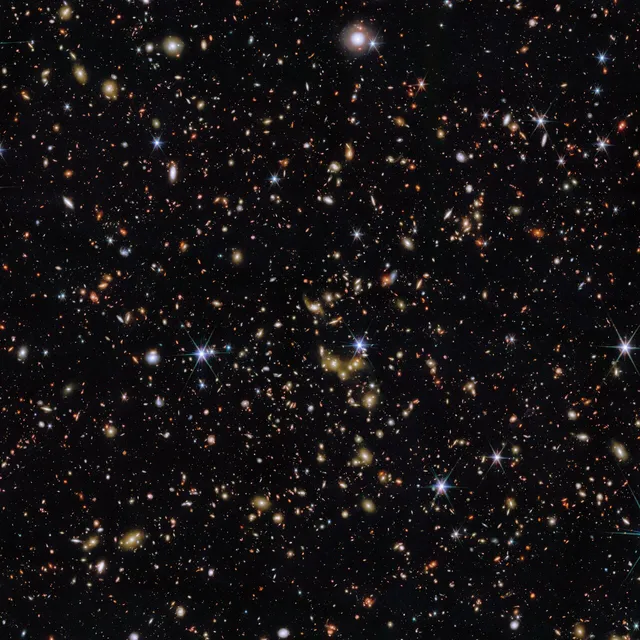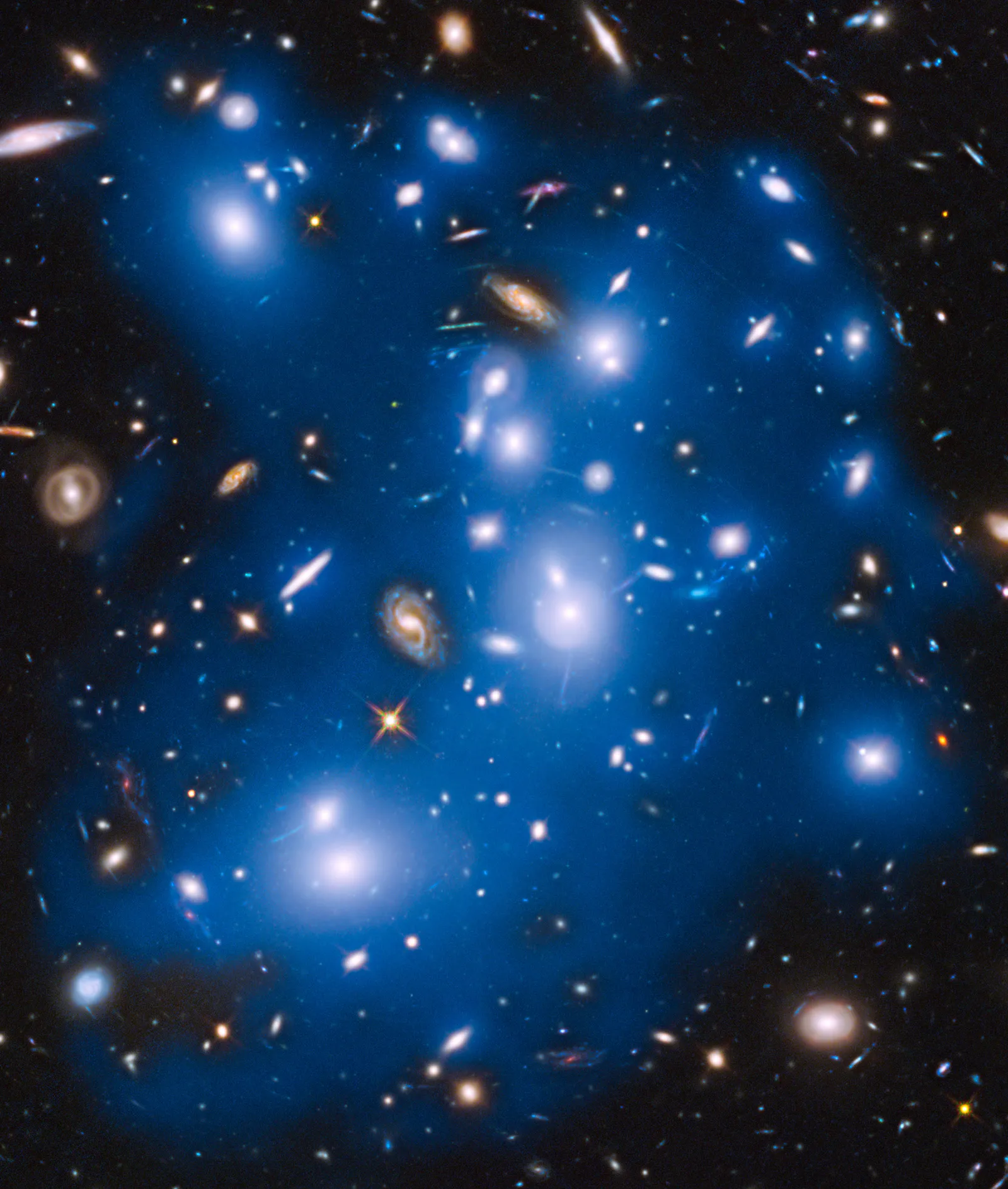
A team of astronomers has released the first catalog from the Chandra Lensing-cluster Ultradeep Extragalactic Survey (CLUES) — an ultradeep X-ray survey of the field around the galaxy cluster Abell 2744. Combining a total exposure of 2 million seconds with the Chandra telescope, the team detected 327 X-ray point sources, most of them distant galaxies hosting active nuclei. The results are described in a preprint posted on arXiv.
What makes this field special is a rare combination of two advantages. First, the depth of the observations rivals the classic Chandra Deep Fields, the deepest X-ray surveys ever conducted. Second, the massive galaxy cluster Abell 2744, at redshift z=0.3, acts as a natural telescope: its gravity bends space and magnifies the light of objects lying behind it. This is strong gravitational lensing — the same effect that has already helped the James Webb Space Telescope spot some of the most distant known galaxies in this very field.
How the data were assembled
The study is based on 101 archival observations with the ACIS-I camera aboard Chandra, taken at different times and combined into a single dataset. The total exposure reached 2 million seconds, covering an area of 369 square arcminutes. Sources were searched for simultaneously in three energy bands: soft (0.5-2 keV), hard (2-7 keV), and full (0.5-7 keV).
The main technical challenge was the bright, structured intracluster medium — hot gas filling the space between the cluster's galaxies — at the center of the field. This gas glows in X-rays and can either hide faint point sources or generate false detections. To address this, the authors fit the shape of each candidate source's image using Chandra's point spread function (how the instrument spreads a point source's light across the detector). This improved source positions and helped filter out artifacts in the crowded central region.
How deep the survey reaches
According to detailed simulations, the survey reaches 50 percent flux completeness at 6.3×10⁻¹⁶ erg/cm²/s in the full band, 2.8×10⁻¹⁶ in the soft band, and 4.9×10⁻¹⁶ in the hard band. These are extraordinarily faint signal levels, near the limits of what modern X-ray astronomy can detect, comparable to the deepest cosmological surveys.
The number of detected sources as a function of brightness broadly agrees with what's seen in ordinary, "blank" patches of sky without massive clusters, with a discrepancy no larger than about a factor of two. The authors note a small excess of sources above a flux of roughly 10⁻¹⁴ erg/cm²/s — among the brightest objects in the catalog — possibly related to the cluster itself or to lensing effects, though they remain cautious about this interpretation.
Why it matters
The significance of this catalog extends beyond pure X-ray statistics. The Abell 2744 field has for years been one of the most intensively studied patches of sky for the Hubble and James Webb telescopes, thanks to gravitational lensing that has revealed some of the earliest and most distant known galaxies there. Now that optical and infrared coverage is joined by an equally deep layer of X-ray observations.
This opens the door to searching for active galactic nuclei among objects that JWST has already classified by shape and spectrum, testing whether early galaxies really do host actively growing supermassive black holes. The faint excess of bright sources found in this study may also hint at differences in source populations within clusters compared to random sky patches, though confirming this will require further spectral analysis and comparisons with other lensing fields.
The authors emphasize that all survey products — the source catalog, X-ray images, exposure maps, background maps, and sensitivity maps — have already been made publicly available, allowing other teams to immediately use this data for their own studies of the distant universe.