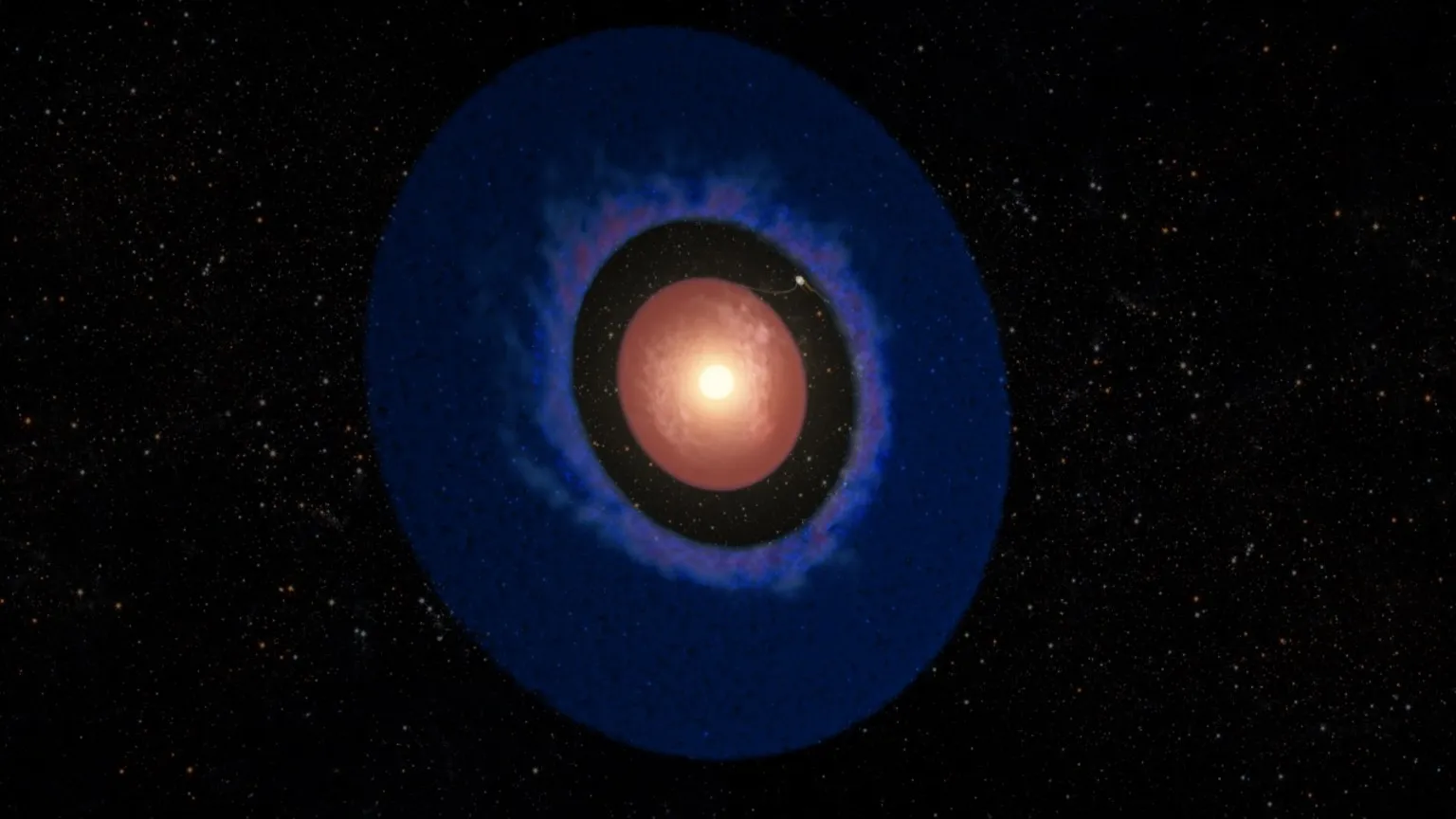
Astronomers have confirmed the youngest known exoplanet, Elias 2-24 b. The planet is less than 1 million years old and is still embedded in the disk of gas and dust from which planets form.
The object has roughly Jupiter’s mass and orbits the young star Elias 2-24, located 450 light-years from Earth. The observations offer a view of a stage in planetary-system evolution that is usually hidden by dense dust.
A planet inside a gap in the disk
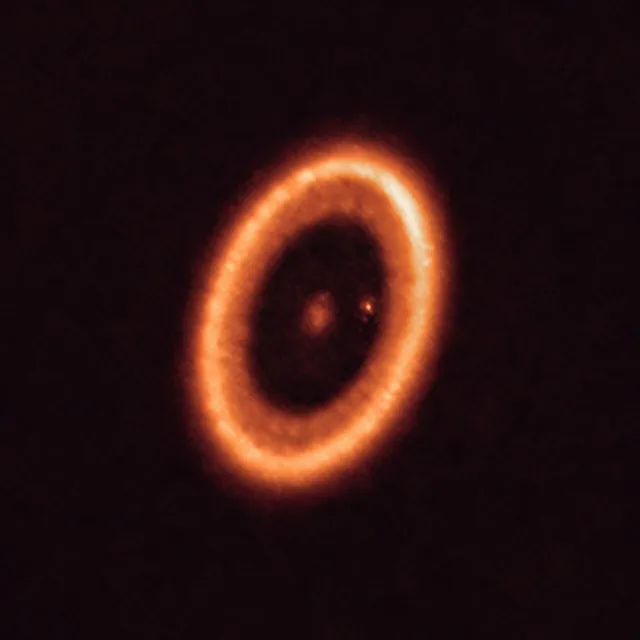
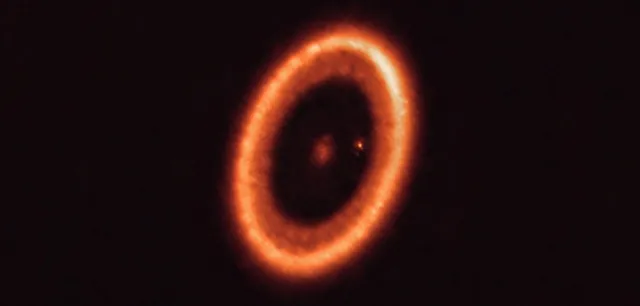
Elias 2-24 b lies inside a prominent gap in a protoplanetary disk, a flat structure of gas, dust, ice, and rocky material surrounding a young star. Planets gradually form from this leftover material.
Earlier observations with ALMA in Chile showed a dust-depleted gap in the disk around Elias 2-24. The European Southern Observatory’s Very Large Telescope later detected a faint point of light in the same location. It could have been a planet, but a single observation could not rule out a background star or an imaging feature.
A new study led by doctoral candidate Andrea Bernardi of Universidad Diego Portales used archival data from the W. M. Keck Observatory in Hawaii. The team identified the same object in images taken in 2018 and 2020 and tracked its motion over time.
The observations used a coronagraph, an instrument that blocks the bright light of a star. This makes it possible to see much fainter nearby objects, including planets embedded in dusty disks. The source moved in a way consistent with an orbit around Elias 2-24, providing the key confirmation that it is a planet.
A distance that models did not expect
The planet is located at a distance from its star about 55 times greater than the Earth-Sun distance. That is much farther out than Jupiter’s orbit, which is a little more than five times farther from the Sun than Earth is.
This creates a challenge for current models. They predict that a Jupiter-sized gas giant should take about 5 million years to form at a Jupiter-like distance from its star. At even greater distances, the process should take longer.
Yet Elias 2-24 b already has a mass comparable to Jupiter’s even though its system is less than 1 million years old. Before this discovery, the youngest confirmed planets were four objects around the stars PDS 70 and WISPIT 2, all older than 5 million years.
Our planet-formation models already struggled to explain the previous record holders for the youngest known planet. Elias 2-24 b shows us that even our best planet-formation models are still missing some important processes.Lucas Cieza, Instituto de Estudios Astrofísicos in Chile
Why it matters
Most of the roughly 6,000 confirmed exoplanets have been found through transits, the brief dimming of starlight when a planet crosses in front of its star. This method is especially effective for planets in close orbits.
Young planets far from their stars are much harder to study. Dust obscures them, while their long orbital periods make repeated observations more difficult. As a result, astronomers have far fewer direct observations of early planet formation than they do of mature planetary systems billions of years old.
Elias 2-24 b is not a direct counterpart of the early Earth. Instead, it provides a rare test of how quickly gas giants can form in the outer parts of young planetary systems. Such discoveries can help refine models of material accretion and the formation of gaps in protoplanetary disks.
What comes next
The study was published in The Astrophysical Journal Letters. It also demonstrates the value of astronomical archives: the confirmation depended on combining results from ALMA, the Very Large Telescope, and Keck Observatory.
Future searches for similar planets may become easier with NASA’s Nancy Grace Roman Space Telescope and its more powerful coronagraph. Such an instrument could help detect faint planets on smaller orbits, where direct observations are strongly limited by the glare of their host stars.