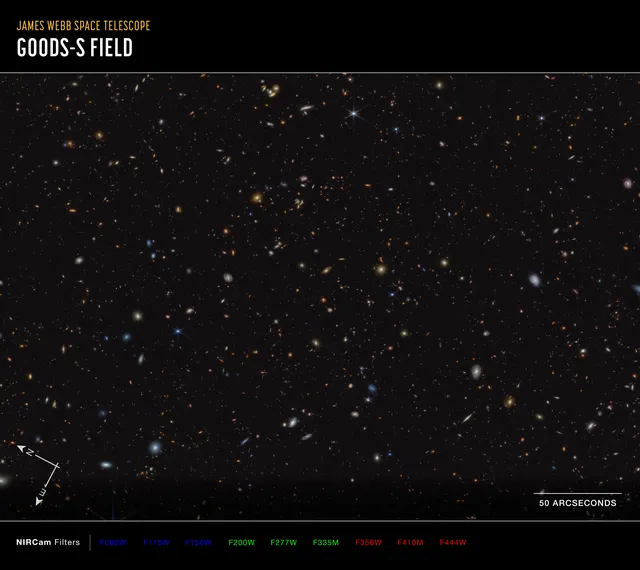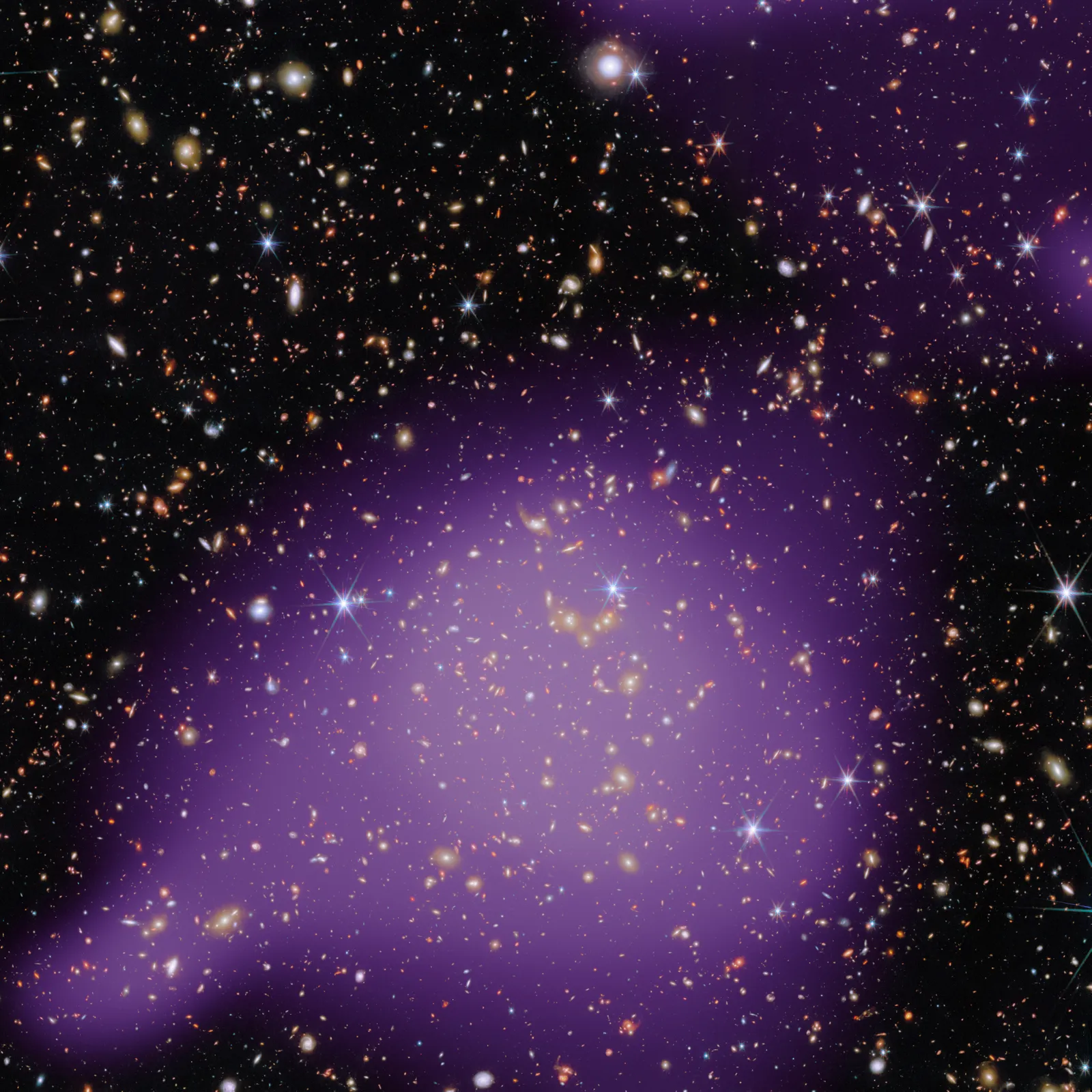
Images from JWST of the earliest galaxies in the universe revealed something unexpected: instead of smooth spiral or elliptical shapes, these objects look like strings of beads made of dense stellar clumps. The sizes and masses of these clumps vary by hundreds of times — from concentrations the scale of a dwarf galaxy to structures comparable to a massive globular star cluster. A new study, released as a preprint on arXiv, offers the first analytical framework explaining why these clumps appear at all, what masses they take on, and why some are visible while others are not.
Where the clumps come from
The authors build on the classical Toomre instability — a physical criterion describing when a galactic gas disk stops being stable against its own gravity and starts fragmenting into separate clumps. This is not a new idea; the mechanism has been known for decades and is used to explain star formation in disks of present-day galaxies. What is new here is that the researchers integrated the full dispersion relation of the instability over the entire unstable branch, rather than limiting themselves to the typical scale of the fastest-growing mode. The result is not a single characteristic mass but a complete intrinsic mass spectrum of clumps — a distribution that arises before any additional dynamical or radiative processes come into play.
This spectrum spans almost two orders of magnitude in mass — roughly 300 thousand to 20 million solar masses. The authors also derived analytical relations between clump mass and size, and between surface density and size. The clumps observed by JWST are naturally reproduced by the model when the turbulent gas velocities in the disks are 10-80 km/s, a figure consistent with what is known about gas turbulence in early galaxies. The exact position of a clump on the mass-size diagram is set by the compactness of the parent disk itself: denser disks produce different clumps than more diffuse ones.
What reshapes the initial spectrum
The intrinsic mass spectrum derived from the Toomre instability is only the starting point. The actual clumps seen by JWST undergo further evolution. The key process here is gas dynamical friction: a massive clump moving through the surrounding disk gas loses orbital energy and migrates toward the galactic center over a timescale inversely proportional to its mass. This means the heaviest clumps get removed from the spectrum faster than lighter ones, and this effect suppresses the high-mass tail of the distribution. As a result, the theoretical model reproduces the observed slope of the clump mass function, dN/dM ∝ M^(-1.89) — a value previously measured observationally but not derived analytically from first principles.
A separate part of the work addresses the question of clump visibility. Once a stellar clump has formed, it is still surrounded by the dense natal gas out of which the stars formed, and this gas absorbs much of the emitted light. The authors tested two possible clearing mechanisms: supernova explosions and radiation pressure. It turned out that supernova energy is insufficient to disperse such dense gas. Radiation pressure, however, works reliably: in clumps with little dust, Lyman-alpha photon trapping dominates, while as a clump becomes enriched with dust, infrared radiation trapping takes over.
Why it matters
Before this work, JWST observations recorded the clumpy structure of early galaxies as an empirical fact, while individual numerical simulations reproduced similar structures in specific cases without offering a general analytical explanation. The framework presented here for the first time combines three different stages into one consistent picture: the physical origin of clumps from disk instability, their subsequent dynamical evolution due to friction against the surrounding gas, and finally the conditions under which a clump becomes visible to a telescope. This gives researchers a compact analytical tool to quickly test new observations from JWST and future missions without resorting each time to expensive hydrodynamic simulations. At the same time, the authors note that the model matches the observed mass scales and mass-function slope for a reasonable choice of turbulence parameters, so further observations and comparisons with numerical simulations remain necessary to test the limits of its applicability.