Rubin Spots Dwarf Planet Candidate Beyond Pluto
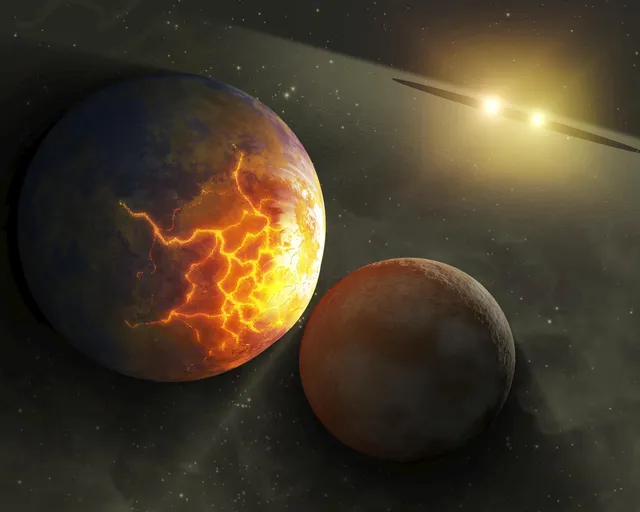
During the run-up to the LSST survey, Rubin Observatory spotted the trans-Neptunian object 2026 ED138. It was found by Matthew Holman of the Center for Astrophysics | Harvard & Smithsonian, who on 13 October ran 2026 data through a search code for moving objects. The object's brightness and distance pointed to an unusually large body.
Rubin observed ED138 30 times over 20 nights between 4 March and 11 July. Archival DECam images reach back to 2016, so its orbit has been traced across more than 10 years. The object now lies about 46 au from the Sun. The Minor Planet Center announced the find, and if confirmed, ED138 would be among the largest dwarf planets discovered in this region.
Lensed Supernova Ares Will Return in 70 Years
Astronomers discovered supernova Ares at redshift 1.276 in a massive galaxy that the MACS J0308.9+2645 cluster lenses into three images. JWST/NIRSpec spectra show helium lines along with hydrogen (Hα) and Paβ. Comparison with local core-collapse supernovae classifies Ares as Type IIb, the most distant of its class identified spectroscopically.
The spectrum corresponds to roughly 34 days after peak brightness. A cluster lens model built from JWST data shows we are seeing the first of three images. The other two should appear near the cluster center in 70 years or more, magnified about 5 and 1.5 times. Planned JWST spectroscopy will tighten the time delay and magnifications and provide a template spectrum at the supernova's location.
Stripped Star With Likely Neutron Star Companion
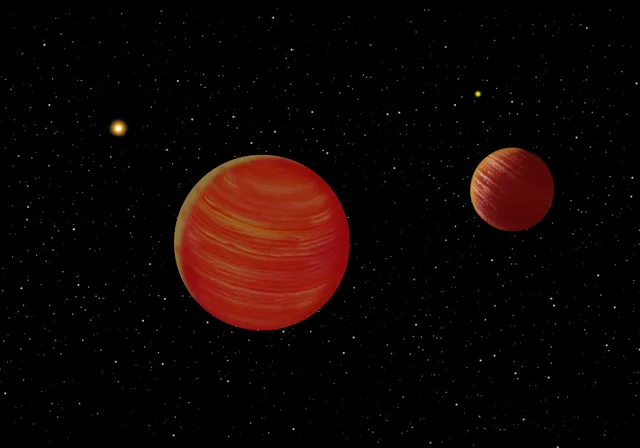
The system SMASH J004005−733351 in the Small Magellanic Cloud was found in a new color-based survey for stripped stars and confirmed with spectroscopy. It is a helium star of about 3.84 solar masses orbiting an unseen companion with a period of 19.95 hours, and a radial-velocity semi-amplitude of roughly 92 km/s.
The orbital solution implies a companion mass of at least 1.2 solar masses. The lack of brightness variations from irradiation rules out a main-sequence star, so the companion is most likely a neutron star. After core helium runs out, the stripped star should refill its Roche lobe, probably producing a supernova and, if the system survives, a double neutron star binary. The system is a new benchmark for these late stages of binary evolution.
Star Formation Found Next to Nearly Pristine Gas
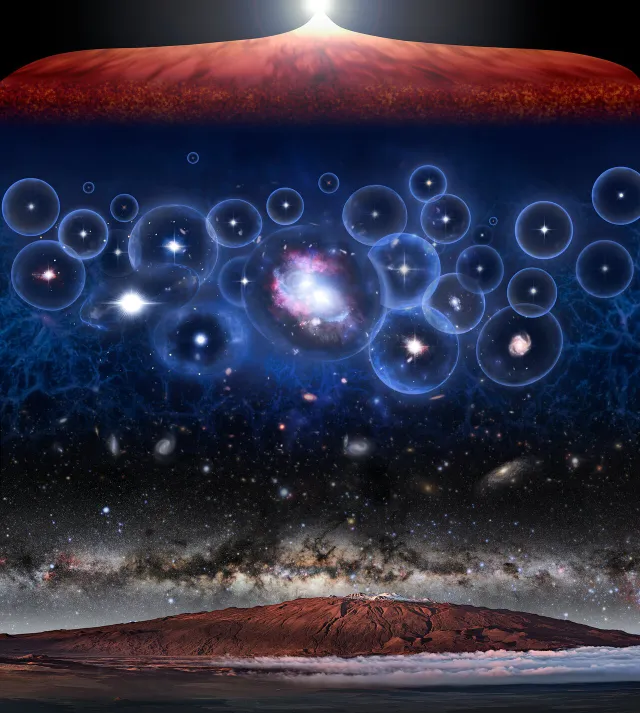
Using the KCWI spectrograph on the Keck telescope, astronomers found two high-confidence star-forming sources near a chemically near-pristine damped Lyα system (DLA) at redshift 3.078, whose iron abundance is below −3.66 on the [Fe/H] scale. The sources, seen in Lyα emission, lie at impact parameters of 66 and 137 kiloparsecs from the gas cloud.
This is the first detection of star formation around such a nearly pristine DLA. The weak, narrow Lyα lines and the galaxies' position on the mass–metallicity relation suggest very few metals, and He II 1640 Å emission was not detected. Future rest-frame optical observations should pin down their metallicity and test whether such DLAs can signpost primitive galaxies 2 billion years after the Big Bang.
VLT Finds Double Debris Disc Around Dead Star
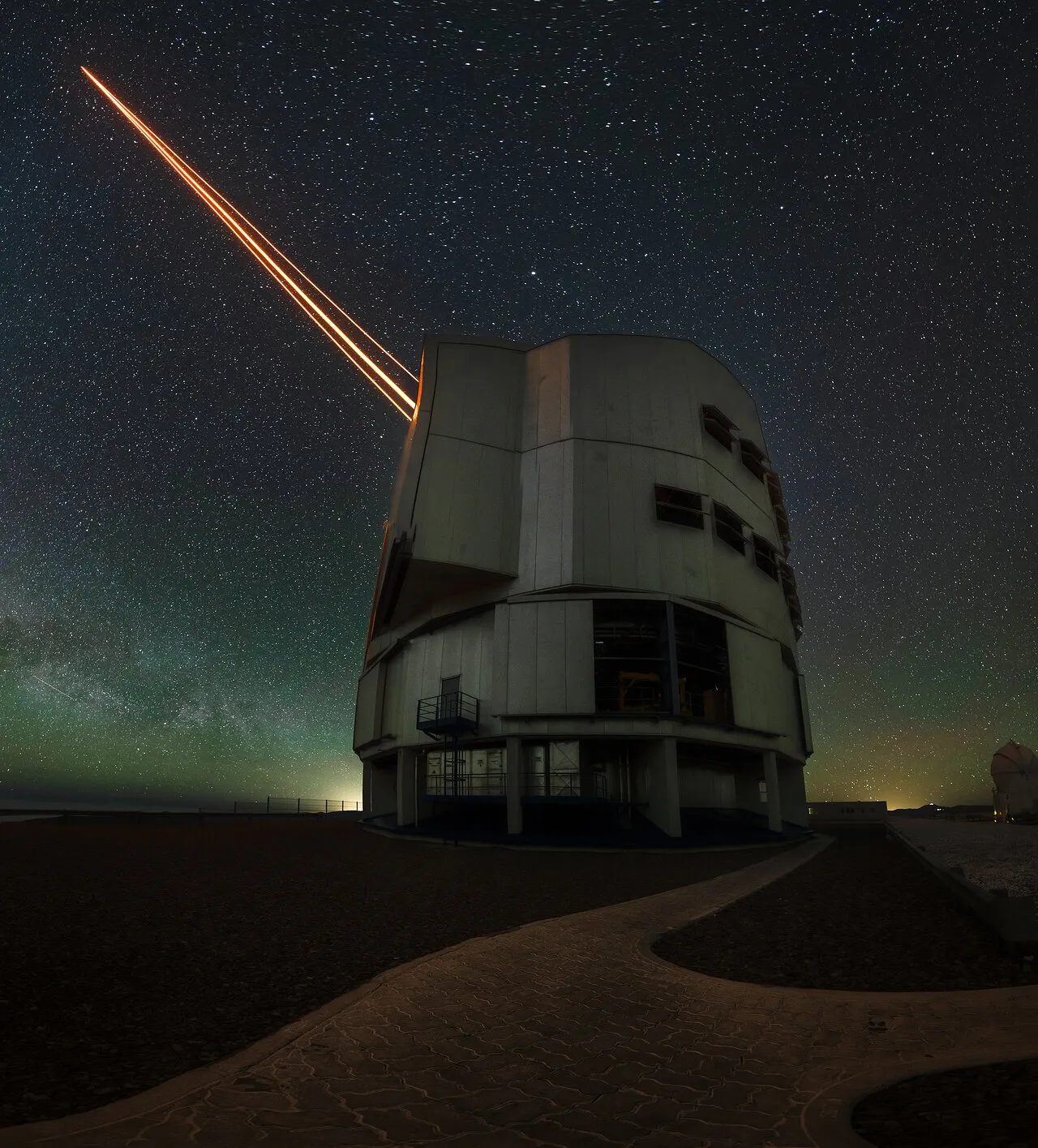
Astronomers using the European Southern Observatory's Very Large Telescope have found a rare disc of debris around a dead star. The debris is what remains of planets that once orbited it. Unlike in similar systems found before, the material here is organised into two discs separated by a clear gap.
The structure appears to be shaped by two planetary bodies, one possibly as big as Pluto. The gap between the two parts of the disc points to their gravitational influence, and both bodies have survived the violent death of their star. The system offers a glimpse of what may eventually happen to our own Solar System, and helps show what becomes of planets after their star dies.