Vera C. Rubin Observatory in Chile has not yet finished its first year of work, but it has already found a dwarf planet candidate in our Solar System. The object carries the provisional designation 2026 ED138, or ED138 for short. It orbits the Sun beyond Pluto and, by preliminary estimates, may be among the largest and brightest bodies found in that region.
The International Astronomical Union's Minor Planet Center announced the discovery. Mario Jurić, Rubin's Solar System Lead Scientist, and Matthew Holman presented the results at a press conference at the 58th annual meeting of the Division for Planetary Sciences in Spokane, Washington.
How ED138 was found in the data
Holman is a member of the Rubin team and works on improving the algorithms that search for distant moving objects. With his colleague Kevin Napier, he developed a code that looks through billions of detections, compares them, and finds those that belong to the same object.
On the evening of 13 October, Holman ran data collected by Rubin earlier in 2026 through this code. That is how he came across ED138, and he immediately noticed that its brightness and distance pointed to an unusually large object.
My first reaction was one of excited disbelief. Objects like this are very rare, so I immediately started checking whether I or the code had done something wrong.Matthew Holman, Center for Astrophysics | Harvard & Smithsonian
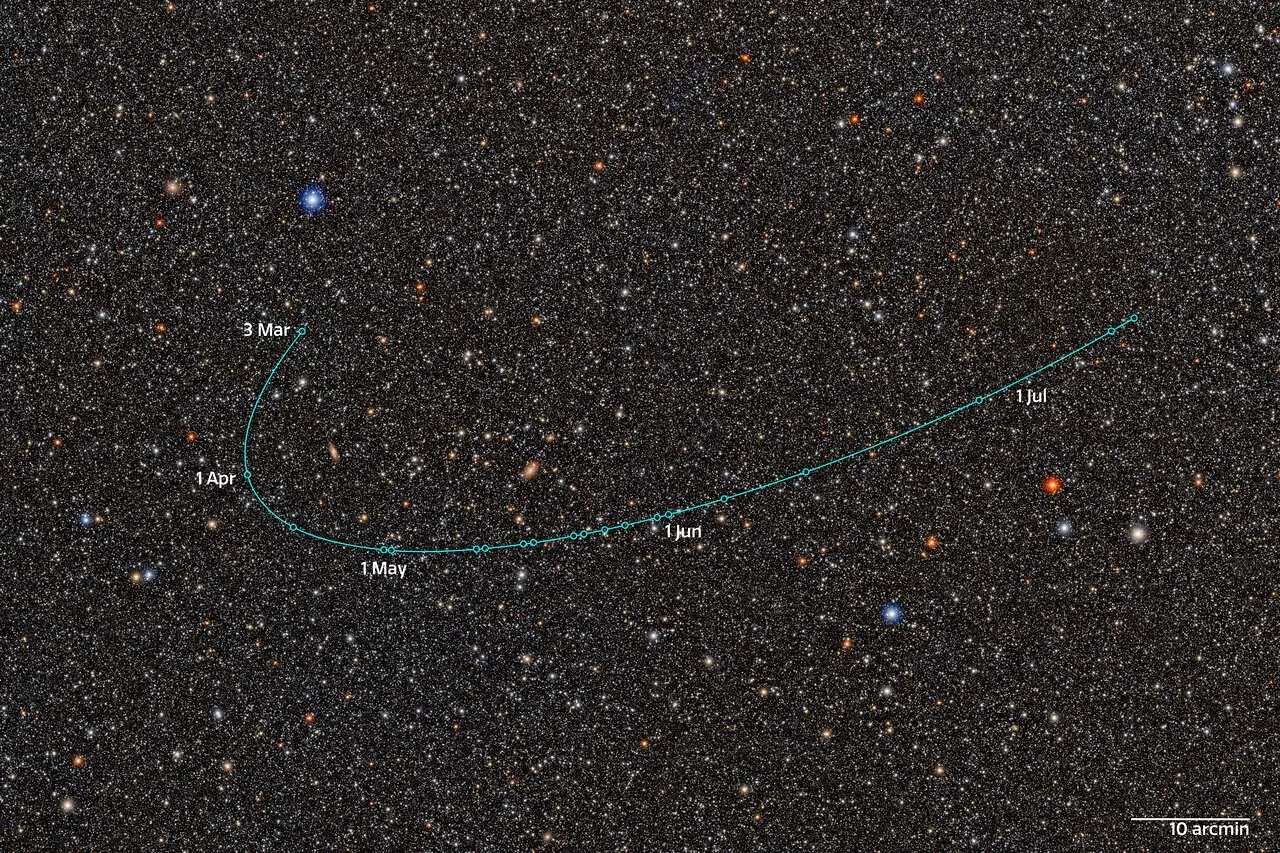
To remove any doubt, the team searched for more observations. Jurić found 20 more in Rubin's catalogs and images, the earliest from 4 March 2026. In all, Rubin recorded ED138 30 times on 20 nights between 4 March and 11 July.
Archival images from the Dark Energy Camera (DECam) reach further back. They were found by the Asteroid Institute's ADAM Precovery service. The camera is mounted on the 4-meter Victor M. Blanco Telescope at Cerro Tololo Inter-American Observatory. These data go back to 2016 and allowed the team to trace more than ten years of ED138's orbit.
What is known about its orbit and size
ED138 is currently about 46 astronomical units from the Sun. One unit is the average Earth–Sun distance, roughly 150 million km. That puts ED138 about 6.9 billion km away, and light takes more than six hours to travel from it. Pluto's average distance is 40 au. The object is a trans-Neptunian object, meaning it orbits the Sun beyond Neptune.
Its orbit is tilted almost 25° from the plane of the Solar System. This classifies ED138 as a "hot-classical" trans-Neptunian object. Such a tilt suggests that Neptune's gravity may have pushed it off its original orbit.
The size was estimated from distance, brightness and an assumed surface reflectivity (albedo). The result is a range of 600 to 1,500 kilometers. For comparison, the Moon is about 3,470 km across, so ED138 would be 17 to 43% of its width.
How solid is the result
ED138 is so far only a candidate. A dwarf planet must be massive enough for its own gravity to pull it into a round shape. Icy bodies of this size are expected to be round, but its shape has not been measured. The size range is wide, and it can be narrowed only with infrared observations.
Now that Rubin has identified the object, researchers around the world can plan such observations. The images are available to Rubin data rights holders on the observatory's science platform. Anyone can view the orbit in the interactive 3D app Orbitviewer.
If confirmed, ED138 would join the five dwarf planets recognized by the International Astronomical Union: Pluto, Ceres, Eris, Haumea and Makemake.
Why it matters
ED138 was found in a region of sky close to the plane of the Milky Way. It holds millions of stars, and a faint moving object is easily lost against them. This is likely why it went unnoticed until now. Rubin monitors the whole Southern Hemisphere sky regularly and continuously, and its algorithms pick out moving points among billions of points of light. That made it possible to isolate the object in a crowded field.
There is also the "precovery" effect. Once a new object is found, archival images from months or even years earlier can be searched to find it where nobody knew to look. This lets orbits be determined faster and more accurately.
Studying the sizes, composition and orbits of trans-Neptunian objects helps explain how the Solar System formed, how the giant planets migrated, and how smaller bodies were scattered.
ED138 is not Rubin's first find in this region. In April, before the ten-year LSST survey formally began in June 2026, the team submitted observations of more than 11,000 new asteroids to the Minor Planet Center, including roughly 380 new trans-Neptunian objects. The team then called it "the tip of the iceberg."
Holman believes ED138 may not be the only such body. Rubin will image the whole southern sky again and again for ten years, so any other similar worlds hiding in places earlier surveys skipped are now within reach.