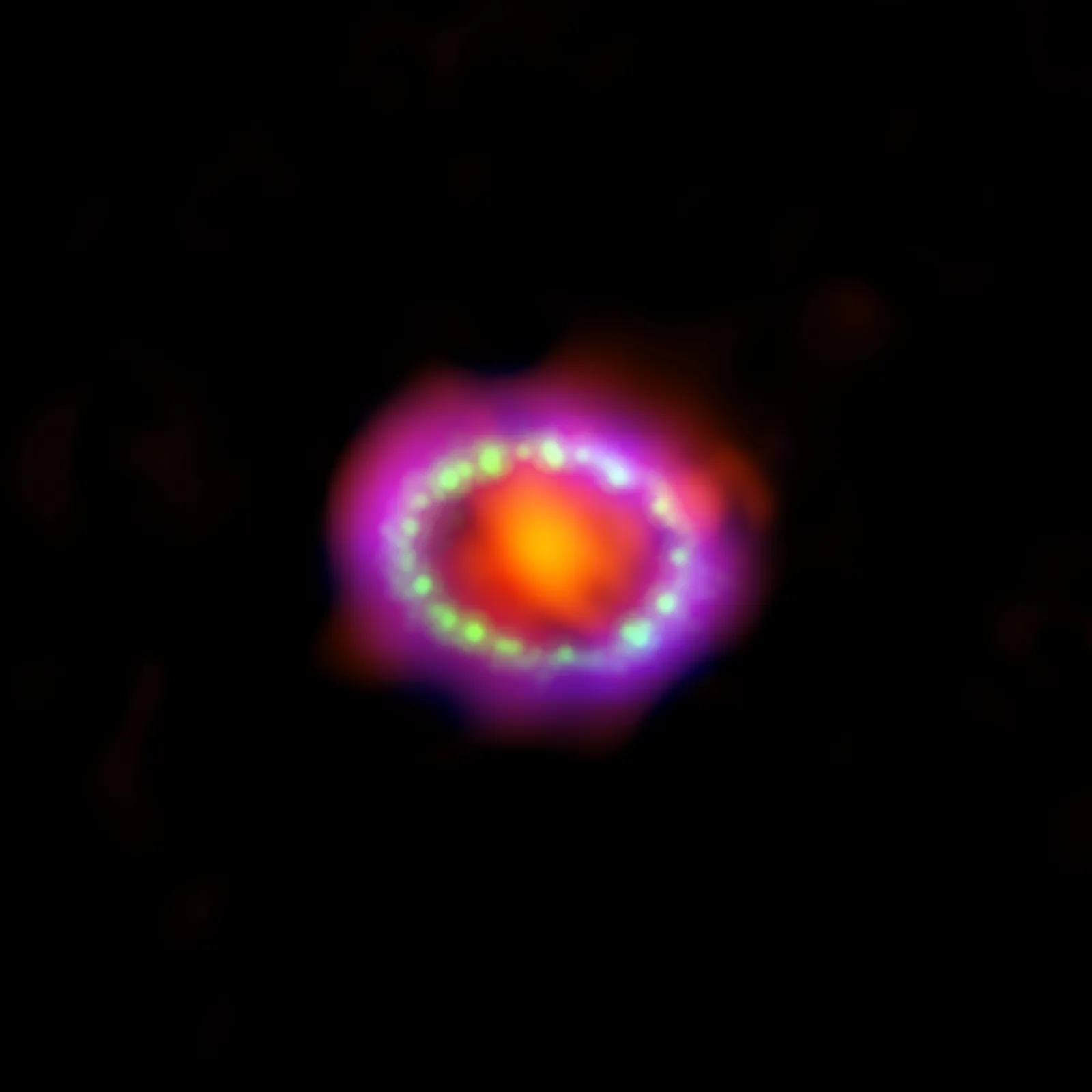
Supernova Ares, at redshift z = 1.276, is one of the most distant explosions studied in detail. Its light passed through a gravitational lens formed by a galaxy cluster and was split into several images. The first image has already been recorded. The rest will arrive after a long delay.
The discovery is described in a preprint on arXiv, which has not yet been peer reviewed. The data come from the NIRSpec spectrograph on the James Webb Space Telescope.
What was found
The supernova exploded in a massive galaxy behind the cluster MACS J0308.9+2645. This galaxy appears in three images. Its spectroscopic redshift is 1.276 ± 0.002. Redshift measures how much light has been stretched by the expansion of the Universe, and serves as a measure of distance.
The NIRSpec spectrum covers the optical and near-infrared range in the supernova's own rest frame. It shows helium lines at 5876, 7065 and 10830 angstroms. Hydrogen (Hα) and Pa-beta lines are also present.
The researchers compared the spectra and light curves (graphs of brightness over time) with local core-collapse supernovae. The result is Type IIb. This is the most distant supernova of this type identified spectroscopically.
Which stage of the explosion we see
A comparison with the light curves of nearby Type IIb supernovae gives a spectrum phase of 34 days after the radioactive peak. The uncertainty is from −9 to +10 days, and all figures are in the supernova's rest frame. The radioactive peak is the brightness maximum powered by the decay of radioactive elements.
This is the late photospheric stage. It offers a rare view of a stripped-envelope supernova at such a distance.
How the lens stretches time
A massive cluster bends space and changes the direction of light rays. Rays taking different paths travel different distances and feel the cluster's gravity differently. So the same event appears several times, but at different moments.
A cluster model built from new JWST data shows that Ares is seen in the first image, which arrives before the others. Two more images will appear near the cluster center. That will happen no sooner than in 70 years. The predicted magnification is about 5 times for one image and about 1.5 times for the other.
What's new
Few lensed supernovae are known, and even fewer have been classified spectroscopically. Two rare facts come together here. This is a record-distance Type IIb supernova, and the system has a reappearance predicted decades ahead.
A 70-year delay is very long. Most of those who saw the first image will not see the repeat. But it can be predicted in advance, which is valuable for testing cluster models.
How solid is the result
The classification rests on comparison with local supernovae. The phase is estimated with a noticeable uncertainty (−9 to +10 days). The delay forecast is given as "≳70 years", that is, a lower bound rather than an exact date. The magnifications are also approximate.
What's next
Observations of the cluster in NIRSpec's multi-object mode (Multi-Object Spectroscopy) are planned. They should allow more detailed modeling of the lensed system and tighter constraints on the time delay and magnifications. They will also provide a template spectrum at the location of Ares. Such a template is needed to separate the supernova's light from that of its host galaxy.