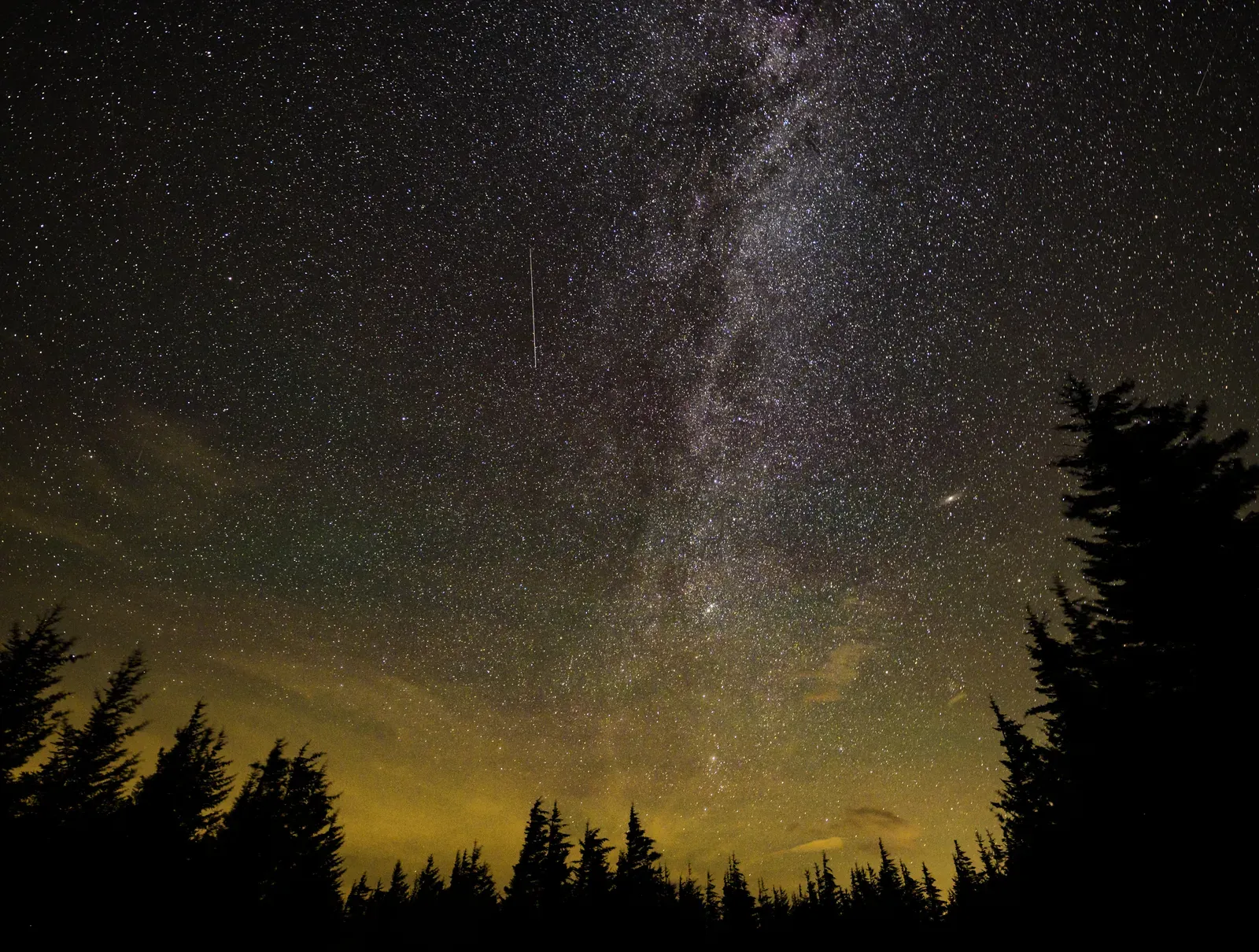
November 2026 is rich in morning sights. The Moon meets Jupiter and Venus, Jupiter closes in on Mars, and Mercury moves far enough from the Sun in the sky to be spotted. The highlight of the month is the peak of the Leonid meteor shower on the night of November 16–17.
Almost everything can be seen without instruments; binoculars are needed only for Uranus. The events below are in chronological order.
November 3: the Moon meets Jupiter
On the night of November 2–3, the Moon passes very close to Jupiter, making a bright pair in the night sky. Both rise around 23:40, so the best time to watch is from midnight until dawn. Look first in the east, and toward morning high in the southeast. Your eyes are enough.
The occultation itself, when the Moon completely covers the planet, is visible only from Asia and Australia. From Ukraine it is a striking close approach. In reality hundreds of millions of kilometres separate the Moon and Jupiter, and we see them together only because they lie in the same direction.
November 7: the crescent Moon meets Venus
A thin crescent Moon lines up with brilliant Venus in the morning sky, one of the most photogenic pairs of the autumn. Look on November 7 between 06:00 and 07:00, before sunrise, low in the southeast. The naked eye is enough.
The occultation of Venus is not visible from Ukraine. Venus is the brightest planet in our sky because its dense clouds reflect most of the sunlight that reaches it. Beside a thin crescent it looks especially striking.
November 12: Northern Taurids peak
The Northern Taurids peak on the night of November 11–12. It is not a rich shower, but it is famous for slow fireballs, exceptionally bright meteors. It is active from October through December.
You can watch all night after the Moon sets at about 17:40. The young Moon will not interfere, and the best time is after midnight, when the radiant in Taurus stands high in the south. The radiant is the point in the sky from which the meteors appear to fly out, an effect of perspective, like railway tracks converging at the horizon. Meteor showers occur when Earth passes through a cloud of dust and debris left by a comet or asteroid. The particles burn up in the atmosphere, and we see a bright streak. Your eyes are all you need.
November 16: Jupiter and Mars in conjunction
Jupiter and Mars come very close together in the morning sky on November 15–16. Look between 04:00 and 06:30, before sunrise, high in the southeast at about 50° above the horizon, in Leo.
It is a contrasting pair: dazzling white Jupiter beside reddish Mars. Both planets are visible to the naked eye. Astronomers call it a conjunction when two bodies pass close together in the sky. In reality the planets are hundreds of millions of kilometres apart.
November 17: Leonids peak
The night of November 16–17 is the main event of the month. The Leonids peak, with fast, bright meteors from Comet Tempel–Tuttle. Conditions are favourable this year, because the first-quarter Moon sets at 23:20, before the best pre-dawn hours.
Watch from moonset until dawn, with the best time between 03:00 and 06:00. The radiant is in Leo, in the east, but meteors appear all over the sky, so look high up. Your eyes are enough. Comet Tempel–Tuttle leaves a trail of dust along its orbit, and every November Earth passes through it. The grains hit the atmosphere at high speed, which is why the Leonids are so fast.
November 21: Mercury at greatest western elongation
On November 21, Mercury reaches its greatest western elongation. This is the best chance to catch the elusive planet, because it is at its greatest apparent distance from the Sun. Look between 06:15 and 07:00, in the twilight before dawn, low above the southeastern horizon.
Mercury orbits closer to the Sun than Earth does, so it always stays near it in the sky. Elongation is the planet's angular distance from the Sun. Western means the planet rises before the Sun and is seen in the morning. The naked eye is enough, but you need a clear horizon.
November 25: Uranus at opposition
On November 25, Uranus is at opposition: it sits opposite the Sun and is at its brightest of the year. The best time to look is around 23:00, when it is highest, in the south at about 59° above the horizon, in Taurus.
Under a truly dark sky Uranus hovers at the edge of naked-eye visibility, while binoculars find it easily. Opposition means Earth lies between the Sun and the planet. The planet is then visible all night, fully lit and at its closest to us.
November 27: Venus at greatest brightness
Now in the morning sky, Venus again reaches peak brilliance. On November 27 the Morning Star appears in full glory before sunrise. Look between 05:00 and 07:00, low in the southeast. The naked eye is enough.
Venus's brightness depends on its distance from us and on how much of its lit disc faces Earth. The peak comes when these factors combine most favourably.
The up-to-date list of events always lives on the Sky Calendar page.