BepiColombo to Detach Transfer Module Near Mercury
After eight years of travel, the ESA/JAXA BepiColombo mission is entering its Mercury Arrival Phase. On 3 September 2026, the Mercury Transfer Module will separate from the two science orbiters, marking the first major step in one of the most operationally challenging planetary arrival sequences ESA has ever attempted.
ESA will livestream the milestone starting at 13:45 CEST from mission control. Viewers will witness the opening stage of a critical maneuver that sets up the spacecraft for their eventual insertion into orbit around Mercury.
Plasma Blob Explains M87 Jet Shape
Researchers ran general-relativistic radiative-transfer simulations of black hole accretion and jet launching for the M87 jet, adding a distinct plasma blob at the launching region. This addition reproduced the observed low-energy spectral energy distribution across ten decades in frequency and produced a flatter self-absorption spectrum (α=0.08) between 22 and 86 GHz.
The model matches observations out to 0.6 milliarcseconds from the core at 86 GHz and reproduces the jet's edge-brightened structure out to 1.3 milliarcseconds, including a brighter southern edge and individual bright knots. It is the most detailed reconstruction yet of the jet's morphology at these scales.
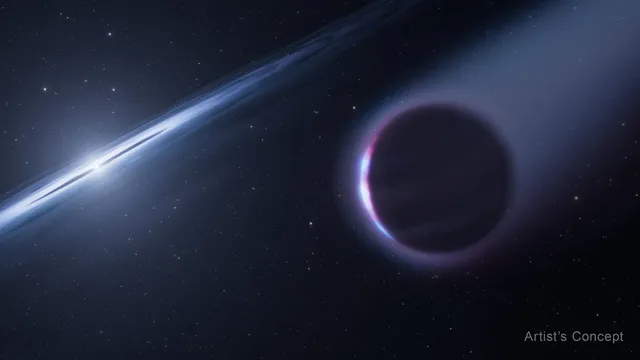
TOI-561b: a Lava World With a Mirror Atmosphere
Ultra-short-period rocky planets are expected to lose any atmosphere to intense stellar radiation, making TOI-561b's detected envelope a puzzle. Astronomers used JWST's NIRSpec instrument to record a 37-hour continuous phase curve at 3–5 microns, separating the planet's signal from stellar variability.
The data point to a high Bond albedo and moderate heat redistribution across the planet. Circulation models suggest silicate clouds made of SiO2 and MgSiO3 form near the day-night terminator, reflecting much of the incoming starlight. The findings confirm a global reflective atmosphere, likely sustained by ongoing exchange with the planet's interior.
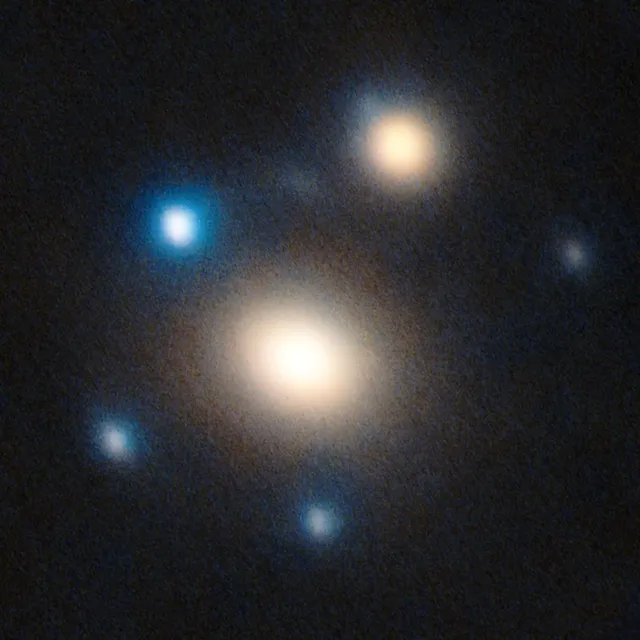
The Milky Way Ate Another Galaxy
Astronomers found evidence that the Milky Way absorbed a massive companion galaxy 1.8 billion years before merging with Gaia-Sausage-Enceladus roughly 10 billion years ago. The team showed that three previously separate populations — the proposed Kraken and Heracles dwarf galaxies and a so-called "low-energy" stellar group — are actually remnants of the same merger, which they name the LKH galaxy.
Globular clusters were key to the discovery, since these dense star clusters often survive mergers intact even as their host galaxies are torn apart. By analyzing their chemistry and orbital motion, researchers untangled a chaotic chapter of the Milky Way's youth, when it was still small and collisions were far more disruptive than today.
JWST Maps Chemistry of Comet ZTF in Detail
JWST observed the Oort Cloud comet C/2022 E3 (ZTF) at a distance of 1.33 AU from the Sun, detecting emission from nine molecules including water, methanol, hydrogen cyanide, ethane, methane, and carbon dioxide. Spatial-spectral maps revealed that water's distribution in the coma differs from that of the other volatiles, while its ortho-to-para ratio matched the statistical equilibrium value.
Dust analysis showed the grains are dominated by amorphous carbon (56%), with the remainder split between silicate pyroxene and both crystalline and amorphous olivine. The results let researchers compare ZTF's composition with other well-studied comets, offering clues about the raw material from which the Solar System formed.