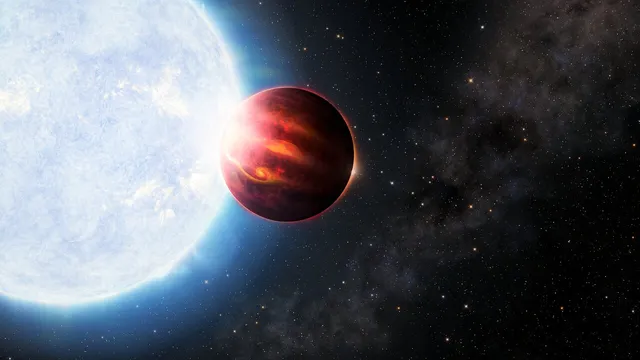
Ultra-short-period rocky planets complete an orbit around their star in less than an Earth day. Because they sit so close, they receive hundreds of times more radiation than Earth gets from the Sun, and according to standard theory should long ago have been stripped down to bare rock, with no gas envelope surviving. That is why signs of an atmosphere on TOI-561 b came as a surprise — and a new James Webb Space Telescope study now offers the most thorough confirmation yet.
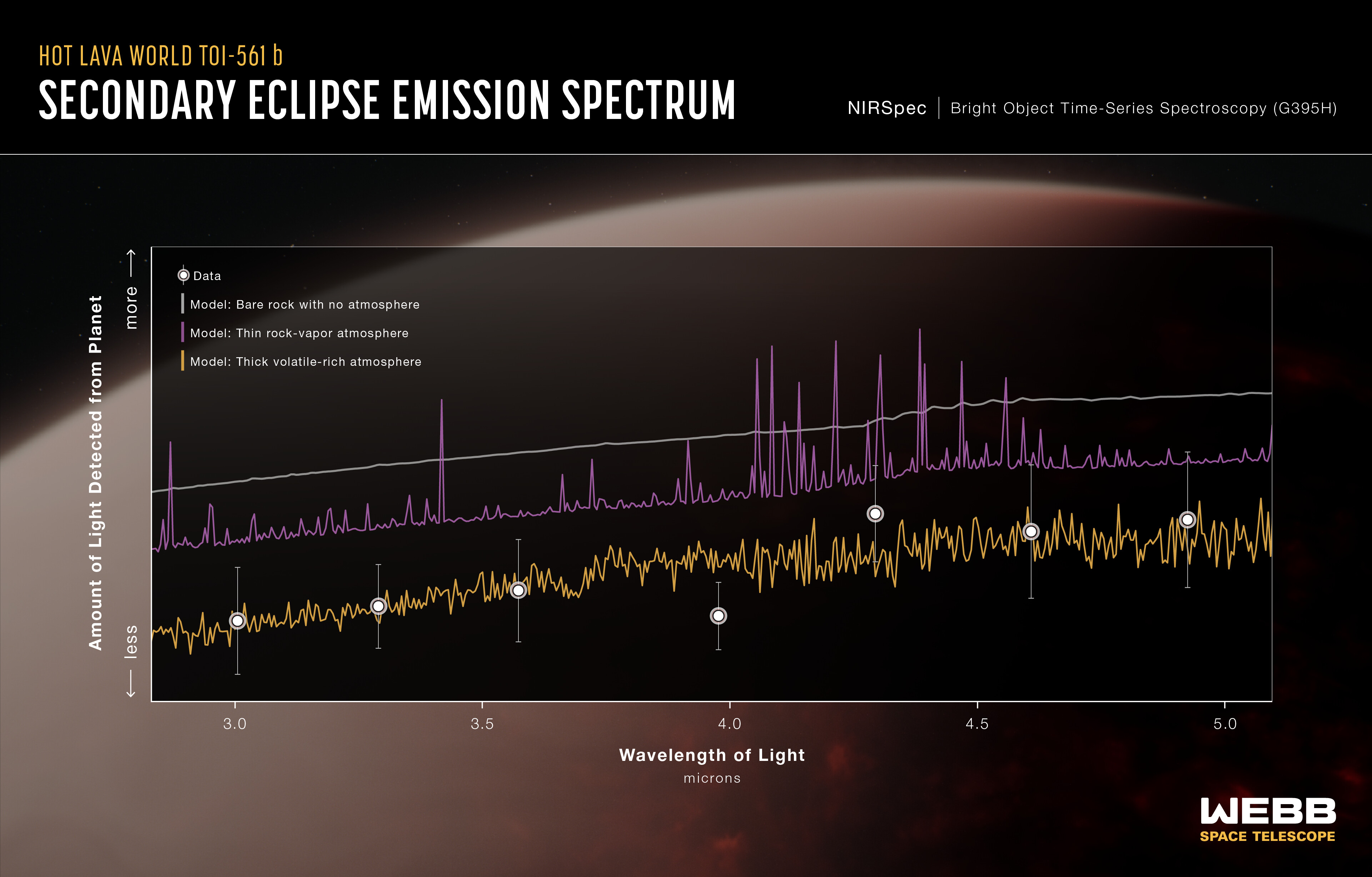
Earlier evidence for an atmosphere on TOI-561 b rested on two things: the planet's bulk density and the emission spectrum of its dayside during eclipse. Both approaches give only a partial view. A full-orbit phase curve — continuous emission measurements across the planet's entire orbit, including day-night transitions — allows a far more complete reconstruction of atmospheric circulation, heat distribution, and cloud presence.
Thirty-seven hours without a break
The team used the James Webb Space Telescope's NIRSpec spectrograph to observe the planet across 3-5 microns. The observation ran for 37 continuous hours — long enough to cover multiple orbital phases and secure a long out-of-eclipse baseline.
That duration proved essential. A star's surface generates its own noise through granulation — small-scale convective plasma motion — which can mimic or mask a planet's signal. With a long, uninterrupted dataset, the researchers were able to model three components simultaneously: stellar granulation, the planetary phase curve, and the dayside emission spectrum. By disentangling these signals, they obtained a dayside spectrum that agrees with previous eclipse-only measurements while being far less sensitive to stellar variability.
A mirror instead of a furnace
The key result comes from an energy-balance argument. By comparing absorbed versus re-emitted energy, and cross-checking against general circulation models (computer simulations of atmospheric airflow), the authors concluded that TOI-561 b has a high Bond albedo — reflecting a substantial fraction of starlight — combined with only moderate heat transport from its day side to its night side.
This combination is unusual for scorched, airless rocky planets, which typically absorb nearly all incoming radiation and show sharp temperature contrasts between hemispheres. High albedo, by contrast, is characteristic of bodies with a cloud layer capable of bouncing light back into space.
Silicate clouds near the terminator
Using outputs from the circulation models, the researchers identified the pressure and temperature conditions under which clouds could condense, then tested several candidate compositions. The observations are best explained by clouds made of silicon dioxide (SiO2) and magnesium silicate (MgSiO3) — essentially condensed, vaporized rock.
According to the calculations, these clouds could form on the planet's dayside near the terminator, the boundary between day and night, where temperatures dip slightly below the peak daytime heat. There, silicate vapor could cool enough to condense into microscopic droplets or crystals that reflect incoming starlight.
An atmosphere fed from below
The study's central conclusion is that TOI-561 b hosts a global, reflective atmosphere despite extreme irradiation. But for such an atmosphere to persist on a planet hot enough to vaporize rock, it must be continuously replenished. Otherwise stellar wind and radiation would erase it on a geologically short timescale.
That implies an ongoing exchange of volatiles between the planet's interior and its surface — likely volcanic outgassing or a similar process feeding the atmosphere from below. If confirmed by further observations, TOI-561 b would become one of the first known rocky exoplanets showing signs of an active geological cycle sustaining a gas envelope against conditions that should have destroyed it.