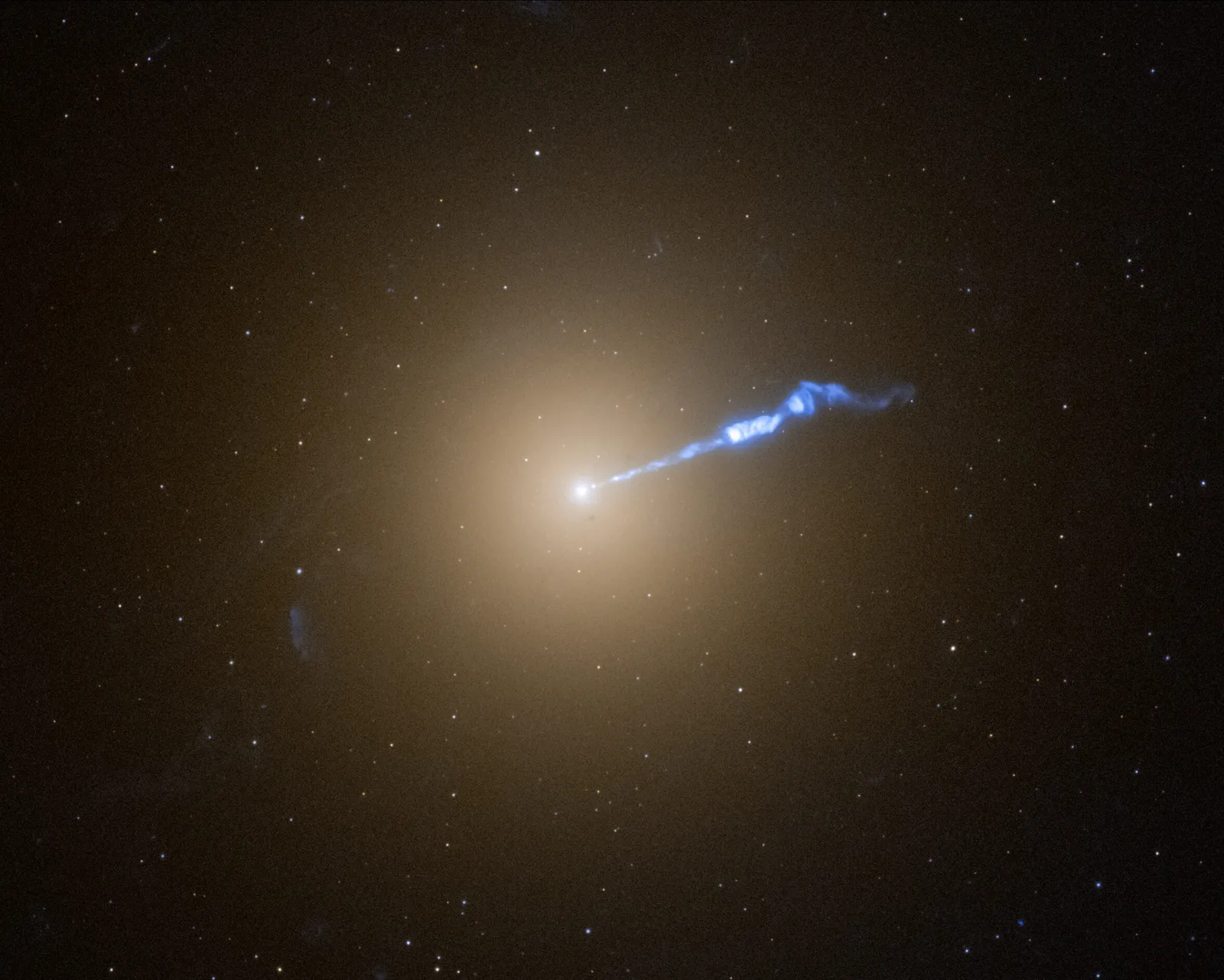
The galaxy M87, located roughly 55 million light-years from Earth, became famous for the first-ever image of a supermassive black hole's shadow, released by the Event Horizon Telescope collaboration in 2019. But the black hole itself is only part of the story. From its vicinity, a powerful jet of matter shoots outward, stretching for thousands of light-years and radiating across the spectrum from radio waves to X-rays. Explaining exactly how this jet is structured at the smallest, sub-parsec scales (a parsec is about 3.26 light-years) has remained difficult.
A new study presents a model that describes these scales more accurately than previous work.
How a black hole's jet is modeled
The authors used general-relativistic radiative-transfer calculations. This computational method combines simulations of matter motion in the accretion disk — the gas swirling around the black hole before falling in — with calculations of how the radiation produced by that gas travels through spacetime curved by gravity. Such calculations produce synthetic images and spectra that can then be compared with real telescope observations.
To previous versions of such models, the researchers added a new element: a compact plasma blob located right in the jet-launching region — the zone where magnetic fields and the black hole's spin accelerate matter to relativistic speeds. Earlier models treated this region more simply, as a smooth continuous flow without localized inhomogeneities.
What the new component achieved
Including the plasma blob immediately improved several independent metrics.
First, the model now reproduces M87's quasi-simultaneous spectral energy distribution across an extremely wide frequency range — from 10 gigahertz to 10 quadrillion hertz (from radio to soft gamma rays). Previous models lacking such a component matched observations less well specifically at the lower end of this range.
Second, agreement improved in the so-called synchrotron self-absorption region — frequencies below 100 gigahertz, where light emitted by the jet is partly absorbed by the jet's own plasma. The synthetic spectrum in this region came out flatter, with a spectral index between 22 and 86 gigahertz equal to 0.08 — closer to real observational data than previous models produced.
Third, the match between the model and real interferometric observations at 86 gigahertz improved in terms of morphology — the jet's shape and structure. The model now agrees with observations out to 0.6 milliarcseconds from the black hole.
A brighter southern edge and new knots
A particularly interesting result concerns the so-called edge-brightened structure — a pattern characteristic of the M87 jet in which the edges of the flow are brighter than its center. The new model reproduces this structure out to 1.3 milliarcseconds from the central black hole, which for M87 corresponds to sub-parsec scales. This is a notably larger region than previous studies managed to explain.
Notably, in the model, the jet's southern edge turned out brighter than its northern edge — exactly as observed by real telescopes. In addition, the synthetic image shows individual bright knots along the southern edge of the jet, a feature earlier models failed to reproduce.
What comes next
The result doesn't directly explain where such a localized plasma blob in the jet-launching region comes from, or how stable or long-lived it is — that remains a subject for further study. But the fact that adding one relatively simple component substantially improves agreement across several independent parameters at once — spectrum, morphology, and brightness distribution — suggests that the real plasma structure near M87's black hole is less smooth than previous accretion-flow models assumed. Future observations, including next-generation networks similar to the Event Horizon Telescope, may help test how robust this picture is.