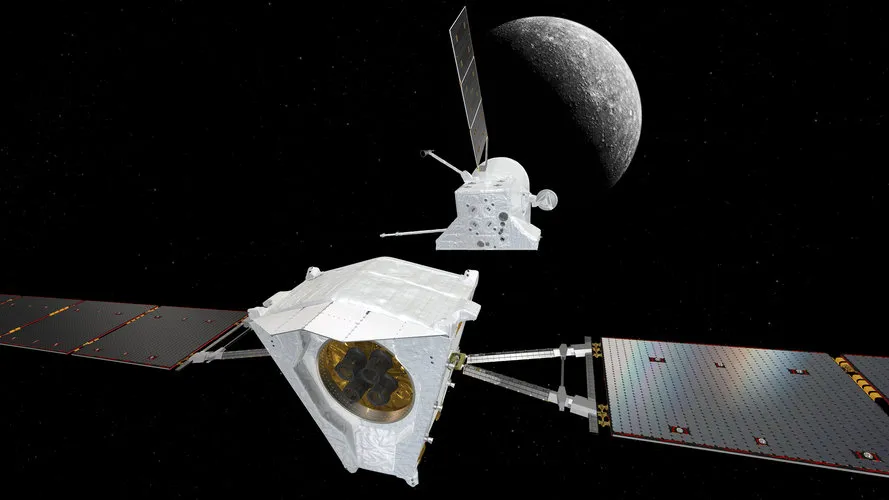
The BepiColombo mission, a joint project of the European Space Agency (ESA) and Japan's space agency JAXA, is approaching one of the most important moments of its years-long journey. On 3 September 2026, the transfer module will separate from the mission's two science orbiters — the first step in a complex sequence of manoeuvres meant to end with the spacecraft settling into orbit around Mercury.
Why the transfer module is no longer needed
BepiColombo consists of three main parts: the Mercury Transfer Module (MTM) and two science orbiters — Europe's Mercury Planetary Orbiter (MPO) and Japan's Mercury Magnetospheric Orbiter, known as Mio. Throughout the eight-year cruise, the transfer module has acted as both engine and power station, supplying electricity from its solar panels and propelling the spacecraft using ion engines — thrusters that generate thrust by accelerating charged particles rather than burning chemical fuel.
This approach allowed BepiColombo to travel efficiently on its long journey to Mercury, one of the hardest planets in the Solar System to reach precisely because it sits so close to the Sun. The spacecraft repeatedly used gravity-assist flybys past Earth, Venus, and Mercury itself to gradually slow down and adjust its trajectory.
Now that the transfer module has done its job, it is no longer needed. Its separation on 3 September 2026 marks the first major step of the Mercury Arrival Phase, which ESA describes as one of the most operationally challenging sequences it has ever attempted in a planetary mission.
What happens next
After separation, MPO and Mio will continue independently. The next stage involves a series of braking manoeuvres needed to shift the spacecraft from a flyby trajectory onto a stable orbit around Mercury. Because of the planet's weak gravitational pull and its proximity to the Sun, this process demands extreme precision: a mistake at this stage could cost the mission years of work — or the orbit insertion itself.
ESA will livestream the event from mission control starting at 13:45 CEST. Viewers will get to watch the flight control team at work in real time, during the very moments when decisions are made that determine the success of the mission's entire scientific programme.
Why it matters
Mercury remains one of the least explored planets in the Solar System. Before BepiColombo, only two NASA spacecraft — Mariner 10 in the 1970s and MESSENGER in the 2010s — studied it up close. The European-Japanese mission aims to answer questions about the planet's magnetic field, internal structure, surface composition, and the unusual presence of ice in polar craters on a world so close to the Sun.
But before any of that science can begin, the spacecraft first have to get there safely. The separation of the transfer module on 3 September is not the end of the mission — it is the beginning of its most complex and riskiest phase: the final arrival at Mercury.