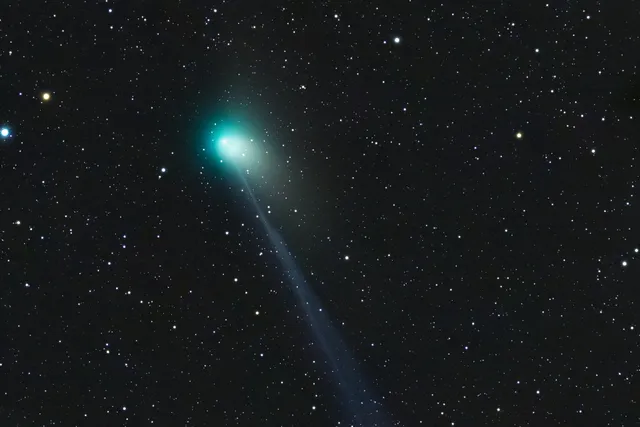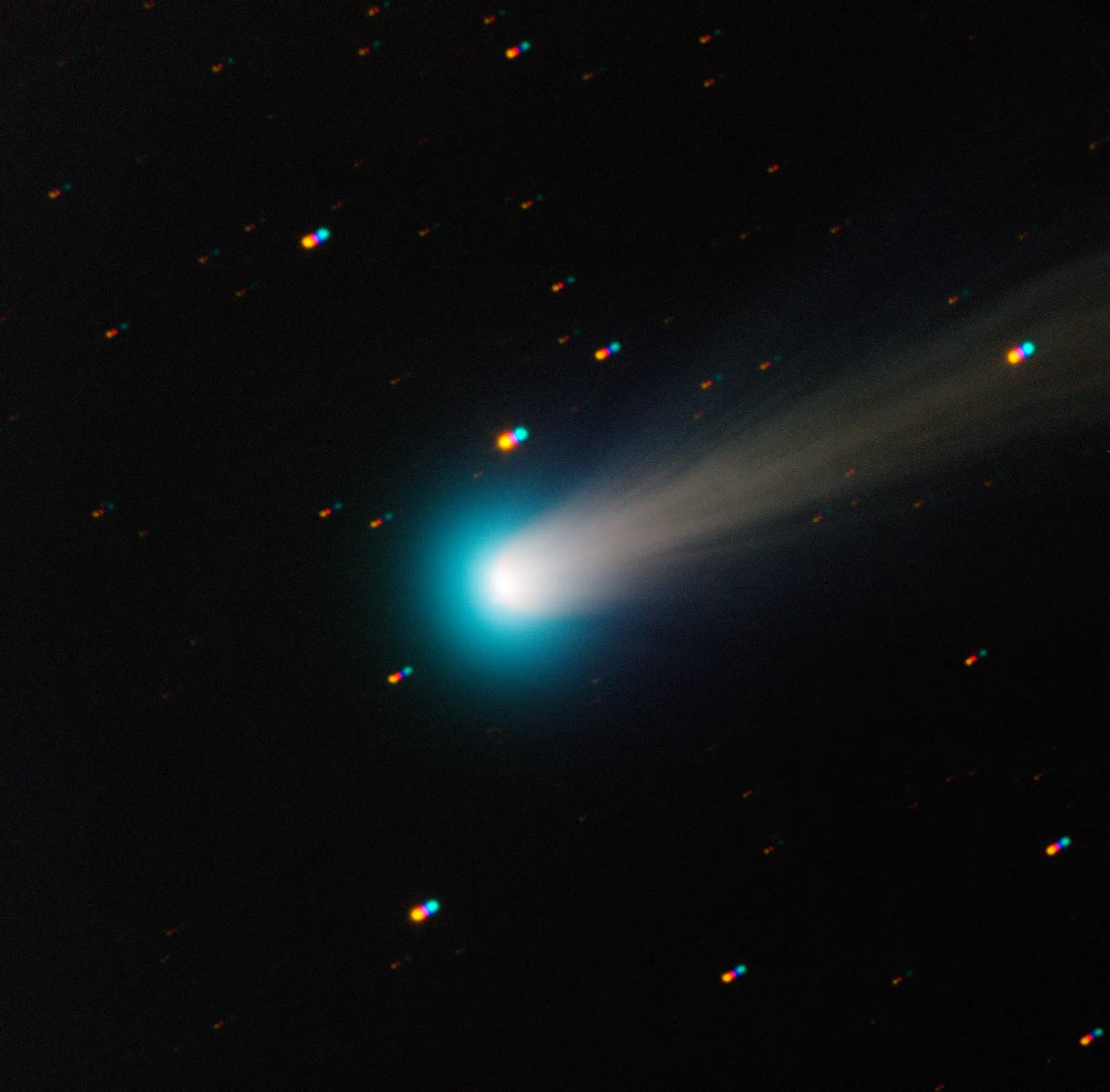
In spring 2023, comet C/2022 E3 (ZTF) became visible to the naked eye — a rare occurrence for a comet from the distant Oort cloud. Now it has been studied in detail with the James Webb Space Telescope, producing one of the most complete spectral maps of a comet's chemical composition to date.
What was observed and how
Observations took place on February 28 and March 1, 2023, when the comet was at a heliocentric distance of 1.33 astronomical units — already past perihelion and moving away from the Sun. The Oort cloud is a hypothetical spherical region at the very edge of the solar system, believed to be the source of long-period comets like ZTF. Such objects preserve material nearly unchanged since the solar system's formation, making their composition valuable for understanding the building blocks of planets.
James Webb detected emission from a whole suite of molecules: water (H2O), hydrogen cyanide (HCN), methanol (CH3OH), ethane (C2H6), methane (CH4), carbon monoxide (CO), carbon dioxide and its heavy isotope (CO2, 13CO2), and carbonyl sulfide (OCS) — a sulfur-bearing compound. A series of hydroxyl (OH) transitions in the near- and mid-infrared were also recorded — so-called prompt emission, produced when water molecules break apart under sunlight.
Maps instead of a single spectrum
The main methodological value of this work isn't just the list of detected molecules — it's the spatial-spectral maps. For most species (except ethane, hydrogen cyanide, and hydroxyl, whose signals were too faint for detailed mapping), researchers built maps of column density (the amount of molecules along the line of sight) and rotational temperature as a function of distance from the nucleus. They simultaneously measured the distribution of the continuum — the background dust emission.
All mapped molecules and the dust showed uneven, anisotropic distributions — gas escapes the nucleus predominantly in certain directions rather than uniformly. At the same time, water showed a distinctly different distribution pattern compared to the other species. This may indicate that water is released from the nucleus through a different mechanism or from different surface regions than the other volatiles.
Isotopes, ortho-to-para ratio, and dust composition
Researchers also checked two quantities traditionally used to compare comets with each other and with solar system formation conditions. Water's ortho-to-para ratio (OPR) — the ratio between two spin states of the molecule — came out close to 3, matching the value expected from statistical equilibrium rather than any special "fingerprint" of formation conditions. The carbon isotope ratio in carbon dioxide (12CO2 to 13CO2) was about 89, nearly identical to the terrestrial value.
The composition of submicron dust grains in the coma was also modeled. Amorphous carbon dominates the mass, at 56%. Next comes amorphous magnesium-iron pyroxene (28%), crystalline olivine (10%), and amorphous magnesium-iron olivine (5%). The overall crystalline mass fraction of the dust was 0.2385±0.0008 — meaning less than a quarter of the dust has an ordered crystalline structure, with the rest being amorphous.
Why this matters
These findings allow C/2022 E3 (ZTF) to be compared with other comets studied to date, including those already observed by James Webb. The more such detailed "chemical portraits" of comets accumulate, the more precisely researchers can determine how similar or different the building blocks of solar system bodies actually were. For now the study focuses on a single comet, but the spatial-spectral mapping method applied here opens the door to more systematic comparisons of volatiles and dust across different comet bodies in the future.