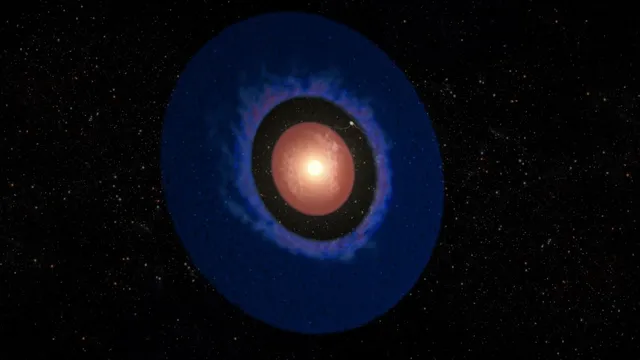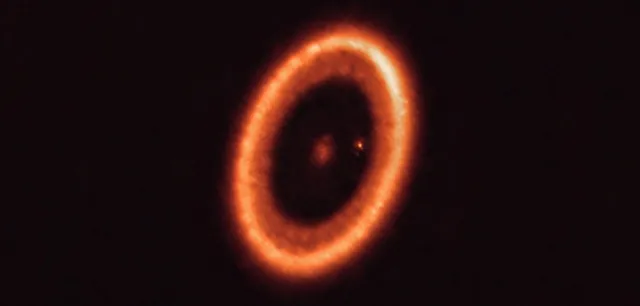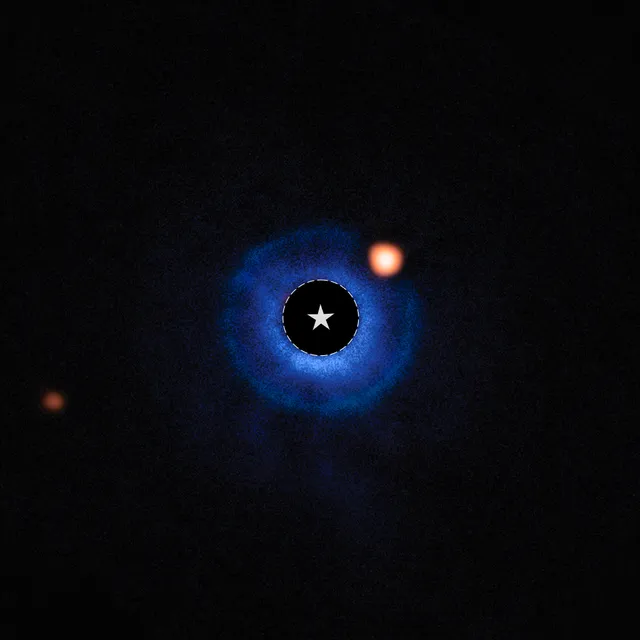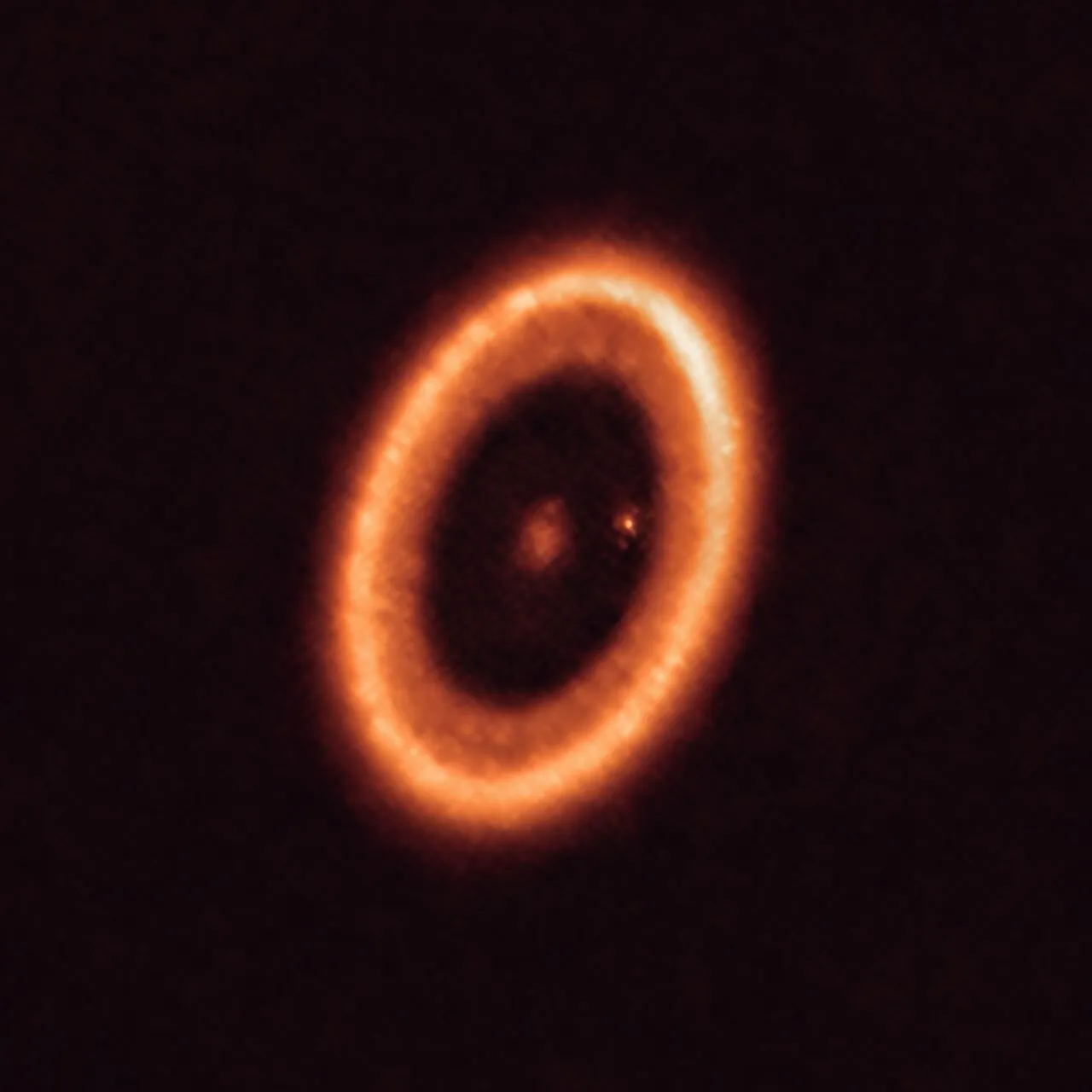
WISPIT 2 is a young star located relatively close to the Sun, surrounded by a protoplanetary disk with several bright dust rings. Such a disk is the leftover gas and dust cloud from which the star itself formed, and its rings usually mark places where planets have already formed or are still forming, clearing gaps as they orbit.
Astronomers had previously confirmed one planet in the system — WISPIT 2b, a gas giant with a mass of roughly 4.9 Jupiter masses, sitting inside a wide gap in the disk 57 astronomical units from the star. Now a team led by Chloe Lawlor has confirmed a second, closer-in companion.
Two instruments, one signal
The detection combined two methods. VLT/SPHERE is a direct-imaging camera with polarimetry, operating in the H-band and capturing scattered polarized light around the star. VLTI/GRAVITY is an interferometer that combines light from four 8-meter VLT telescopes in the K-band, delivering extremely high angular resolution. Combining the two approaches made it possible not just to spot a point of light, but to extract a spectrum of the object.
The GRAVITY signal is consistent with a point-like source — a compact body rather than a blurred smudge or an instrumental artifact. The extracted medium-resolution spectrum shows CO band-head absorption at 2.3 micrometers, and a continuum shape typical of a young gas giant.
Temperature, size, and mass of the new world
To constrain the physical parameters, the team fit grids of atmospheric models to the spectrum using the species software tool and a nested sampling method. The result: an effective temperature of 1500–2600 K, a radius of 0.91–2.2 Jupiter radii, and a luminosity in the range log(L/L☉) between −3.47 and −3.63.
Comparing these values with evolutionary tracks for young planets gives a mass estimate of 8–12 Jupiter masses — roughly twice that of the already known WISPIT 2b. The new object has been designated WISPIT 2c.
Astrometric data rule out the possibility that it is a background star that happens to lie along the same line of sight. The data also hint at orbital motion of WISPIT 2c, though this signal is currently only marginal and requires confirmation from further observations.
A second analog to PDS 70
Before this discovery, PDS 70, with its two confirmed protoplanets, was the only system where astronomers had directly observed multiple planets forming inside their natal disk. With two companions now confirmed — WISPIT 2b and WISPIT 2c — WISPIT 2 becomes the second known example of this kind.
It offers a rare opportunity to watch a multiplanet system assemble in real time, rather than reconstructing the process after the fact from already-formed worlds. Follow-up observations should refine the orbit of WISPIT 2c and check whether the disk around the star is hiding still more objects in the process of being born.