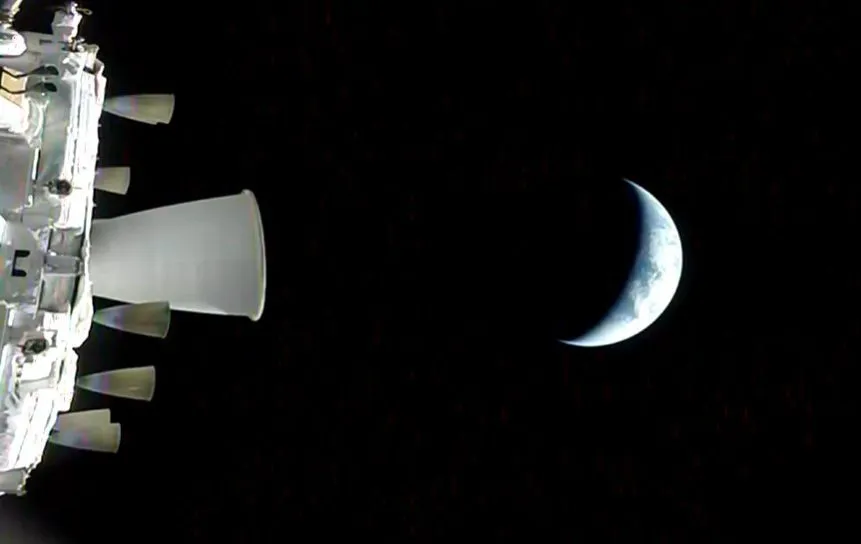
For the first time in 52 years: humans are flying to the Moon
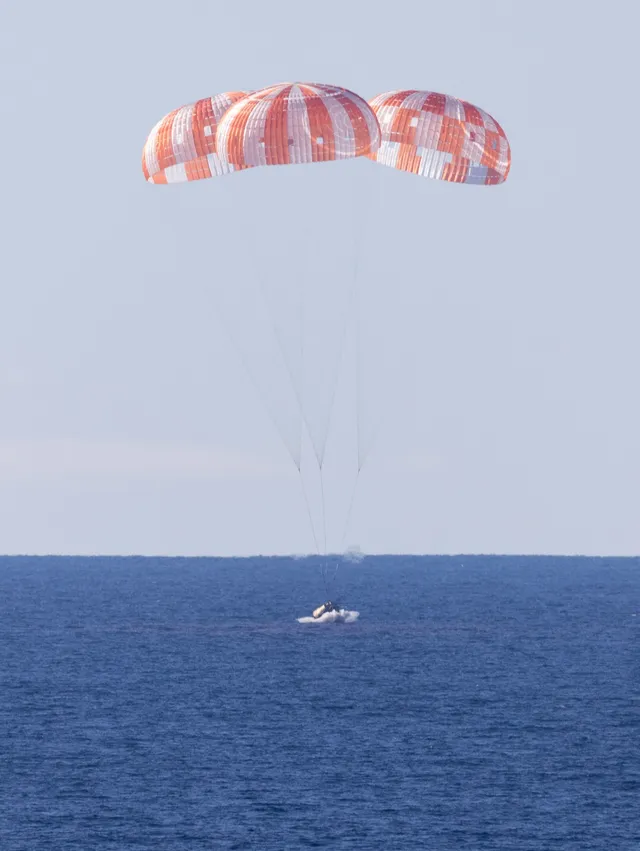
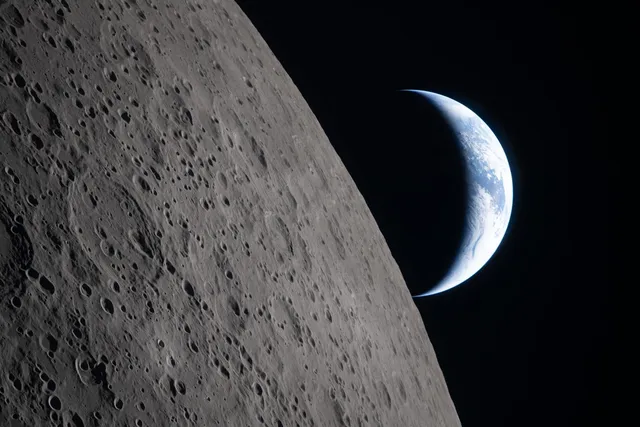
On April 1, 2026, NASA's SLS rocket lifted off from Kennedy Space Center carrying the Orion spacecraft, named "Integrity" by its crew. Aboard are NASA astronauts Reid Wiseman, Victor Glover, and Christina Koch, along with Canadian Space Agency astronaut Jeremy Hansen. After checking out systems in a high Earth orbit roughly 46,000 miles up and completing a manual piloting demonstration, the crew fired Orion's engine for about six minutes on April 2, sending the spacecraft toward the Moon.
It marks the first time humans have left Earth orbit since Apollo 17 in 1972 — more than 50 years ago. Eight intensive days remain before the mission concludes: a lunar flyby is scheduled for April 6, followed by splashdown in the Pacific Ocean around April 10, capping a ten-day test flight meant to prove Orion's readiness for future lunar landings.
JWST peers into the heart of star-forming region W51A
The James Webb Space Telescope imaged the stellar nursery W51A through 10 NIRCam and 5 MIRI filters, covering a 4×8 parsec region that ranks among the most active star-forming areas in our Galaxy. The sharp images reveal dust filaments converging geometrically onto the protocluster W51-E, while a cavity surrounds the neighboring massive cluster W51-IRS2 — evidence that its own radiation and winds have already choked off further gas infall.
Comparing the data with ALMA observations turned up only 24 sources detected by both facilities, roughly 10% of ALMA's catalog, since the rest are too cold or embedded for Webb to see. A separate puzzle is a compact knot of [Fe II] and H₂ emission north of W51-IRS2, likely the most energetic known protostellar jet, driven by a massive star slamming into dense interstellar gas.
How binary stars form — even next to giants
The DIHCA survey, using ALMA at roughly 160 AU resolution, uncovered 72 low-mass multiple star systems embedded within 23 dense clouds that are simultaneously forming massive stars. The peak separation between companions is about 1200 AU — two to three times tighter than the roughly 4000 AU typical of quieter clouds that form only low-mass stars. The authors attribute this to the higher pressure of the surrounding medium, where greater turbulence and density compress cloud fragments more tightly.
Yet the fraction of multiple systems does not rise with stellar density, contrary to theoretical expectations. The team suggests that in the extremely crowded environments where massive stars form, dynamical interactions disrupt weakly bound companion pairs before they can be observed.
A maser in NGC 1365 pinpoints bar-driven shocks
Using the Australia Telescope Compact Array, astronomers detected the first extragalactic Class I methanol maser at 36.2 GHz in the barred spiral galaxy NGC 1365. It turns out to be the most luminous such maser known, with a total isotropic luminosity of 19.3 solar luminosities. The emission is precisely localized to the southern arm of the circumnuclear starburst ring, exactly where gas flowing in along the galactic bar collides with the ring at 25–30 km/s.
No comparable maser appears in the northern arm, which is instead dominated by young stars and their feedback — an asymmetry that let researchers cleanly separate bar-driven shocks from stellar feedback. The team argues the 36.2 GHz maser is now a powerful new tool for mapping shock fronts in the nuclei of other galaxies.
Three thousand new solar neighbors — found by volunteers
Volunteers with the Backyard Worlds: Planet 9 citizen science project combed through images from the WISE infrared survey and identified 3,006 new candidate L and T dwarfs based on their motion across the sky. Of these, 2,357 have L-type and 649 have T-type photometric spectral classifications, with another 80 objects flagged as likely dwarfs lacking a confirmed proper motion measurement. If spectroscopy confirms their nature, this single catalog would more than double the known population of these cool dwarfs.
The sample includes 28 new companions to more massive stars and 9 candidate binary systems made up of two ultracool dwarfs. The authors note that no automated pipeline could have produced this result — it took tens of thousands of volunteers manually scanning images for faint moving objects.