The notion that planets inherit the chemical composition of the stars they formed around has long remained a theoretical assumption without direct observational backing. Using a spectrograph on the Gemini South telescope in Chile, astronomers have now obtained exactly that confirmation. The target was WASP-189b, an ultra-hot Jupiter whose scorching atmosphere allowed researchers to detect gaseous magnesium and silicon directly.
The result, published in Nature Communications, gives planetary scientists the first empirical evidence for a link that underpins nearly all current models of rocky planet formation.
WASP-189b: a testbed for heavy elements
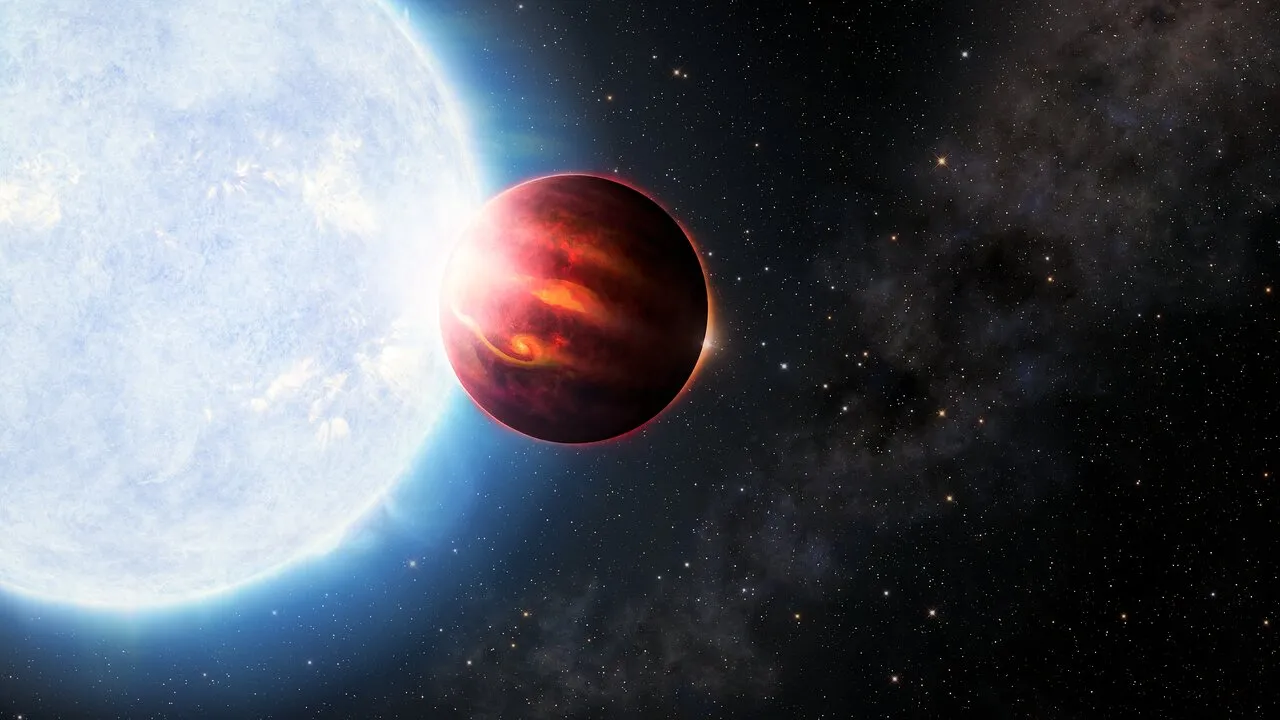
WASP-189b lies ~320 light-years away in the constellation Libra. It belongs to the class of ultra-hot Jupiters (UHJs) — giant planets orbiting so close to their stars that atmospheric temperatures reach levels high enough to vaporize even heavy, rock-forming elements: magnesium, silicon, and iron.
This trait makes WASP-189b a convenient target for spectroscopy — the technique of breaking light into component wavelengths to identify chemical elements. In cooler planets, these elements hide in clouds or condense into solid particles, invisible to spectral analysis. In WASP-189b's atmosphere, they remain gaseous and leave clear spectral fingerprints.
IGRINS at Gemini South: two elements measured at once
A team led by Jorge Antonio Sanchez, a graduate student at Arizona State University (ASU), observed WASP-189b using the Immersion GRating INfrared Spectrograph (IGRINS), mounted on the Gemini South telescope as a visiting instrument in 2022-2023. The instrument's high spectral resolution allowed the first-ever simultaneous detection of magnesium and silicon in a single exoplanet's atmosphere.
The data showed that the magnesium-to-silicon ratio in WASP-189b exactly matches the same ratio in its host star. This link had previously been checked only within the Solar System — now it has been confirmed beyond it.
WASP-189b gives us a much-needed observational anchor in our understanding of terrestrial planet formation since it offers a measurable quantity that validates the presumed resemblance of stellar composition and the proportion of rocky material around host stars used to form planets.Jorge Antonio Sanchez, Arizona State University
IGRINS itself has since left Gemini South and returned to its home institution, the University of Texas at Austin. Its successor, IGRINS-2, is now a facility instrument on the Gemini North telescope in Hawai'i.
From stellar spectra to planetary geochemistry
Hot giants like WASP-189b are thought to build their outer gas layer from material in the protoplanetary disk — the same leftover cloud of gas and dust from which the star itself formed. It follows logically that the disk's composition, and thus that of the planets, mirrors the star's: both originated from the same primordial material.
This assumption has underpinned models of rocky planet formation for decades, along with astrobiological assessments of habitability. Magnesium, silicon, and iron govern a planet's geochemistry: they shape its magnetic field, plate tectonics, and the release of life-sustaining compounds — much as they do on Earth.
If a planet's elemental ratios truly trace back to its star, then ordinary stellar spectroscopy — a method available even for faint, small stars — becomes a practical tool for assessing the geochemical conditions of planets too small to characterize directly.
Co-author Michael Line (ASU) notes that such measurements require extremely high spectral resolution, currently achievable only with ground-based telescopes. The team plans further multi-wavelength observations of WASP-189b and similar targets to expand the list of detected elements and better understand the conditions accompanying planet formation.