Roman Space Telescope Launches Toward L2
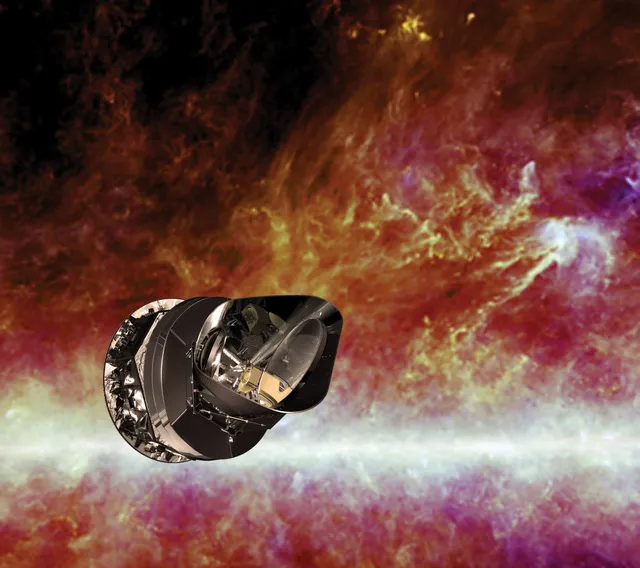
On 30 August 2026, NASA's Nancy Grace Roman Space Telescope launched aboard a SpaceX Falcon Heavy rocket from Kennedy Space Center in Florida. The observatory is heading to the second Sun-Earth Lagrange point, roughly 1.5 million kilometers from Earth, where it will have an unobstructed view of nearly 12 percent of the sky. ESA contributed star trackers, batteries and coronagraph detectors, and will support the mission with a new 35-metre antenna in Australia.
With a 2.4-metre primary mirror and two instruments — a Wide Field Instrument and a coronagraph — Roman will map galaxy clustering and observe thousands of distant type Ia supernovae to trace the expansion of the universe and test whether dark energy is truly constant. It is also expected to discover thousands of new exoplanets, including cold and free-floating worlds. Science operations begin after a three-month commissioning period, with the mission designed to last at least five years.
Single Simulation Explains Neutron Star Merger
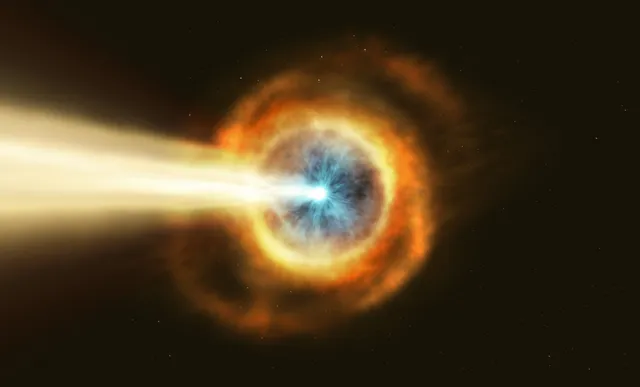
Researchers performed an end-to-end, first-principles general-relativistic magnetohydrodynamic simulation with neutrino radiation transport to model the merger of two neutron stars. The simulation covers the full chain of events, from the merger itself through nucleosynthesis to the formation of a kilonova, successfully reproducing the real 2017 observations of GW170817 alongside its gamma-ray burst GRB170817A and optical afterglow AT2017gfo.
The key finding is that a large-scale dynamo generated during the merger simultaneously produces a relativistic jet with a luminosity of about 10^51 erg/s and ejects 0.08 solar masses of neutron-rich material. This is the first time gravitational-wave, gamma-ray, and kilonova observations of a single event have been explained within one unified physical framework, without separate assumptions for each channel.
Continuous Inflow Feeding Supermassive Black Hole
Using simultaneous observations from XRISM, XMM-Newton and NuSTAR, astronomers detected an ultra-fast inflow of gas plunging toward the supermassive black hole in the Seyfert galaxy ESP 39607 at roughly 16 percent the speed of light. The signature came from redshifted iron absorption lines near 4.7 and 4.9 keV, tracing gas at just 49 to 77 gravitational radii from the black hole.
Strikingly, similar inflows were detected in the same galaxy in earlier observations, spanning a baseline of at least 2.2 years in the source's rest frame, even though the dynamical lifetime of gas at that distance is only a few days. This implies the inflow is continuously replenished, forming an accretion "cascade" that could supply a substantial fraction of the accretion needed to power the galaxy's active nucleus.
Star-Disk Collisions Explain Mysterious X-ray Flares
Quasi-periodic eruptions (QPEs) are bright, recurring X-ray flares from the nuclei of low-mass galaxies, typically lasting 10-20 percent of their recurrence period, with longer flares being more luminous. One leading theory attributes these to a star on an orbit around a black hole repeatedly colliding with the surrounding accretion disk. Researchers ran two-dimensional radiation-hydrodynamic simulations of such collisions using a realistic disk structure.
They found that the disk's thick, puffed-up atmosphere causes the collision's shock wave to break through at different times across its surface, stretching the flare to roughly 10 percent of the orbital period, matching observations. More oblique collisions produce longer, brighter flares, while the disk's surface density profile naturally explains why longer flares tend to be more luminous, even for the weakest eruptions.
Radial Velocity Confirms TRAPPIST-1 Planet Masses
The TRAPPIST-1 system, with its seven Earth-sized planets, has mostly been studied through transit timing variations (TTVs). Now, using the SPIRou and NIRPS near-infrared spectrographs, astronomers have for the first time detected the combined radial velocity signal from the system's planets, confirmed with high confidence (1860:1 odds), even though the data lack the precision to resolve individual planets.
Using planet b as a proxy for the whole system, the team measured a velocity amplitude of 3.65 m/s, corresponding to a mass of 1.31 Earth masses — consistent with the earlier TTV-based estimate of 1.374 Earth masses. The observations also ruled out Saturn-mass planets within 2.7-year orbits and Neptune-mass planets within 20 days, and pinned down the star's rotation period at 3.22 days.