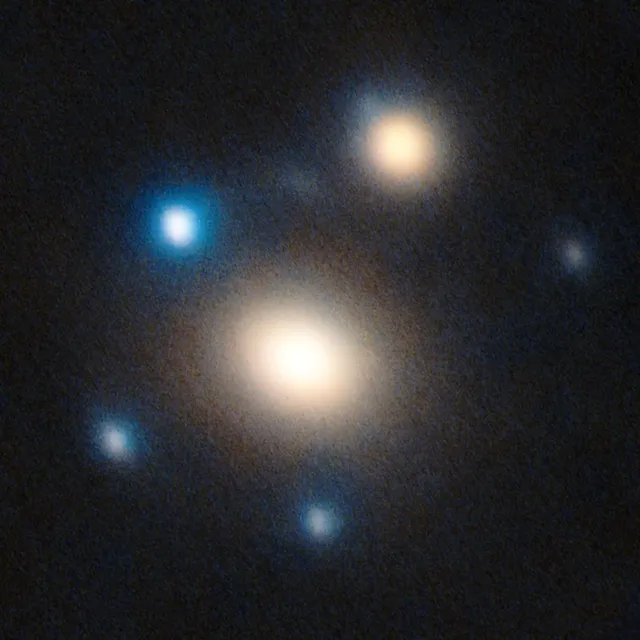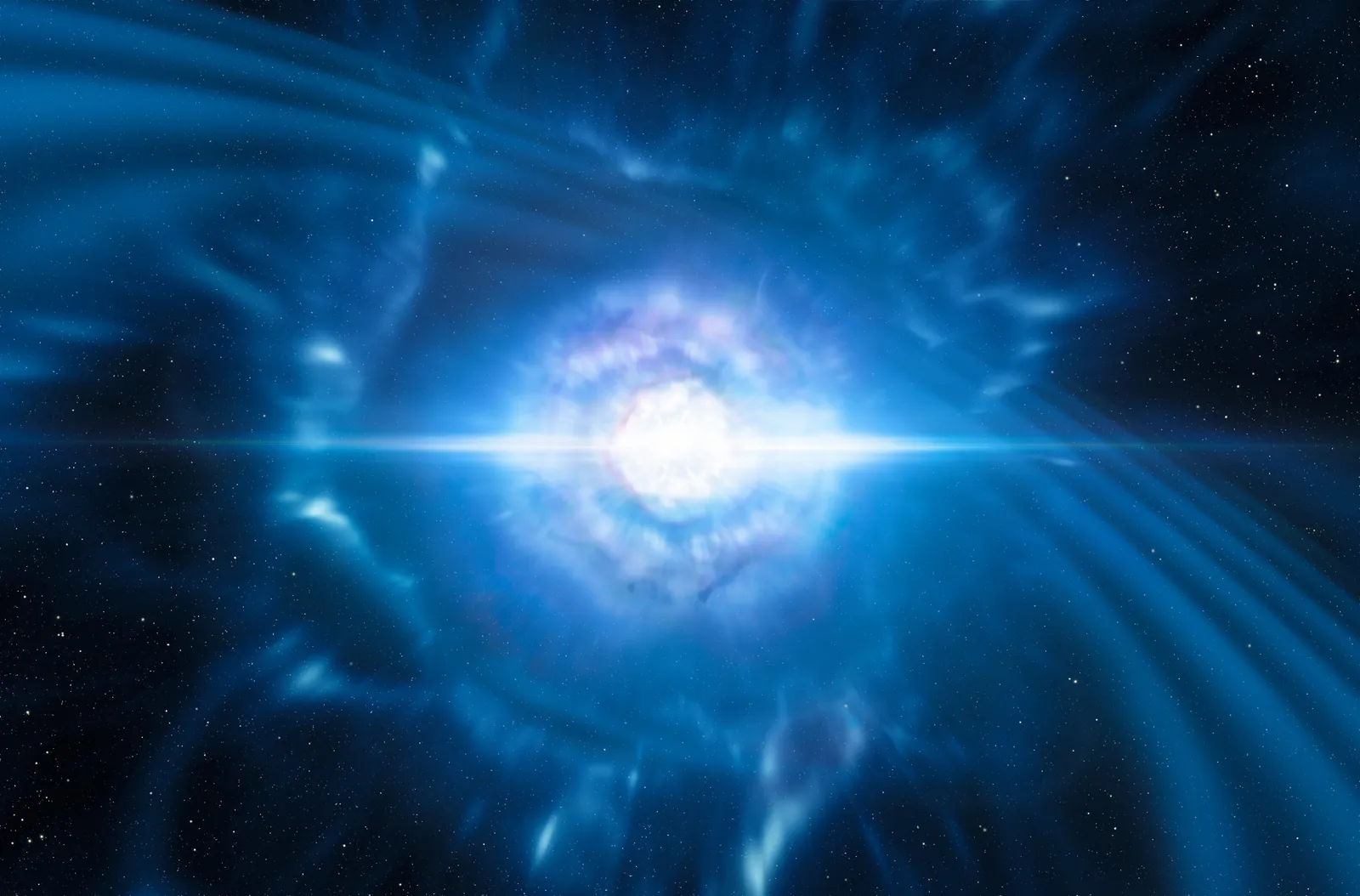
The merger of two neutron stars in August 2017 became one of the most important events in the history of astrophysics. The LIGO and Virgo gravitational-wave detectors caught, for the first time, waves from the collision of such compact objects, and over the following hours and days astronomers detected two more signals: a short gamma-ray burst, GRB170817A, and a slowly fading optical glow — the kilonova AT2017gfo. Together, these three observations launched multimessenger astronomy — the study of a single cosmic event through several different "languages": gravitational waves, gamma rays, and visible light.
The problem is that, until now, no single physical model explained all three signals simultaneously, starting from basic physics equations. Researchers typically modeled separate aspects of the event — the jet mechanism, the properties of the ejected matter, the kilonova light curve — using simplified assumptions or tuning parameters to match observed data. The new work proposes an end-to-end, "first-principles" calculation, meaning no such tuning.
How the model is built
The authors ran a chain of three consecutive types of calculations. First came a general-relativistic magnetohydrodynamic simulation with neutrino-radiation transfer. It describes the merger itself: how the two neutron stars combine, what happens to the resulting disk of matter, how magnetic fields are generated, and how neutrinos carry energy and affect the composition of the matter. This is the most complex and precise type of modeling available today for compact objects.
The results of this simulation were then fed into nucleosynthesis calculations — the process of forming new chemical elements in hot, neutron-rich matter ejected during the merger. It is in such an environment, according to current understanding, that heavy elements are born through the so-called r-process (rapid neutron capture by atomic nuclei).
Finally, the resulting composition and matter distribution were used to calculate photon radiative transfer through the ejected shell — allowing the team to build kilonova light curves at various wavelengths and compare them with AT2017gfo observations.
What the simulation showed
The main result is that a large-scale magnetic dynamo — a process of self-amplifying magnetic fields in the turbulent disk around the newly formed compact remnant — is simultaneously responsible for two seemingly different phenomena.
First, it forms a relativistic jet — a narrow stream of matter moving at nearly the speed of light — with an isotropic-equivalent luminosity of about 10⁵¹ erg per second. According to the authors' calculations, this jet reproduces the observed afterglow of GRB170817A.
Second, the same dynamo drives the ejection of about 0.08 solar masses of neutron-rich matter into the surrounding space. This matter, cooling and undergoing radioactive decay, produces a glow whose shape and brightness match the AT2017gfo kilonova light curves.
Thus, a single physical model — without separate tuning for the jet and separate tuning for the kilonova — reproduces both observed phenomena. This is the claimed "unified framework" for interpreting neutron star mergers across three types of data at once: gravitational waves, gamma-ray bursts, and optical light.
Why it matters
If the result holds up when tested on other events and further calculations, it would become a powerful tool for understanding the physics of compact objects. Instead of modeling the jet and the kilonova separately, with different sets of assumptions, researchers could use a single consistent calculation grounded in basic equations of magnetohydrodynamics, general relativity, and nuclear physics.
This also matters for the question of the origin of heavy elements in the universe. If the model correctly describes the mechanism and amount of ejected neutron-rich matter, it provides an independent way to test how much neutron star mergers contribute as a primary source of gold, platinum, uranium, and other heavy elements observed today.
The likely next step is applying this approach to other, less thoroughly studied merger events, as well as testing how sensitive the results are to the initial parameters of the system — the masses of the stars, their rotation, and the equation of state of neutron star matter.