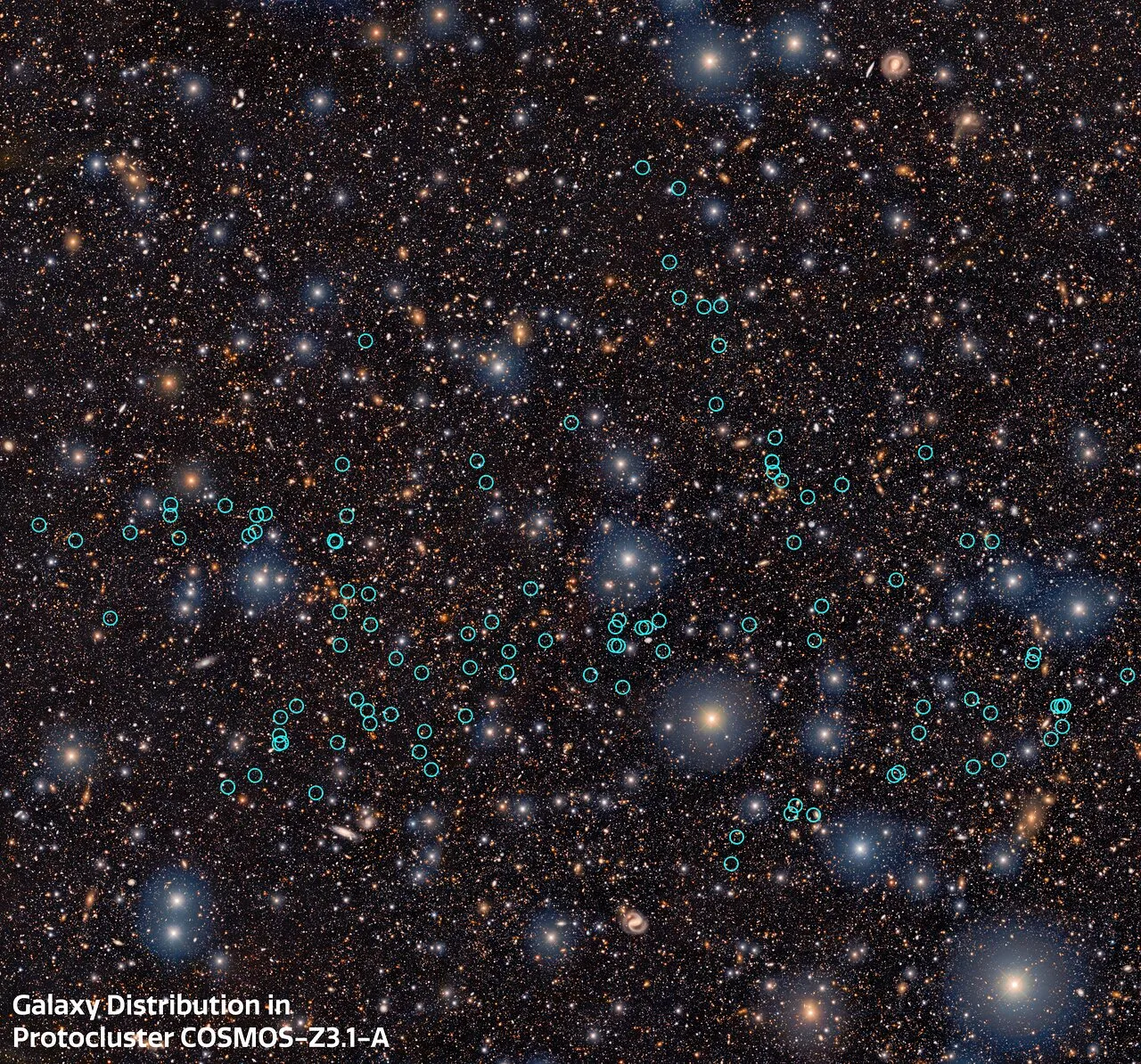
Astronomers have discovered the most distant known ancestor of a "cluster of clusters" of galaxies — a massive structure observed when the Universe was just 2.1 billion years old. The discovery supports existing theories of how galaxy clusters form and evolve, and shows how they connect to the larger cosmic web.
Galaxy clusters are the most massive gravitationally bound structures in the Universe, gathering hundreds to thousands of galaxies across millions of light-years. The clusters we observe relatively close to us today are mature structures that grew out of protoclusters — sprawling, loosely bound collections of galaxies still in the process of merging.
The ODIN survey and three spectrographs for a 3D map
A team led by Vandana Ramakrishnan, a Purdue University graduate student at the time of the study, used data from the One-hundred-deg2 DECam Imaging in Narrowbands (ODIN) survey. The survey was conducted with the DECam camera mounted on the 4-meter Víctor M. Blanco Telescope at Cerro Tololo Inter-American Observatory in Chile. With its wide field of view and 570-megapixel resolution, DECam spent more than 100 nights over three years imaging a huge area of the southern sky.
In total, the team identified 150 distant protoclusters that formed when the Universe was between 1 and 3 billion years old. They focused on two structures showing a striking overdensity of galaxies — COSMOS-z3.1-A and COSMOS-z3.1-C. ODIN provided only the 2D sky coordinates of these objects, so a full 3D reconstruction was needed to understand their true shape and their connection to the cosmic web.
To build the 3D maps, Ramakrishnan was joined by fellow graduate students Byeongha Moon (Korea Astronomy and Space Science Institute) and Nicole Firestone (Rutgers University). Most spectra came from the Dark Energy Spectroscopic Instrument (DESI), a powerful multi-object spectrograph capable of measuring distances to 5,000 galaxies simultaneously. DESI is mounted on the 4-meter Nicholas U. Mayall Telescope at Kitt Peak National Observatory in Arizona. Additional spectra were obtained with the GMOS spectrograph on the Gemini South telescope in Chile and the DEIMOS spectrograph on the Keck II telescope in Hawai'i.
The most massive structure of its era
The resulting 3D maps let the team predict what kind of clusters COSMOS-z3.1-A and COSMOS-z3.1-C will eventually become. Both are set to grow more massive than the largest known cluster in the nearby Universe, the Coma Cluster.
Moreover, COSMOS-z3.1-A turned out to be something rarer than an ordinary protocluster — a proto-supercluster, the seed of a true "cluster of clusters." Observed when the Universe was only 2.1 billion years old, it is now the earliest and most distant proto-supercluster ever found, with an estimated mass of 5,000 times that of the Milky Way.
COSMOS-z3.1-A represents the most extreme, most overdense regions of the Universe. We think there should be fewer than one such object for every 10,000 galaxy clustersVandana Ramakrishnan, Purdue University
The detailed 3D maps showed that these ancient protoclusters are clumpy and irregular, lying at the intersections of multiple filaments of the cosmic web. This is the first time such features have been directly observed at such a great distance, and it matches theoretical expectations for how matter is distributed throughout the cosmos.
Current models describe structure formation as proceeding "bottom-up": small clumps of matter form first and gradually merge into ever-larger structures. The clumpy substructure seen in the maps is likely direct evidence of this process. Over time, these clumps will collapse together, and the protoclusters will evolve into the rounder, more compact clusters seen in the nearby Universe today.
What comes next: the Rubin Observatory
With its wide coverage and imaging depth, ODIN is well suited to finding more massive structures like these in the distant Universe. The 3D reconstruction method the team developed makes it possible to clearly distinguish the dense cores of protoclusters from their outskirts and from the cosmic filaments feeding into them.
The researchers expect more discoveries over the next decade as the NSF–DOE Vera C. Rubin Observatory conducts its Legacy Survey of Space and Time (LSST). By imaging the entire southern sky every few nights, Rubin will build a dataset that complements ODIN's deep imaging of the same region of sky. Together, the two surveys will provide a detailed view of both the nearby and distant Universe, allowing astronomers to trace the evolution of galaxy clusters across cosmic time.