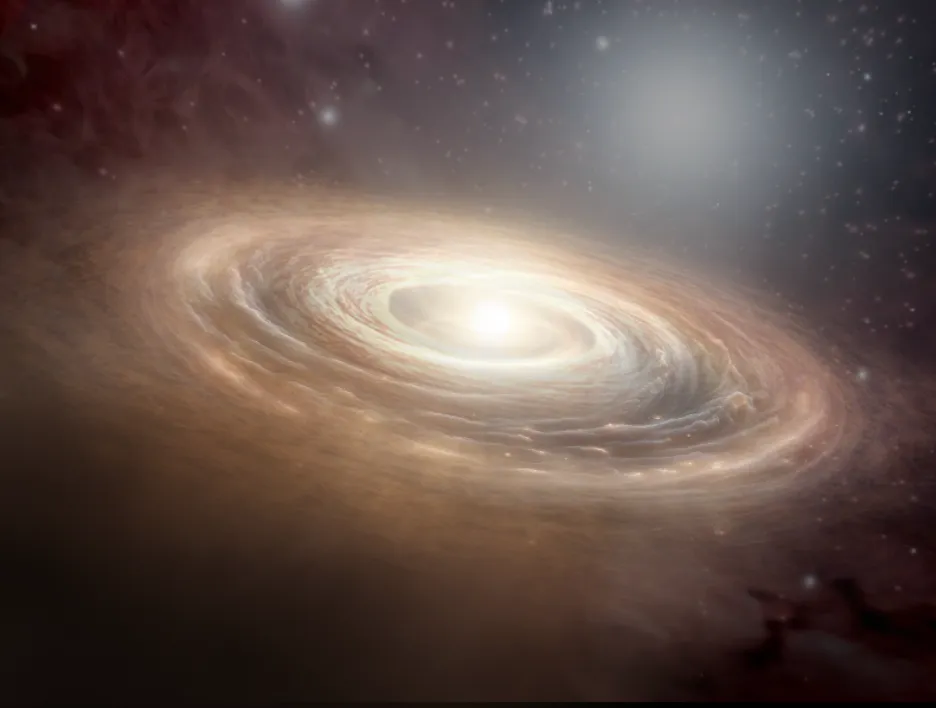
For a long time, planets were thought to be a relatively late arrival in cosmic history. Before rocky worlds could form, several generations of stars had to be born and explode, seeding interstellar gas with heavy elements. Standard estimates place the peak of planet formation in the universe several billion years after the Big Bang. A new study by Eduard I. Vorobyov (University of Innsbruck; Southern Federal University) and collaborators challenges this leisurely picture: in local pockets of enriched gas, planets may have started forming much earlier.
Stars Without Metals and Their Explosive Finale
The universe's first stars, known as Population III stars, were born from truly pristine gas — hydrogen, helium, and traces of lithium. There were no heavier elements in this gas, and without them, neither a planet nor life can be assembled. Yet this exact composition favored the formation of extremely massive stars. They burned fast and ended their existence in pair-instability supernovae — explosions that completely destroy the progenitor star, ejecting more than 100 solar masses of heavy elements into the surrounding space.
Cosmological simulations show that oxygen from these explosions could have produced a significant fraction of water inside the dense cores of the supernova remnant. In theory, this creates the conditions for planet formation in water-rich disks around the next generation of stars — as early as 150–200 million years after the Big Bang. But does this hypothesis hold up under numerical modeling?
How Planetesimals Assembled in a Watery Disk
To test whether water-rich dense cores inside Population III supernova remnants can actually form planetesimals — the building blocks of rocky planets — Vorobyov's team ran numerical simulations of one such gas core collapsing into a protoplanetary disk around a protostar.
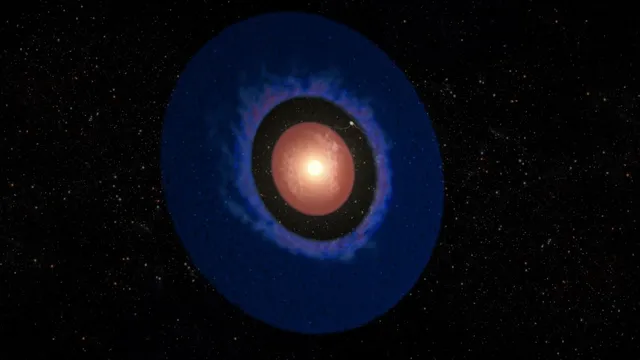
The model starts with the gravitational collapse of a one-solar-mass gas cloud. A protostar is born 24,000 years after the collapse begins. As the protostar's gravity pulls in surrounding material, a rotating disk forms around it.
Tracking the evolution of gas and dust in the disk, the authors found that within 0.5–1.0 astronomical units of a protostar that had grown to 0.4 solar masses, several Earth masses of planetesimals had accumulated after 40,000 years. The simulation did not follow the disk's evolution all the way to fully formed planets — that requires far more complex multi-body modeling and enormous computational resources. But the planetesimal mass gathered is enough to eventually build a Mars- to Earth-sized planet.
What This Means for the Search for the Universe's Oldest Planets
The key difference between Population III stars and their descendants is fate. The massive primordial stars lived fast and died in grand explosions. But the low-mass stars born from the water-rich remnants of those explosions would still be quietly burning hydrogen in their cores today. Such ancient, metal-poor stars are known to exist in the halo of the Milky Way, and it is around them that future exoplanet surveys might one day find the universe's very first planets.
Vorobyov and colleagues' study shows for the first time that water-rich protoplanetary disks with planetesimals could have appeared billions of years earlier than previously thought. This isn't proof that any specific ancient planet exists — the model stops at the planetesimal stage, not fully formed worlds. But it's a strong argument that planet formation began far earlier than the traditional scenario of gradual metal enrichment allowed.