Most Powerful Known Radio Galaxy Found
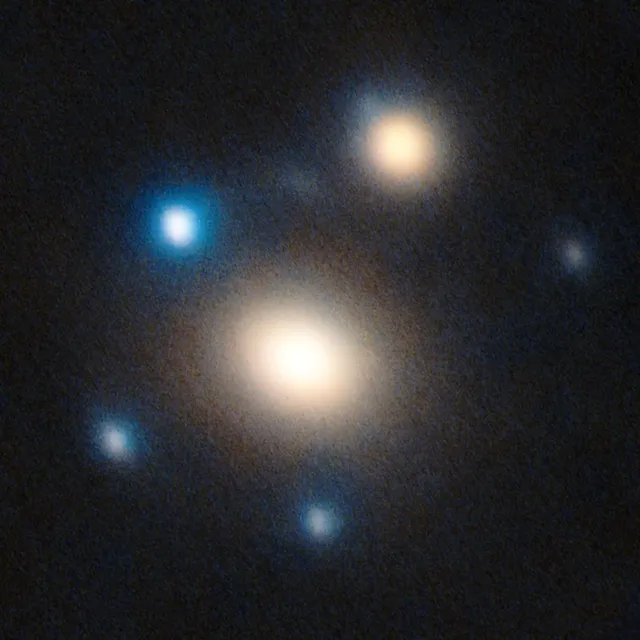
An international team confirmed radio source TXS 2354+015 as one of the most powerful radio galaxies known. Its optical spectrum revealed a bright, asymmetric Lyman-alpha emission line with an equivalent width of about 900 angstroms, and detection of the NV line pinned down its redshift at z=4.946.
The radio spectrum follows a power law with a slope of 0.94, and the source's luminosity at 500 MHz reaches 6.2×10^29 W/Hz — a record among known radio galaxies. The discovery highlights the effectiveness of the Lyman break technique for finding the most massive active galaxies in the early universe.
Plan for Sample Return From SPA Basin
The SPARX Science Definition Team released a report on a proposed sample-return mission to the South Pole-Aitken (SPA) basin — the Moon's largest, oldest and deepest impact structure, located on its far side. For over two decades this mission has remained the top priority in planetary science, recommended by multiple NASA decadal surveys.
The report details science objectives, measurement requirements and possible mission architectures that draw on the growing commercial space industry and plans for sustained human presence at the lunar south pole. Such a mission could test nearly 60 years of hypotheses about the Moon's origin and evolution while merging robotic and human exploration.
TOI-2109 b's Orbit Shrinks and Wobbles
Combining years of TESS, CHEOPS, HST and JWST observations, astronomers confirmed that the orbit of ultra-hot Jupiter TOI-2109 b is more complex than previously thought. Besides the expected orbital decay at a rate of -3.46 ms/yr, the team found sinusoidal transit-timing variations pointing to a nearby planetary companion.
TOI-2109 b is a super-Jupiter with an orbital period of just 0.67 days, making it one of only two known exoplanets — alongside WASP-12 b — with a decaying orbit. If confirmed, the system would be a rare example of a close-in giant planet with a companion on a dynamically quiet migration path.
Stellar Micro-Disruptions Outpace Black Hole Mergers
Using an extended version of the Rapster code to model dense star clusters, researchers compared rates of compact-object mergers and micro-tidal disruption events (μTDEs), in which a star is partially torn apart by a compact object. Across 100,000 simulated clusters with varying parameters, black hole merger rates peaked at z≈2-3, matching observed LVK detection rates.
Meanwhile, the cumulative number of μTDEs exceeds mergers by a factor of a few, with about 90% arising from encounters with single compact objects. Accretion during these events spins up black holes and neutron stars, offering a new dynamical pathway for producing high-spin black holes and objects filling the lower mass gap.
Euclid Tracks Evolution of Galaxy Disc Breaks
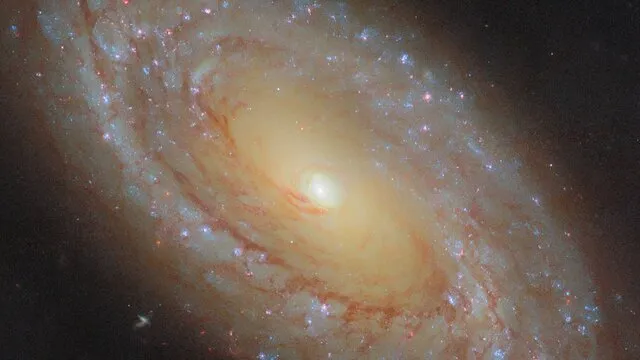
Analyzing nearly 9,000 disc galaxies from Euclid's first data release, astronomers studied disc breaks — changes in the slope of a galaxy's brightness profile that trace disc formation and growth. An automated pipeline classified galaxies into Type I, II, III and composite profiles with roughly 70% accuracy.
The results show that down-bending Type II profiles dominate in the local universe, while Type III and II+III profiles become increasingly common with redshift, each reaching 30% at z~1. This is the first statistically robust measurement of disc break evolution over 5 billion years, suggesting a shift from environmental influence to internal, secular processes as galaxies mature.