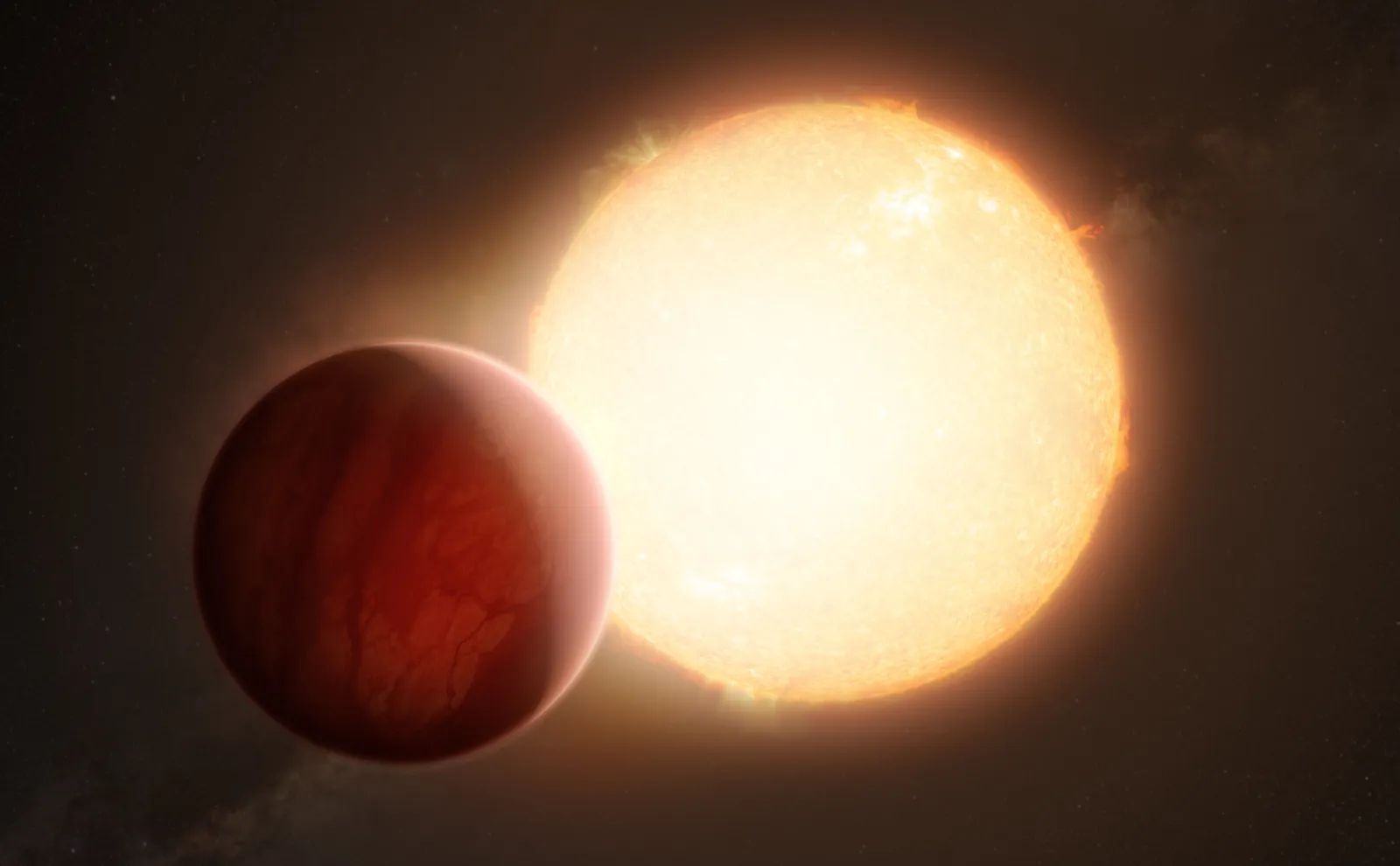
The exoplanet TOI-2109 b has attracted attention for years thanks to its extremes. It's a gas giant that completes an orbit around its star in under 16 hours — the shortest confirmed orbital period among all known giant planets. A new analysis, combining ground-based survey data, TESS and CHEOPS photometry, and fresh observations from Hubble and James Webb, confirms two unusual features of this system: timing variations hinting at an unseen companion, and a possible gradual decay of the planet's own orbit.
TOI-2109 b is a super-Jupiter with a mass of about 5.02 Jupiter masses and a radius of 1.347 Jupiter radii. The planet sits so close to its star that its orbital period is just 0.67247479 days. Given this proximity, tidal forces between planet and star should be extremely strong, and theoretical models predict TOI-2109 b has the fastest orbital decay rate of any known giant planet.
What transit timing variations reveal
The main method here is the analysis of transit timing variations (TTV). If a planet orbits its star on a perfectly stable path, the moments it crosses in front of the stellar disk — transits — can be predicted with high precision years in advance. But if extra forces act on the planet — gravity from another body in the system, gradual orbital shrinkage from tidal friction, or even acceleration of the whole system through space — the actual transit times begin to drift from predictions. These drifts are exactly what the authors studied.
Earlier observations already hinted at a long-term quadratic trend in TTVs, characteristic of orbital decay, as well as short-term sinusoidal wobbles that could be explained by a near-resonant planetary companion — a body whose gravity periodically tugs TOI-2109 b forward and backward along its orbit.
What the new analysis found
By combining archival data with new transit and eclipse observations (moments when the planet passes behind its star) from Hubble and James Webb, the researchers obtained a much sharper picture. Statistical confidence in each model was assessed using the Bayesian Information Criterion (BIC) — the larger the difference (ΔBIC) between a model including an effect and one without it, the stronger the evidence that the effect is real.
For the sinusoidal wobble, ΔBIC reached 33.6 — very strong evidence for a nearby planetary companion, consistent with the earlier hypothesis proposed by J.-V. Harre and colleagues in 2024. The authors also tested and ruled out several alternative, non-planetary explanations for this pattern.
For the quadratic trend, ΔBIC was 6.75 — weaker but still statistically meaningful evidence. It corresponds to an orbital decay rate of -3.46 ± 1.17 milliseconds per year. From this, the authors estimated the star's tidal quality factor (Q*) — a parameter describing how efficiently a star dissipates tidal energy received from a close-in planet. For TOI-2109 b, this came out to 2.13⁺¹·¹⁸₋₀.₆₁ × 10⁷.
At the same time, the authors are careful to note a limitation: the quadratic trend could theoretically be caused by non-planetary processes, including line-of-sight acceleration of the whole system — for instance, from motion of another star or body within the same stellar system. This alternative cannot yet be ruled out.
How solid is the result
The evidence for sinusoidal timing variations is described as "very strong" — a ΔBIC of 33.6 far exceeds thresholds typically considered decisive in statistics. This also matches an independent conclusion from another research group in 2024, adding confidence. The evidence for the quadratic trend, while formally "strong," comes with a caveat about the line-of-sight acceleration alternative. In other words, orbital decay for TOI-2109 b remains a hypothesis requiring further confirmation, not a settled fact.
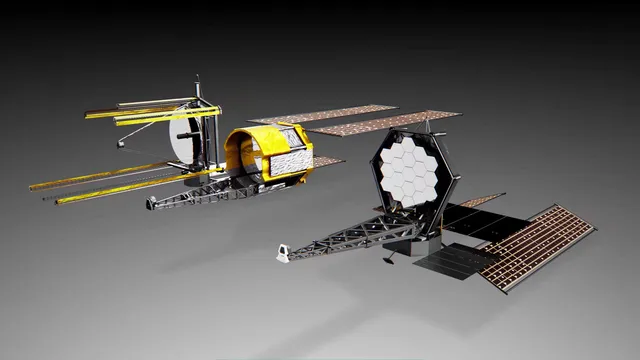
Data for the analysis came from several sources: ground-based survey telescopes, NASA's TESS (Transiting Exoplanet Survey Satellite) mission, the Swiss CHEOPS telescope, and both archival and new observations from the Hubble and James Webb Space Telescopes. The paper is currently available as a preprint on arXiv.
Why it matters
If TOI-2109 b's orbital decay is confirmed by future observations, it will become only the second known exoplanet — after WASP-12 b — with an orbit that is genuinely shrinking over time. Such systems offer a rare direct way to measure the internal tidal properties of stars, which are otherwise difficult to probe.
Beyond that, the combination of orbital decay with a nearby planetary companion makes TOI-2109 b the most extreme known member of an ultra-rare class of close-in giant planets with companions. These systems matter for understanding how hot Jupiters migrate and evolve — whether they end up in their tight orbits through violent gravitational encounters, or through calmer, gradual migration involving neighboring bodies.