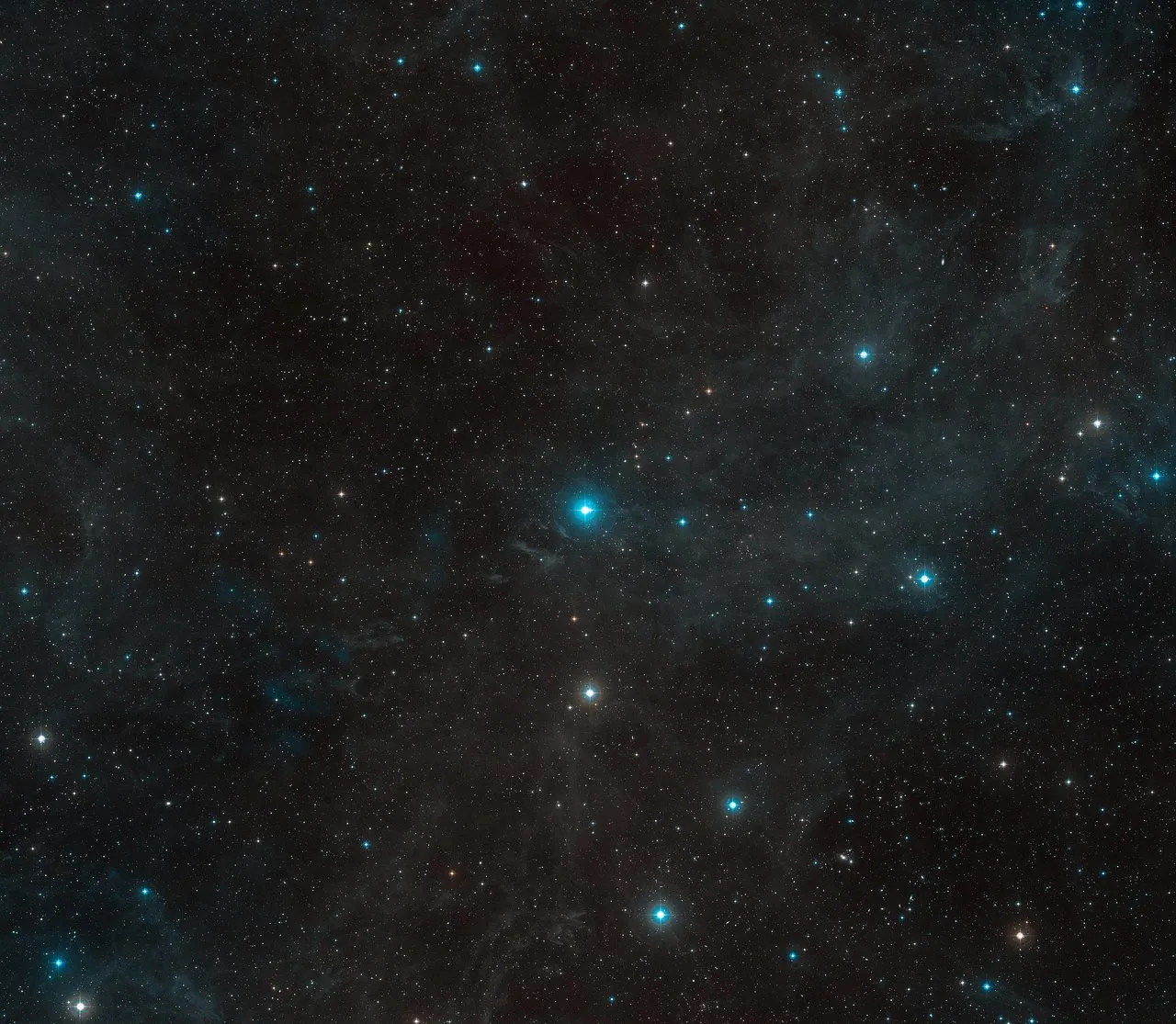
More than 6,000 exoplanets have been found so far, and nearly all of them orbit F, G, and K-type stars — the same class as our Sun. That's not because planets exist only around such stars. It's simply that these stars are bright and stable enough for the two dominant detection methods: transits and radial velocity. More massive, hotter A-type stars remain largely unexplored territory. A new study led by Logan Wilson (Center for Astrophysics | Harvard & Smithsonian) offers a way to change that.
Listening to a star's heartbeat
A-type stars have few and broad spectral lines, which makes radial velocity measurements nearly useless. Many of them also pulsate in brightness, and these pulsations obscure any planetary transits hiding in their light curves. But this apparent problem turns into a solution for a particular subclass called δ Scuti stars. Their pulsations are regular enough to work like a precise clock.
If a star is gently tugged by an unseen companion, the timing at which its pulsations reach an observer shifts periodically — similar to the Rømer delay seen in binary star systems. By measuring these tiny timing shifts for a star's two most prominent pulsation modes (labeled f1 and f2), astronomers can detect orbital motion even where no other method works — including for massive objects on intermediate-period orbits, the hardest to find around massive stars.
Wilson's team applied this approach to 16,440 highly pulsating δ Scuti stars observed at high cadence by TESS. From that sample, they narrowed down nine systems showing periodic timing modulations that could indicate substellar companions — brown dwarfs or massive planets.
The standout candidate: HD 156295
The most striking signal came from the star HD 156295. According to the team's calculations, the companion has a mass of about 6.3 Jupiter masses and orbits the star every 2,200 days. That corresponds to a distance of roughly 3.9 astronomical units — right at the outer edge of the star's habitable zone, the region where liquid water could theoretically exist on a planet's surface.
If confirmed, HD 156295 would become the hottest known star to host a planet in its habitable zone. The detection also hints that massive planets on intermediate orbits may be more common around A-type stars than expected for Sun-like stars, supporting the idea that hot, massive stars could form such companions more efficiently.
The other eight candidates appear more consistent with brown dwarfs. Six of them fall into a range of masses and orbital separations known as the "brown dwarf desert" — a region where such objects are typically rare compared to both planets and stellar companions. Some earlier observations had suggested this desert is less severe around hotter stars, and the new study supports that trend.
How solid is the result
The authors are careful to note that all of this remains tentative. The probability that the HD 156295 signal truly comes from a planet, rather than noise or another effect, is estimated at just over 50%. The parameters of all nine candidates — both mass and orbital period — carry large uncertainties.
By observing subtle variations in the timing of stellar pulsation modes, researchers may have made the first detection of a planet in the habitable zone of a massive A-type star.
The study, published in the Astrophysical Journal (Wilson et al. 2026, ApJ 1009, 78), relies entirely on TESS data — a mission originally designed to hunt for transits, not to time stellar pulsations. It's a case where one astronomer's discarded data became another's treasure. With new TESS observations arriving constantly, a clearer picture of these unusual candidates may not be far off.