Roman's Coronagraph Takes First Test Image
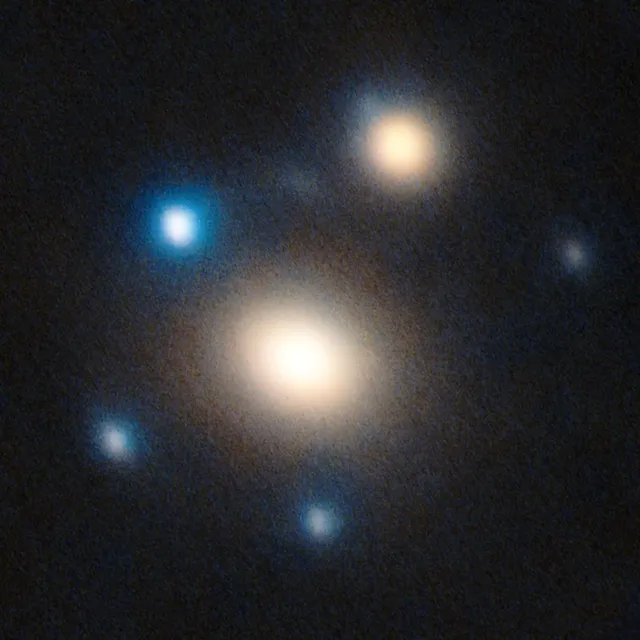
On Sept. 22, the Coronagraph Instrument on NASA's Nancy Grace Roman Space Telescope turned on its cameras in space for the first time. Designed and built by NASA's Jet Propulsion Laboratory in Southern California, the instrument woke up on Sept. 1 and exercised its digital, electronic, and mechanical systems in mid-month.
Once the team confirmed that the fine-guidance system was holding the instrument steady, scientists adjusted the focus and took a first, still blurry look at space. “This observation confirms that the instrument can produce a focused image,” said JPL's Vanessa Bailey, calling it a very limited test that starts a methodical series of increasingly complex tasks. Eventually, the coronagraph will demonstrate technology that blocks starlight to reveal planets and dusty disks around nearby stars.
Gaia Neutron Stars: How Many Are Out There
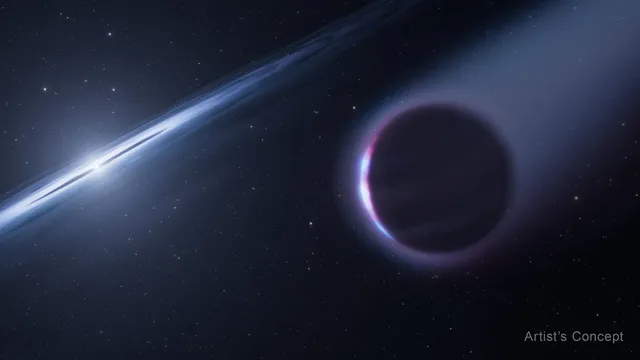
Gaia DR3 revealed a new class of neutron stars in au-scale orbits around solar-type companions. How they form remains unclear, and the current sample of 27 candidates is strongly biased by Gaia's astrometric sensitivity. The authors modelled the Gaia selection function and built it into a hierarchical Bayesian framework to infer the intrinsic properties of the population.
The space density comes out at roughly 120 systems per cubic kiloparsec within 2 kpc, meaning only about 3% of the local population has been found. Neutron star masses peak near 1.3 solar masses. Just 0.01–1% of all neutron stars are born in such systems, making them 10–100 times rarer than high-mass X-ray binaries. Gaia DR4 could expand the sample to 300–650 candidates and allow tests of formation models at longer orbital periods.
Webb Studies Planet-Shattering Collisions
In the early history of our Solar System, a Mars-sized object called Theia smashed into the infant Earth. The impact vaporised massive amounts of rock and blasted it into space, and some of that material later coalesced into the Moon. This is how the giant-impact hypothesis explains the origin of our satellite.
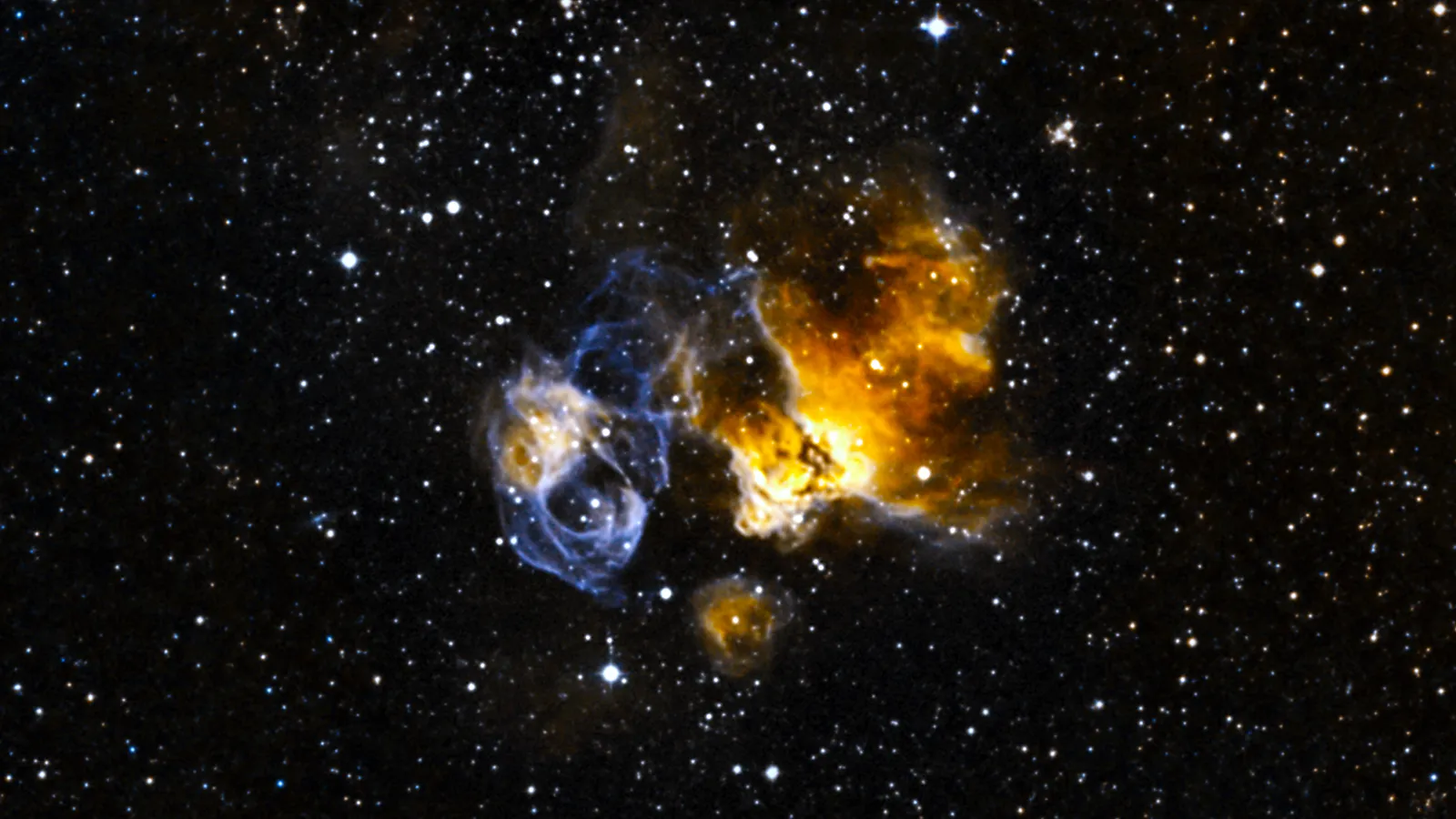
Astronomers have now used the NASA/ESA/CSA James Webb Space Telescope to study a class of young stellar systems that show signs of similar upheavals. The observations provide clues to the amount of energy released in such collisions. This helps researchers better understand the composition and evolution of these chaotic systems, and sheds light on processes that once played out around our own Sun.
Young Planet Found Around a Red Dwarf
The transiting planet TIC 88297141 Ab was found in TESS data around a young M dwarf of 0.31 solar masses in the Scorpius-Centaurus association. The star's age of 15.6 ± 1.6 million years comes from group membership and is supported by lithium and isochrone dating. The planet orbits every 4.64 days and has a radius of 7.21 Earth radii, or 0.64 Jupiter radii.
Ground-based photometry confirmed that the signal comes from the target star. A second M dwarf sits at a projected separation of 260 au, and no other stellar companions were detected. The false positive probability is 10⁻⁵, which validates the planet. Radial velocities only constrain the mass, giving M sin i below 4.7 Jupiter masses. A future mass measurement will show whether this is a low-density super-puff, like other planets of similar size at these ages, or an unusually massive one.
Gestalt: A Meta-Foundation Model for Astronomy
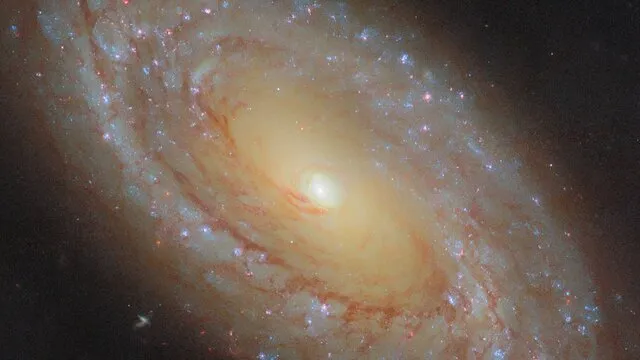
The Platonic Representation Hypothesis predicts that sufficiently scaled foundation models converge on a shared representation of the world. The authors asked whether combining such models could beat each of its components. For galaxies, they took 22 frozen foundation models from eight families, whitened each embedding, and ran a randomised SVD on their concatenation.
The resulting 1024-dimensional embedding outperforms every basket member on 19 of 21 metrics for galaxy physical properties and morphology, using HSC, JWST, and DESI Legacy Survey images. Performance rises with basket size and architectural diversity and transfers across surveys. A fresh pre-train of a comparable model would cost 10⁴–10⁵ A100 GPU hours, whereas assembling Gestalt takes minutes on a single machine.