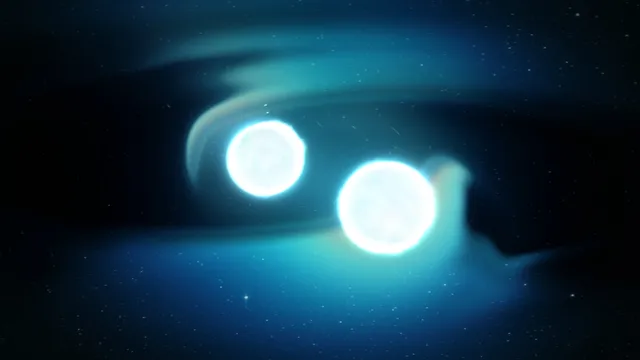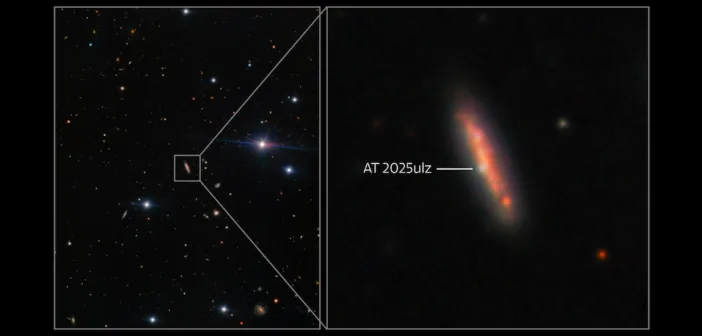
In August 2025, the LIGO-Virgo-KAGRA collaboration announced a gravitational wave candidate, S250818k. The signal was tentative: the chance that it was not astrophysical in origin was estimated at 71%. Still, it drew attention because it could have been a kilonova, a flash produced when compact objects collide and at least one of them is a neutron star.
A new paper now reports radio observations of an object that may be the counterpart of this signal. It does not settle the question. But it shows that the radio band helps to tell an ordinary supernova from more exotic scenarios.
Why S250818k drew interest
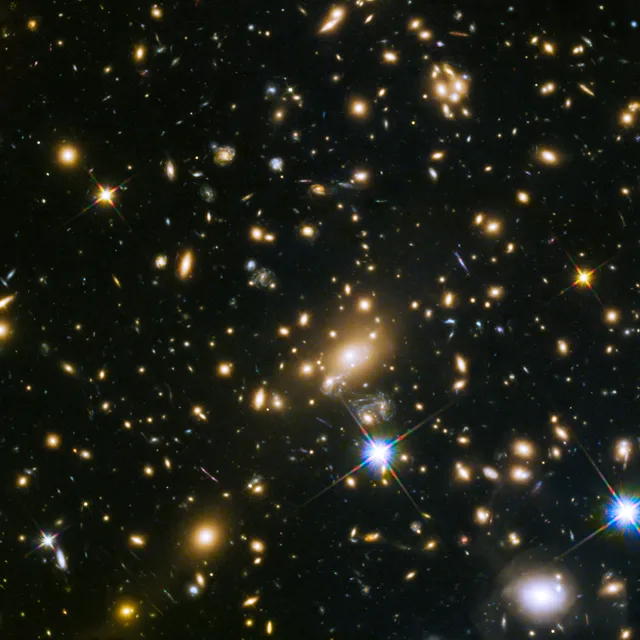
A kilonova has been linked to a gravitational wave event only once, in 2017. That was the kilonova associated with GW170817, whose fading light Hubble observed. Any new candidate that might repeat the feat is therefore of great interest.
S250818k carried an additional twist. It was possible that the collision involved a neutron star with less than the mass of the Sun. Stellar evolution models do not predict such light neutron stars, so they would need a different formation pathway.
From kilonova to supernova
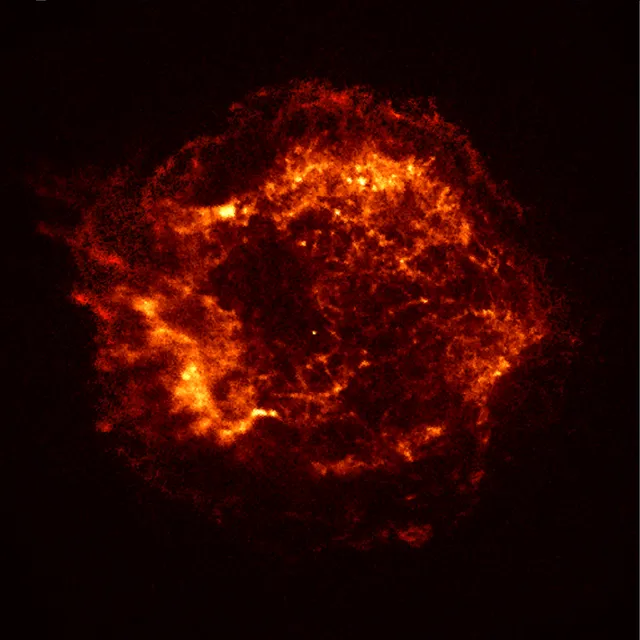
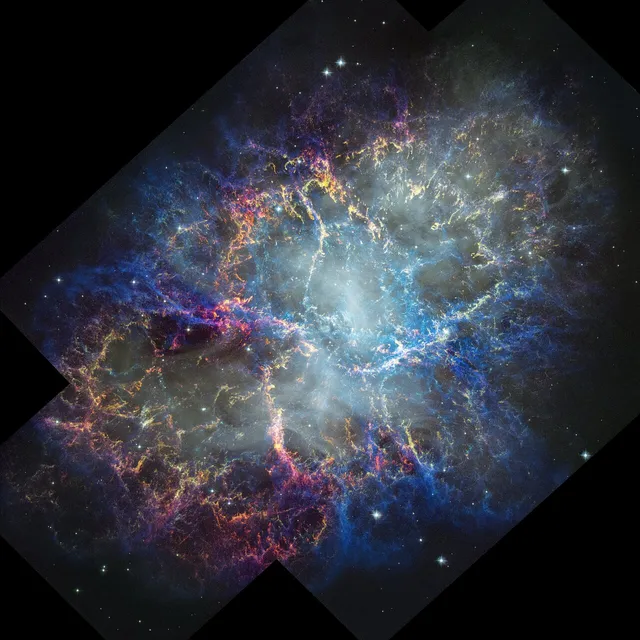
An optical transient was found in the localization region of the signal. Early observations showed a kilonova-like color and rapid fading. Later the object brightened, like a supernova interacting with circumstellar gas. It was therefore classified as supernova SN 2025ulz, which made it unlikely to be the source of the gravitational wave signal.
The link was not completely ruled out, though. Theories suggest that the collapse of a rapidly rotating massive star could produce both a supernova and a kilonova. Such a star could form one or more neutron stars below one solar mass, in one of two ways. The collapsing core could split into two neutron stars. Or neutron stars could coalesce out of neutron-rich material in the disk around the dying star. In either case they might merge shortly after the collapse, and the kilonova emission could be hidden by the expanding supernova.
What the radio data showed
Radio observations offer a way to tell these scenarios apart. A typical supernova has relatively slow-moving ejecta. The collapse of a rapidly rotating progenitor could instead produce a relativistic jet, a stream of matter moving at nearly the speed of light.
Tanner O'Dwyer (Johns Hopkins University) and collaborators used data from the Very Large Array (VLA), the upgraded Giant Metrewave Radio Telescope (GMRT) and MeerKAT. In stacked observations made 51–96 days after the gravitational wave trigger, they found a faint but significant radio source.
The data can be explained in two ways. In the supernova scenario, the estimated expansion speed and the progenitor's mass-loss rate fall well within the range of known stripped-envelope supernovae. The data are also compatible with an off-axis relativistic jet. However, the authors could not resolve degeneracies in the event's properties, including the jet energy and the interstellar medium density.
How solid is the result
The study is published in a peer-reviewed journal, The Astrophysical Journal Letters (2026, volume 1009, L44). It does not establish a link between S250818k and SN 2025ulz through an exotic kilonova-plus-supernova mechanism. The authors suggest that a supernova fits the data more naturally.
The starting uncertainty also remains. The gravitational wave signal itself is a weak candidate, and the chance that it was not astrophysical is high.
The main takeaway lies elsewhere: radio observations will play an important role in examining future gravitational wave signals. They can help to check whether an optical flash is an ordinary supernova or something rarer.