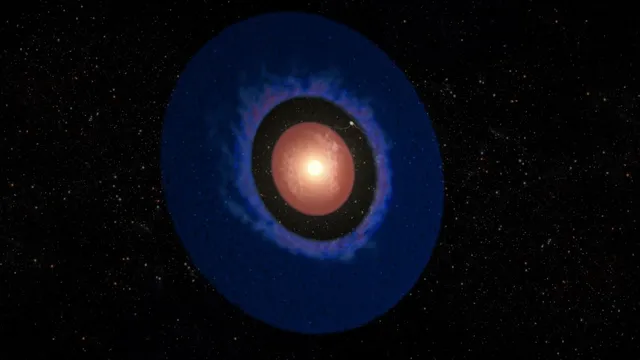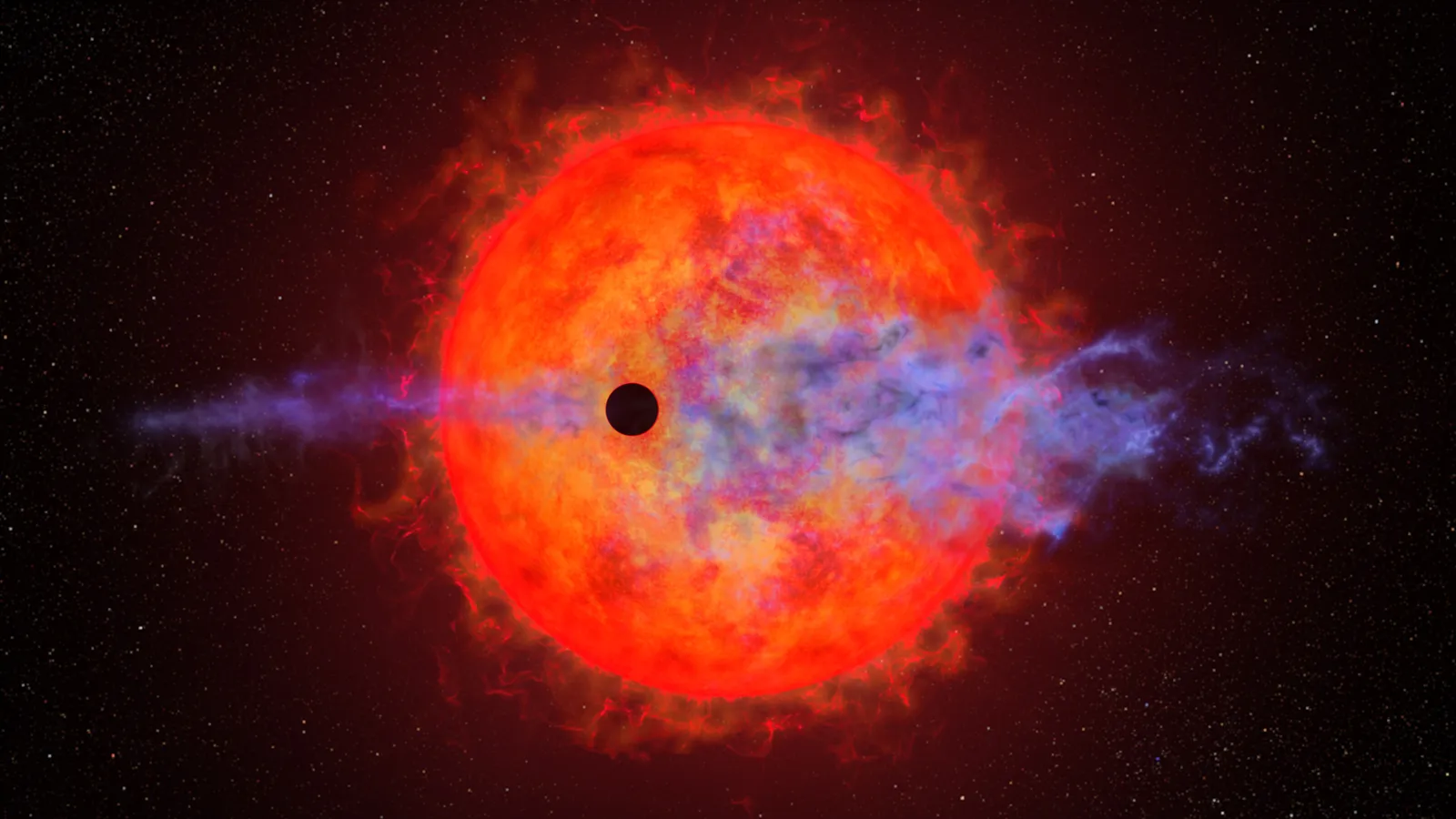
Astronomers have reported the discovery and validation of TIC 88297141 Ab. It orbits a young red dwarf in the Scorpius-Centaurus association of stars. The system's age is 15.6 ± 1.6 million years, which is almost infancy for a planetary system.
The work is a preprint on arXiv, so it has not yet been peer-reviewed in a journal. The transits were found in data from the TESS space telescope. Ground-based telescopes, a high-resolution imager and a spectrograph were used to check that the signal really belongs to the planet.
The system
The host star has a mass of 0.31 solar masses and a radius of 0.74 solar radii. It is a pre-main-sequence star, meaning it is still young. Such stars are typically larger than stable red dwarfs of the same mass.
The planet orbits the star every 4.64 days. Its radius is 7.21 ± 0.32 Earth radii, or 0.64 Jupiter radii. This is a sub-Saturn-sized planet: much larger than Earth, but smaller than Jupiter.
The system has another companion, a red dwarf with a radius of 0.4 solar radii. It moves together with the main star at a projected separation of 260 au. One astronomical unit is the distance from Earth to the Sun. Speckle imaging with Gemini-S/Zorro revealed no other stars nearby.
How a signal was found in a variable star's data
The transit method looks for short, periodic dips in a star's brightness when a planet passes in front of it. Young stars make this harder. They change brightness on their own because of activity, which can mask a planet's faint signal.
So the authors used a custom pipeline designed for variable stars. They then fitted the transits and the stellar activity together in one global model. That gave the orbital period and the planet's radius.
Ground-based photometry from LCO/Swope and LCOGT/Sinistro showed that the dimming occurs on the target star itself. This matters because other stars can fall within TESS's field of view. Without such a check, the signal could belong to one of them.
How solid is the result
The statistical analysis gave a false-positive probability of 10⁻⁵. On this basis the planet is considered validated. The age of 15.6 million years follows from the star's membership in the group. It is supported by lithium content and isochrone dating (comparison with models of stellar evolution).
The planet's mass has not been measured. The Magellan/PFS spectrograph collected radial velocities (shifts in the star's spectral lines caused by a planet's gravity). They are consistent with stellar activity. So there is only an upper limit: Mp sin i below 4.7 Jupiter masses at 2σ. That is a ceiling, not a measurement.
What it means
The authors single out the question of density. Other planets of comparable size at such ages are low-density "super-puffs", with very little mass for their radius. TIC 88297141 Ab may belong to that class. But it may also be unusually massive for its size.
Both outcomes are interesting. A planet's density at a young age helps show what planets are like at the start of their lives. That is why a precise mass measurement is needed, and it is the next step.