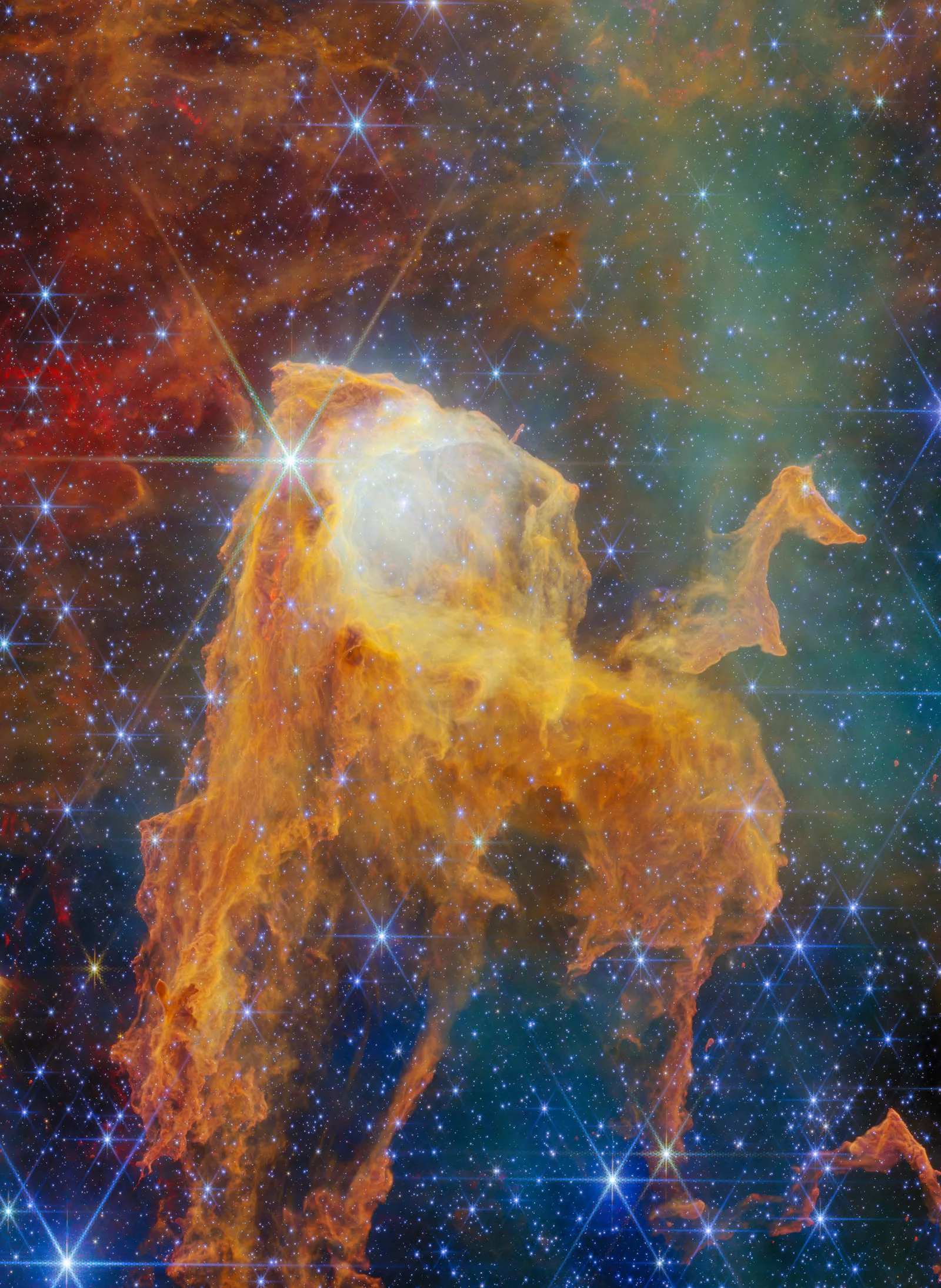
The James Webb Space Telescope continues to reveal new details in the Carina Nebula, one of the largest and brightest stellar nurseries in our galaxy. Its latest image focuses on a feature called the Treasure Chest — a dense cloud of gas and dust shaped like a wooden chest with its lid wide open. Inside this "chest" lies not gold, but a compact cluster of young stars.
The Carina Nebula sits 7500 light-years from Earth in the constellation Carina and spans roughly 260 light-years. It's home to the famous Cosmic Cliffs, the subject of Webb's first-ever released image. The nebula is the nearest high-mass star-forming region, letting astronomers study the full range of star formation, from protostars to fully formed giants. It houses tens of thousands of protostars and some of the most massive stars in the Milky Way.
What is a cometary globule
The Treasure Chest belongs to a class of objects called cometary globules — isolated clouds of gas and dust with a dense, dark head and a long sweeping tail, often resembling comets. The Treasure Chest stands out because it looks less like a comet and more like an open wooden chest.
Peering inside such a dense cloud is impossible in visible light, since dust efficiently blocks it. But Webb's Near-Infrared Camera, NIRCam, detects longer wavelengths of light that pass through dusty veils. That's how astronomers were able to see what's hiding inside the "chest."
The cluster inside the chest
Inside the Treasure Chest, astronomers count roughly 70 stars. The brightest and most massive is a rare O-type star weighing about 19 solar masses. Such stars are uncommon — hot, extremely luminous, and relatively short-lived on cosmic timescales.
The cluster's age is estimated at around 1.3 million years, though earlier calculations suggested it was far younger — just 100,000 years old. Because of its youth, the cluster remains deeply embedded in the dust clouds it was born from. Researchers also found evidence that many individual stars are surrounded by their own circumstellar discs — material that could eventually give rise to planetary systems.
Over time, the brilliant light of these young stars will gradually disperse the surrounding cloud, fully revealing the cluster hidden inside.
Eta Carinae's role in sculpting the chest
The Treasure Chest's sculptural shape isn't due to anything visible in the image itself, but to something nearby. Just 39 light-years to the northwest lies Eta Carinae, the most luminous object in the entire Carina Nebula. It's a star system containing at least two stars, one of which is 100 times as massive as the Sun. That star alone shines 5 million times brighter than the Sun.
Adding to this intense radiation is the neighboring star cluster Trumpler 16, which also contains several extremely hot, massive stars. Together, their radiation and stellar winds carve the surrounding gas and dust clouds into intricate shapes — such as a chest with its lid open.
What comes next
Observations of the Treasure Chest are part of a broader Webb program (#5408, led by researcher Reiter) dedicated to studying how young stars in the Carina Nebula gather gas from their surroundings and expel it through powerful outflows. Understanding these processes helps astronomers grasp how massive stars form and how they shape their immediate cosmic environment — destroying some clouds of gas and dust while possibly triggering the birth of new stars in others.