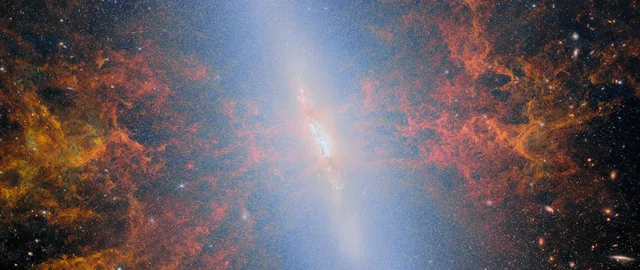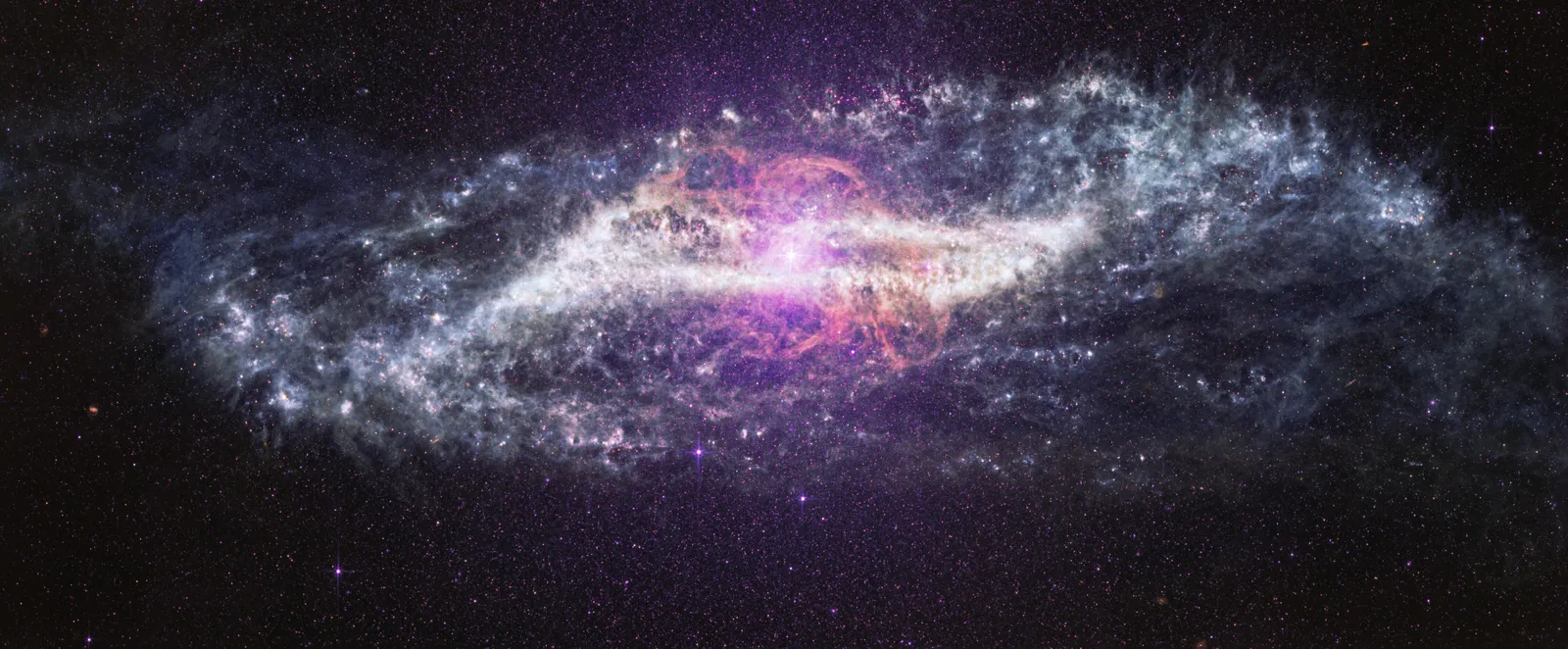
To mark four years of science operations, the James Webb Space Telescope (NASA/ESA/CSA) has returned new images of the galaxy Centaurus A. Where before there were only solid dark lanes of dust, millions of individual stars are now visible.
Centaurus A (also known as NGC 5128) lies 11 million light-years from Earth. In cosmic terms that is close. Yet unlike most nearby galaxies, it is very active. That makes it a useful laboratory for studying how galaxies and black holes grow and change together.
What the dust hides in the core of Centaurus A
At the galaxy's core sits a supermassive black hole actively feeding on surrounding material. As it does, it launches powerful jets and releases large amounts of energy, shaping the galaxy around it.
Centaurus A carries the scars of a turbulent past. Roughly two billion years ago it collided with another galaxy. The aftermath is still visible today, in its unusual structure and ongoing star formation.
In visible light, thick dust lanes hide the central regions: the dust absorbs the light of the stars behind it. The Hubble telescope could not see the core in visible light. The Spitzer telescope saw only large-scale structures in the infrared, without resolving individual stars.
How the infrared view breaks the galaxy into stars
Webb works in near- and mid-infrared wavelengths. Infrared radiation passes through dust better than visible light. This let the telescope look beneath the dust lanes.
What looks "grainy" in the combined image from the MIRI (Mid-Infrared Instrument) and NIRCam (Near-Infrared Camera) is in fact a densely packed field of individual stars. Each of those stars carries information about the galaxy's past.
This turns the observation into a kind of galactic archaeology. Star by star, astronomers can reconstruct a timeline of events: when older stars first formed, when activity slowed, a burst of star formation during the collision, and stars born from gas stirred up in its aftermath.
The MIRI image reveals rich dust structures. A warped, parallelogram-like band cuts across the centre. There is also an unusual "S"-shaped feature. What created it and how strongly the black hole shapes it are questions that need further study. Many of the red points in the image are dust-rich stars or stellar nurseries, where aging stars shed material or new stars are forming.
What spectroscopy revealed about the moving gas
Webb's capabilities go beyond imaging. By analysing light with spectroscopy (splitting light into its components), astronomers can measure how gas moves inside the galaxy.
Early findings show fast-moving ionised gas flowing outward. It is likely driven by the black hole's activity. Closer to the centre, warmer molecular hydrogen sits in a warped, rotating disk.
These observations help approach one of astronomy's biggest questions: how does a black hole influence an entire galaxy. The answer appears complex. A black hole can trigger star formation by compressing gas, but also limit it by pushing material away. Centaurus A offers a rare, nearby view of that interplay.
Four years of Webb operations
The images are tied to Webb's fourth science anniversary. According to the mission team, the telescope has delivered better-than-anticipated performance throughout.
Over the past year alone, the telescope found new evidence for a planet orbiting Alpha Centauri, just four light-years from the Sun, mapped the upper atmosphere and auroras of Uranus, and identified a supernova in the early Universe that occurred just 730 million years after the Big Bang — the earliest known to date.
Centaurus A is a long-familiar galaxy. But the infrared view turned a well-known object into a far more detailed picture, showing the dust, the individual stars and the motion of gas near a supermassive black hole.