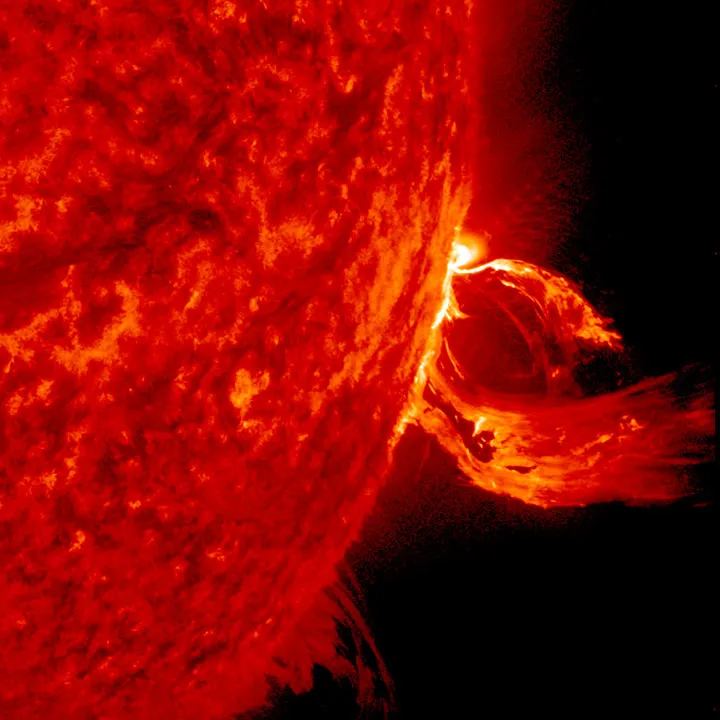
For the first time, scientists working with NASA's PUNCH mission (Polarimeter to Unify the Corona and Heliosphere) have continuously tracked a coronal mass ejection nearly all the way from the Sun to Earth and predicted its arrival time to within 30 minutes. The results were presented at the Committee on Space Research Scientific Meeting and are currently under review at the journal Space Weather.
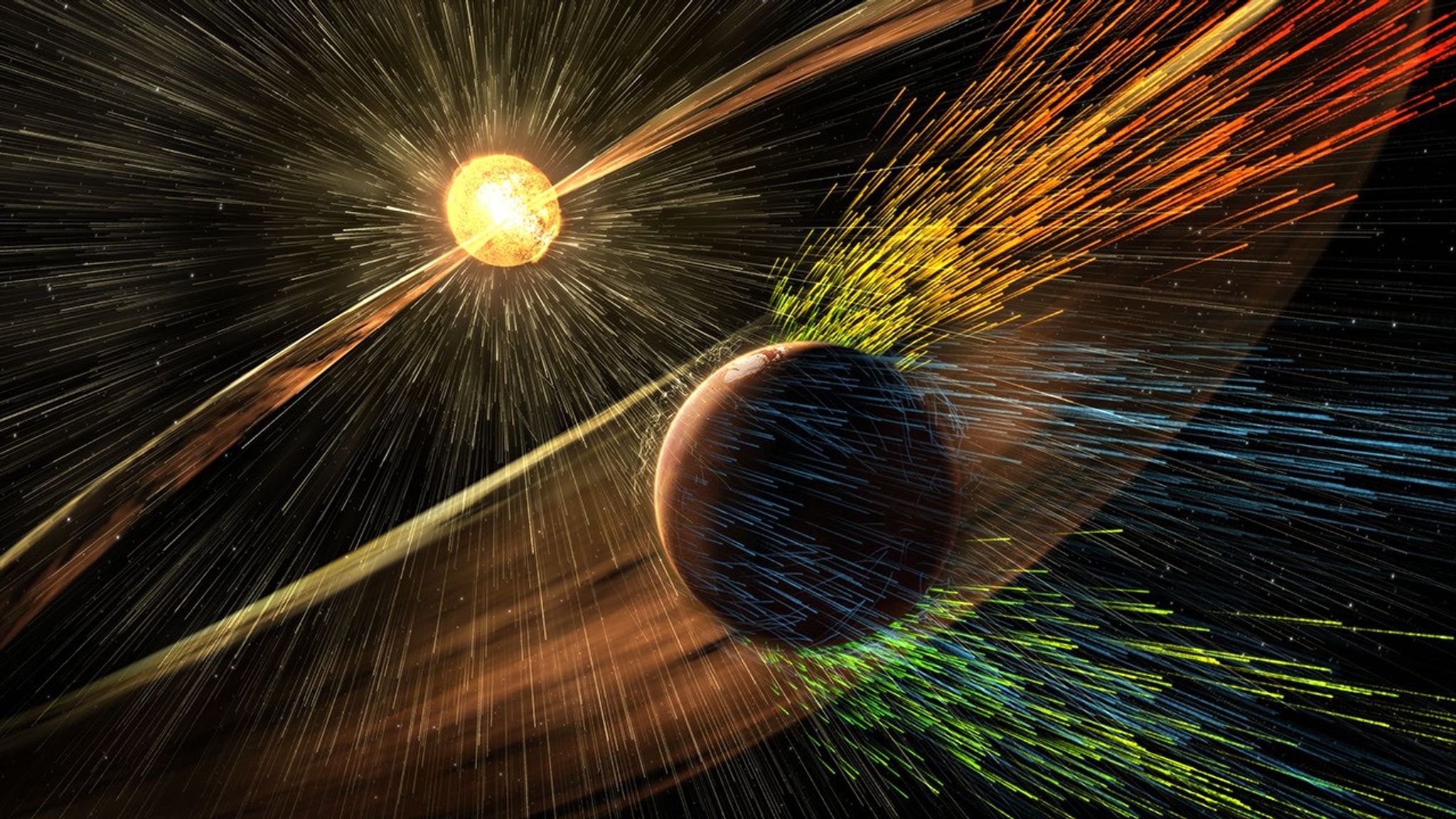
Coronal mass ejections are massive clouds of plasma and magnetic field erupting from the Sun's outer atmosphere, the corona. When such a cloud reaches Earth, it can disrupt power grids, damage satellites, and pose risks to astronauts. Accurate arrival forecasts are therefore critical for anyone managing infrastructure exposed to space weather.
Why tracking the full journey was impossible before
Before PUNCH launched in 2025, instruments could only observe a coronal mass ejection across the first one-fifth of the distance between the Sun and Earth. Beyond that point, the cloud vanished from view, leaving scientists to guess how it changed and moved across the rest of its journey — precisely the stretch that matters most for forecasting Earth impacts.
The PUNCH mission relies on four spacecraft in low Earth orbit working together to provide continuous 3D observations of the inner solar system. Each spacecraft captures a new image every 4 minutes, allowing scientists to track an eruption almost from the Sun itself all the way to our planet's orbit — a capability no previous mission offered.
Putting the method to the test
For this first test, scientists used real data from a coronal mass ejection that left the Sun on May 31, 2025. PUNCH images were fed into a computer model that analyzed the leading edge of the cloud over time, calculating its speed and geometry to estimate when it would reach Earth.
Twelve hours after the eruption, the model settled on a final prediction: the storm would arrive 8 hours later. The actual arrival time differed from that prediction by less than 30 minutes. By comparison, current standard forecasting methods carry a margin of error of 5 hours — meaning the new approach was roughly 10 times more accurate.
Just as importantly, the model itself revealed the moment its estimate stabilized. That means a space weather forecaster could know in advance when to trust the prediction with confidence, rather than waiting for confirmation after the fact.
We accomplished an order of magnitude better result than the state-of-the-art method with a really basic process, just informed by the fact that the coronal mass ejection could be tracked continuously across the solar systemCraig DeForest, PUNCH principal investigator, Southwest Research Institute
DeForest said the team expected PUNCH to perform well, but the actual result exceeded expectations. He compared the potential impact to the leap from steam engines to internal combustion engines for space weather forecasting.
What else the images revealed
Beyond forecasting, the high-resolution images revealed new structures inside coronal mass ejections. The clouds of ejected material turned out to be far clumpier than previously thought, and they continue to evolve throughout their journey across the inner solar system, rather than remaining stable as earlier models assumed.
PUNCH data is also helping scientists understand how plasma moves through space more broadly. That knowledge extends beyond Earth weather forecasting — similar processes occur, for instance, in star-forming regions, where studying plasma behavior at small scales is nearly impossible by direct observation.
This remains an early proof-of-concept test based on a single event. Researchers plan to refine PUNCH's data and modeling further, aiming to eventually forecast coronal mass ejection arrivals even further in advance — and potentially with even greater precision.
The PUNCH mission is led by the Southwest Research Institute, based in San Antonio, which operates the four spacecraft from its facility in Boulder, Colorado. The mission is managed by Space Science Mission Operations at NASA's Goddard Space Flight Center in Greenbelt, Maryland, for the agency's Science Mission Directorate.