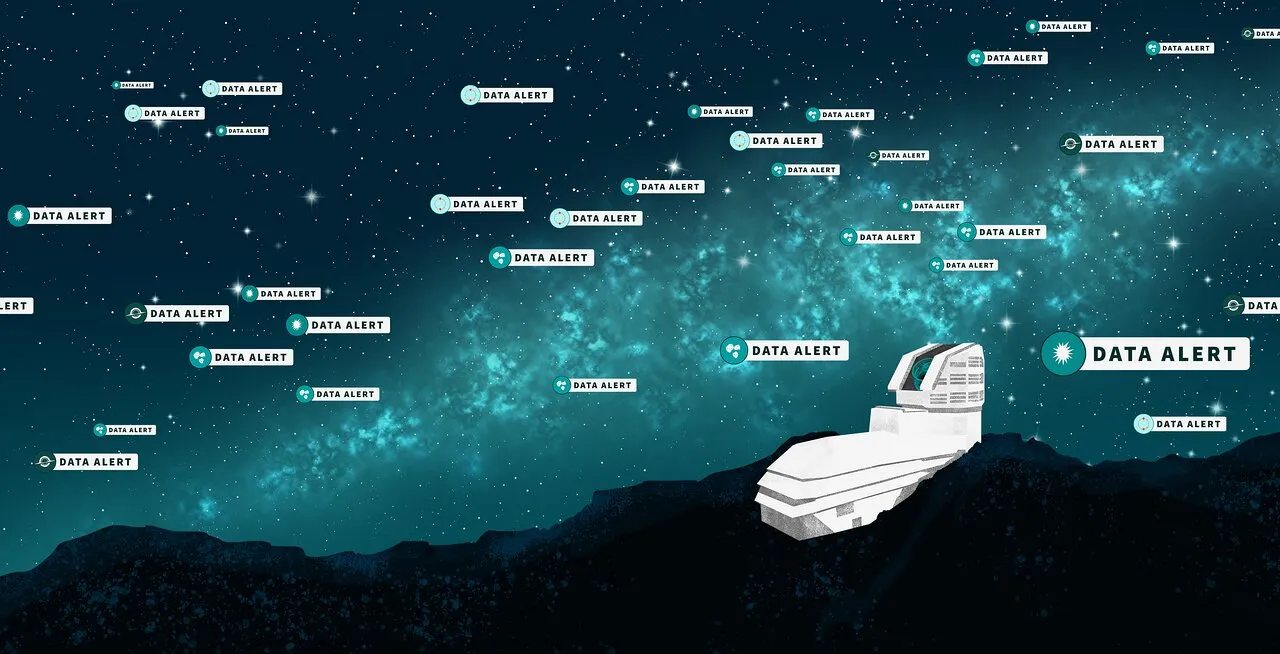
On the night of February 24, 2026, the NSF–DOE Vera C. Rubin Observatory achieved something astronomy has anticipated for years — it began issuing scientific alerts about changes in the night sky in near-real time. During the first night alone, the system generated 800,000 alerts. This is just the beginning: once the observatory reaches full operational capacity, the number of alerts is expected to climb to seven million per night.
To a casual observer, the night sky looks calm and unchanging. In reality, it is constantly in motion: stars flare and fade, supernovae explode, asteroids drift through the Solar System. Rubin was built precisely to catch these changes systematically and notify researchers worldwide within minutes of each observation.
How the telescope spots changes in the sky
The system's principle is simple in concept but demanding in execution. Every 40 seconds, the telescope photographs a new patch of sky. Software automatically compares the fresh image with a template built from Rubin's previous observations of the same region in the same filter.
The template is subtracted from the new image, leaving only the differences. If a bright point appears where nothing was before, if a star's brightness changes, or if an object has shifted position, the system triggers a public alert within two minutes.
Among the first detected phenomena are flares from new supernovae, flickers of variable stars, activity from supermassive black holes at the centers of distant galaxies, and asteroids moving through the Solar System. According to Eric Bellm, Alert Production Pipeline Group Lead for Rubin Data Management at NSF NOIRLab and the University of Washington, enabling real-time processing of 10 terabytes of images nightly required years of technical innovation in image-processing algorithms, databases, and data orchestration.
A 3,200-megapixel camera and the data journey from Chile
At the heart of the system is the LSST Camera, the largest digital camera ever built, with a resolution of 3,200 megapixels. Its extreme sensitivity allows it to detect the faintest and most distant objects in the Universe.
The observatory is located in Chile and jointly operated by NSF NOIRLab and the U.S. Department of Energy's SLAC National Accelerator Laboratory. Data travels from the telescope to SLAC's U.S. Data Facility in California — a distance of more than 8,000 kilometers — in a matter of seconds, after which initial processing begins.
The scale and speed of the alerts are unprecedented. After generating hundreds of thousands of test alerts in the last few months, we are now able to say, within minutes, with each image, here is everything, and go.Hsin-Fang Chiang, SLAC software developer leading operations for data processing at the USDF
Brokers sort millions of signals for researchers
Processing a stream of millions of nightly alerts by hand is impossible. That's why scientists rely on a network of brokers — specialized machine-learning software platforms. They filter raw alerts, classify them by object type, and distribute them to research teams and observatories around the world.
Tom Matheson, Interim Director of the Community Science and Data Center at NSF NOIRLab and head of the Time-Domain Services group that developed the ANTARES broker, notes that the sheer number of alerts Rubin produces is an exciting challenge for astronomers and software engineers alike. Broker teams have built systems that operate rapidly at scale, allowing scientists to find both objects of interest and things never seen before.
Because the alert system is public and near-real-time, research teams using other ground- and space-based telescopes can coordinate follow-up observations of the same object almost instantly. This enables fast, detailed studies of phenomena that unfold over mere hours or days — such as the earliest moments of a supernova explosion.
A ten-year survey of the southern sky
The launch of the alert system marks one of the final milestones before Rubin's main scientific program begins: the Legacy Survey of Space and Time (LSST), a ten-year systematic scan of the southern night sky starting later this year.
In its first year alone, Rubin is expected to capture images of more objects than all optical observatories in human history combined. This data will sharpen our understanding of dark matter and dark energy, help track potentially hazardous asteroids, and aid the search for rare interstellar objects passing through the Solar System.
Importantly, Rubin's alerts are public. They are accessible not only to professional astronomers but also to students and amateur citizen scientists, who can take part in analyzing the data or even make discoveries of their own.